


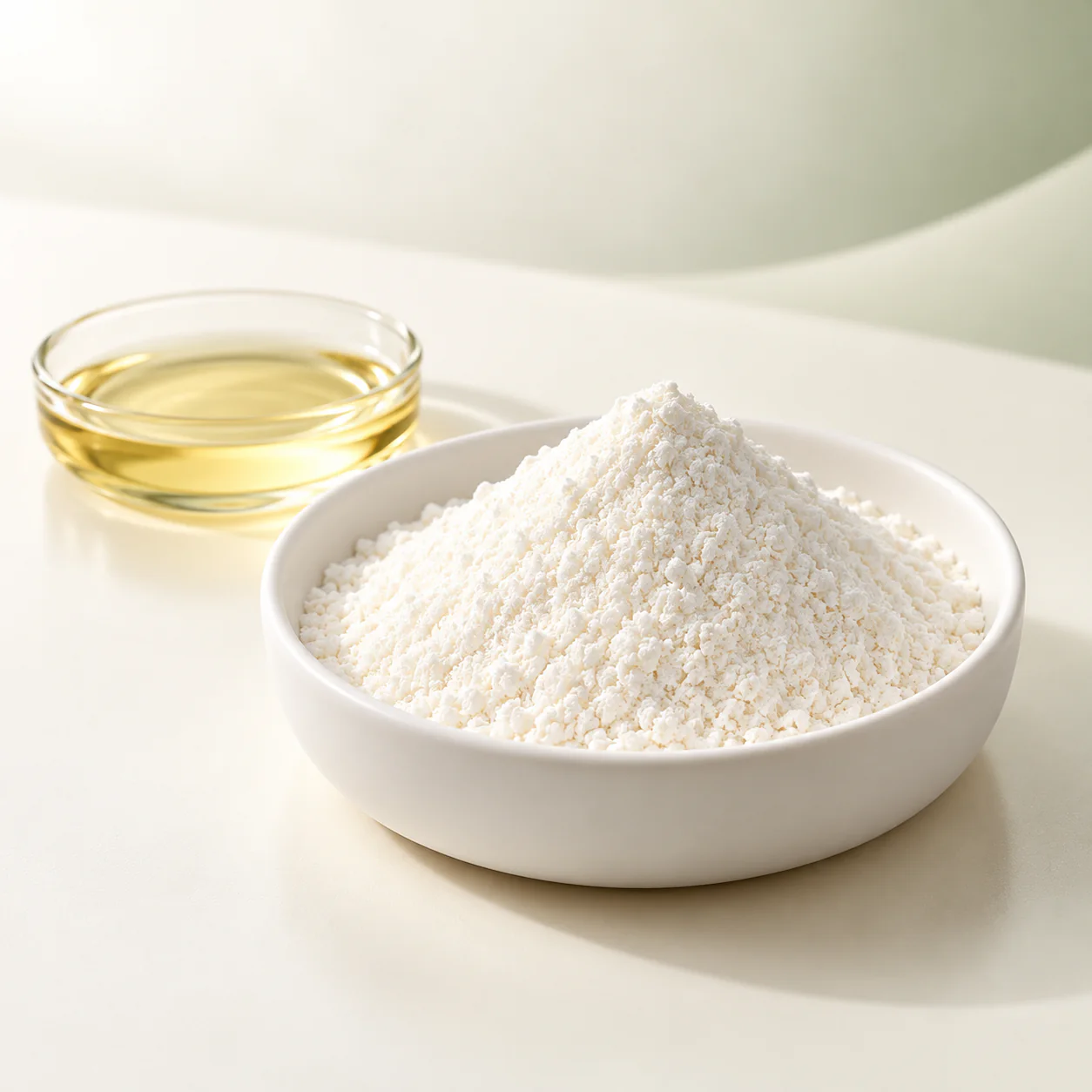
Gamma oryzanol is often easy to describe and difficult to formulate. A powder may perform well in a capsule or dry blend but require a different delivery strategy for a beverage, emulsion or softgel. The central development issue is not whether gamma oryzanol is a powder; it is how the active is distributed, protected and measured in the selected phase.
Why water-based systems need a different design
Gamma oryzanol is associated with the oil fraction of rice bran and is commonly evaluated in oil-phase or lipid-compatible systems. When a water-based product is required, the developer must create a stable dispersion or delivery system. Simply stirring the powder into water may produce floating particles, sediment, incomplete recovery or a visually unacceptable product.
The required approach depends on the product: an oil-in-water emulsion, a solid dispersion, a microemulsion, a pre-dispersed powder or another delivery format. Each route has different excipient, equipment, shear and stability requirements.
The four questions to answer before scale-up
1. Where is the gamma oryzanol located? In the oil phase, at an interface or in a carrier matrix? 2. What is the target particle or droplet behavior? A temporary suspension is not the same as a stable emulsion. 3. How will the product be dosed and sampled? Homogeneity must be maintained until the consumer receives the dose. 4. How will the active be recovered analytically? The method must account for the complete formulation matrix.
If any of these questions is unanswered, a pilot result can be misleading. The formula may look uniform immediately after high-shear mixing but separate during storage or give inconsistent assay results from different sample locations.
Oil phase, emulsion and softgel choices
For softgels and oil drops, evaluate the selected carrier oil, concentration, viscosity, oxidation control, fill temperature and shell compatibility. For an oil-in-water beverage or emulsion, evaluate droplet size, emulsifier system, creaming, sedimentation, phase separation and the effect of pH and salts.
A water-dispersible powder may simplify handling, but its carrier contributes to total addition weight and may affect taste, cloudiness, osmolality or label declarations. It should be qualified as a complete ingredient system, not compared with a high-assay powder only by the active percentage.
The current Ureda Gamma Oryzanol product page lists powder and water-dispersible application routes. The Resource article focuses on the development controls needed to determine whether the selected route survives scale-up.
Stability is more than assay at time zero
Measure appearance, phase separation, particle or droplet size when relevant, viscosity, pH, oxidation markers and gamma-oryzanol assay during storage. Use the final package and the real headspace. For oil systems, light and oxygen control should be part of the design. For emulsions, freeze-thaw or temperature cycling may reveal instability that is not visible at room temperature.
If a material is described as self-stabilizing or highly stable, ask for the matrix, concentration, temperature, time and analytical method behind the statement. Stability data from a simple oil system cannot automatically be transferred to a beverage or cosmetic emulsion.
A practical development sequence
Start with a small screening matrix that compares the candidate format, oil or carrier, addition order and shear. Record the time required to obtain a uniform dispersion. Then test the complete formula with all minerals, flavors, preservatives and other actives. After the laboratory screen, repeat the process at pilot scale because mixing geometry and residence time can change the result.
When the product is a beverage, also check whether the visual appearance is consistent with the brand brief. A stable cloudy drink and a clear drink require different technical solutions. Do not judge a dispersion by a clear appearance unless the formula is intended to be clear.
Supplier documents to request
Request identity, assay basis, physical form, particle-size information, residual-solvent and microbiological data where relevant, carrier composition, storage, packaging, method of analysis and any water-dispersion or emulsion data. Ask whether the grade is intended for dry, oil-phase or water-based development.
Final decision rule
Select gamma oryzanol by phase behavior and process fit. If the final product is water-based, define the dispersion system and verify homogeneity, stability and assay recovery before scale-up. If the product is oil-based, qualify the carrier and oxygen/light controls. In both cases, the finished formula—not the raw powder appearance—determines success.
Technical references
- Gamma oryzanol microemulsion and water-dispersibility study
- Gamma oryzanol oil-in-water emulsion and solid-dispersion study
- FDA GRAS notice with gamma-oryzanol oil stability information
Need help evaluating gamma oryzanol for an oil, softgel, emulsion or beverage project? Contact Ureda Naturals.
