


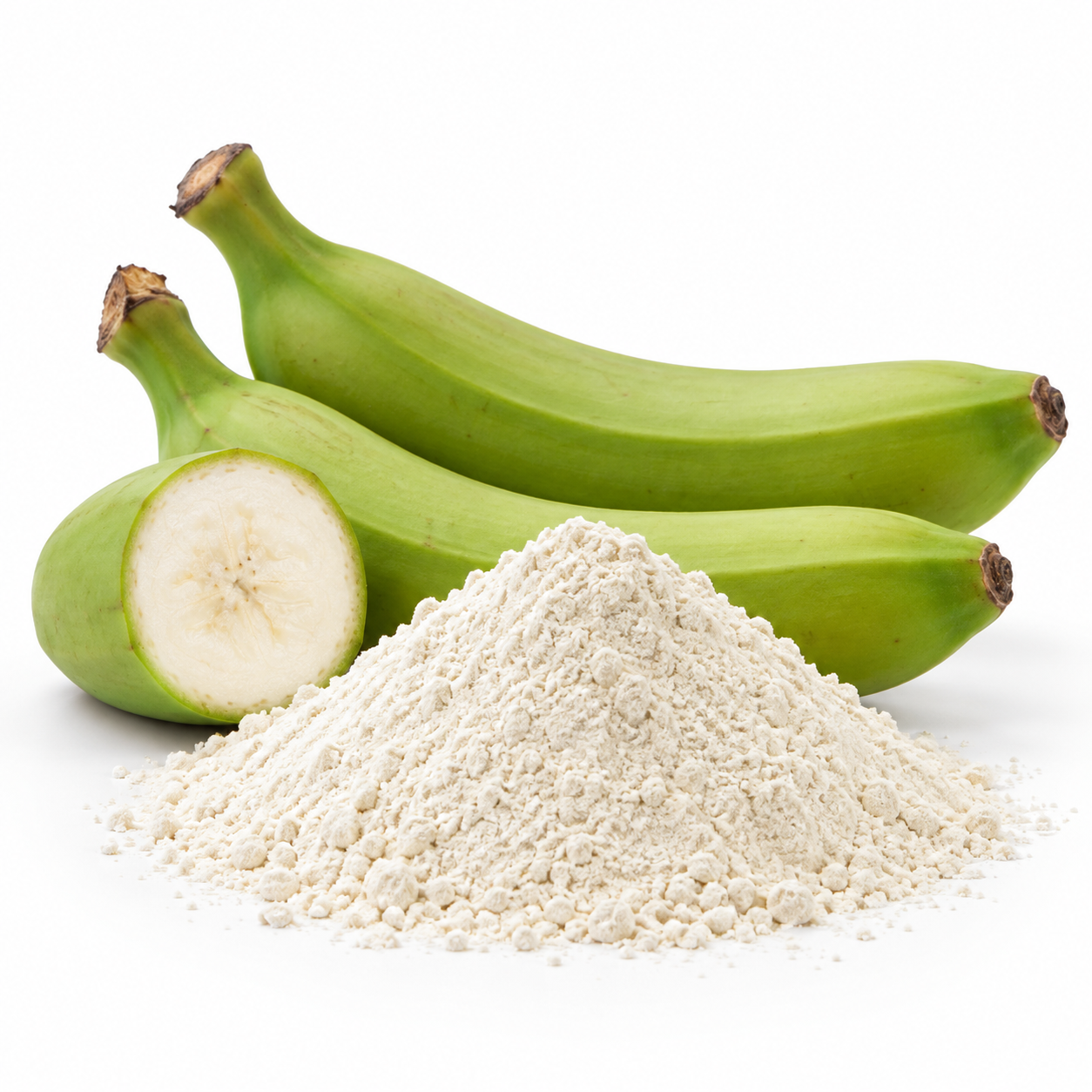
Green banana powder is not simply ripe banana powder with a different color. The maturity of the fruit, drying method, milling conditions, moisture exposure and subsequent heat treatment can change the starch structure and the amount of resistant starch measured in the supplied material or finished product. Developers should qualify green banana powder by process fit, not only by the raw-material name.
Why maturity matters
Unripe green bananas contain a starch profile that differs from fully ripe fruit. As the fruit matures, starch is converted and the sensory profile changes. For a food manufacturer, this means the source and maturity control are part of ingredient identity and functional performance.
The supplier specification should define the material clearly, including the botanical source, powder form, assay basis for resistant starch when claimed, moisture and particle-size information. A generic banana powder description is not enough to confirm that the material is suitable for a resistant-starch application.
Drying and milling affect the starting material
Drying removes water but also exposes the starch matrix to heat and time. Different drying conditions can change starch content and thermal properties. Milling then affects particle size, bulk density, dispersibility, mouthfeel and the speed at which water reaches the particles.
Particle size is not a direct substitute for resistant-starch content. A fine powder may hydrate more quickly and create a smoother texture, but it may also behave differently during heating and shear than a coarser material. Define particle size together with the process and sensory target.
Heat and moisture can change RS2 behavior
Many green banana materials are selected for their resistant-starch content, often including an RS2 fraction. Heat and moisture can disrupt the native starch structure. Gelatinization, cooking, extrusion or prolonged high-moisture processing may change the fraction that remains resistant under the selected analytical method.
This is why a raw-material value should not automatically be copied to the finished-product label. The finished food must be tested using the method required for the target market and claim. The relevant question is how much resistant starch remains after the actual process, not only how much was present before manufacturing.
Match the grade to the product process
For a dry powder blend, evaluate flow, dusting, segregation, particle-size compatibility and reconstitution. For a nutrition bar, check water activity, texture, binding and storage. For bakery or extruded products, evaluate the heat-moisture history and the resulting texture. For a beverage or smoothie, assess suspension, mouthfeel and sediment.
The current Ureda Green Banana Powder page lists standard and higher resistant-starch grades with particle-size options. Use those commercial details as the starting point for sampling, then test the chosen grade in the intended food matrix.
A practical qualification plan
1. Confirm source, maturity description and resistant-starch assay method. 2. Compare at least two particle-size or grade options when texture is critical. 3. Measure moisture and water activity in the supplied powder. 4. Process the ingredient using the intended heat, shear and moisture conditions. 5. Test resistant starch in the finished matrix using the required method. 6. Evaluate texture, flavor, color, dispersion and shelf-life behavior.
The assay method should be documented because different methods can measure different fractions or use different digestion conditions. When comparing supplier COAs, place the method, sample preparation and reporting basis next to the result.
What to ask a supplier
Request the botanical identity, source and maturity control, resistant-starch assay and method, moisture, particle-size distribution, microbiological limits, allergen statement, storage, packaging and available process guidance. Ask whether the quoted grade is intended for raw use, heat-processed foods, dry blends or another application.
Avoid a supplier statement such as retains resistant starch after processing unless the data covers the same product type, process and analytical method. Process evidence should be specific to the product matrix.
Final decision rule
Choose green banana powder by the interaction of resistant-starch content, moisture, particle size and process history. The best grade is the one that survives the intended manufacturing route while meeting the sensory, analytical and labeling requirements of the final product.
Technical references
- Effect of drying conditions on green banana flour
- Thermal stability of green banana starch
- Ureda Green Banana Powder grades and specifications
Need help selecting a green banana powder grade for a food or nutrition product? Contact Ureda Naturals.
