
 English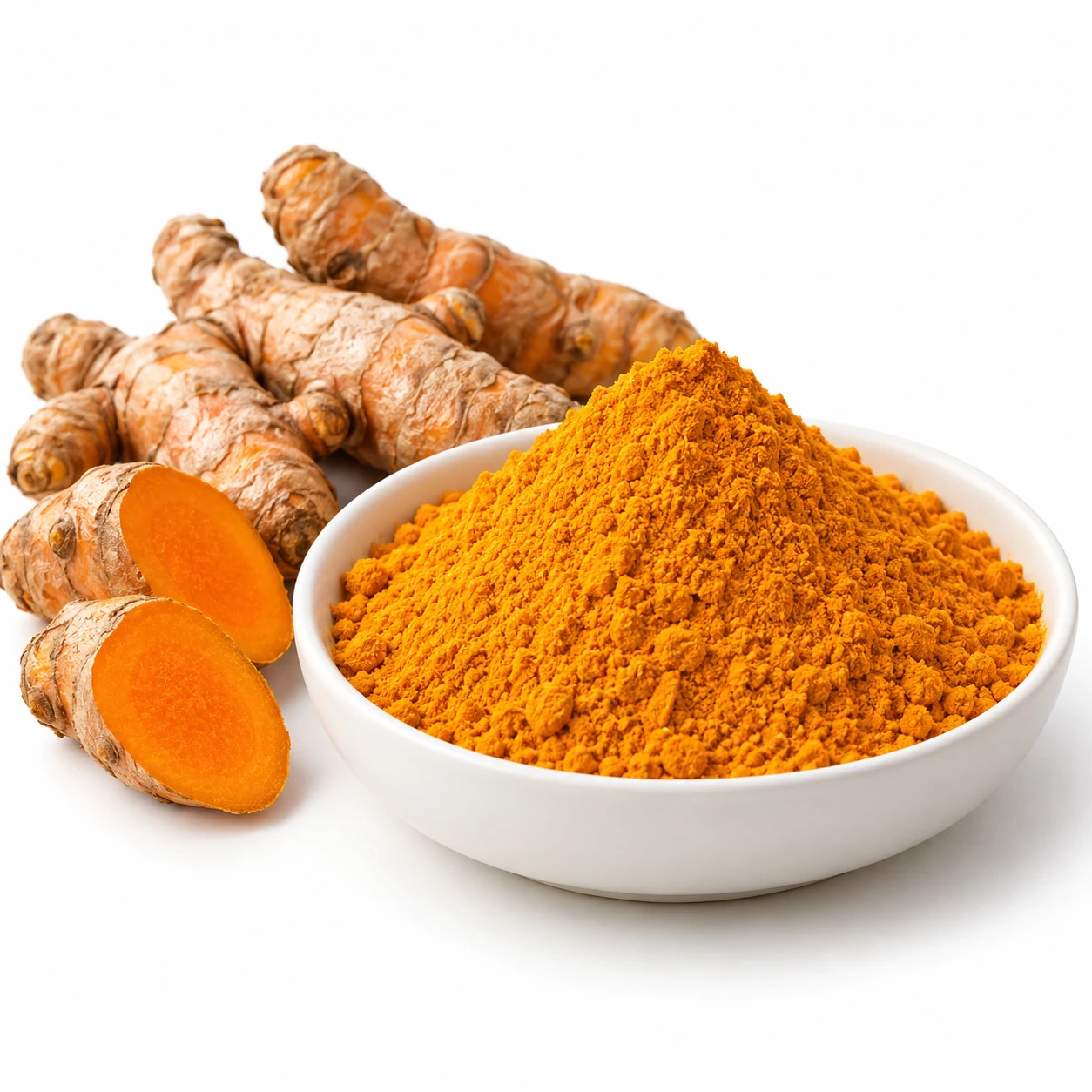
Ureda Naturals is a turmeric extract powder manufacturer supplying 95% total curcuminoids and a 20% water-dispersed grade. Select the concentrated grade for efficient curcuminoid loading or the water-dispersed grade for beverages, gummies and other aqueous formulations.
| Botanical Name | Curcuma longa L. |
|---|---|
| Product Form | Powder |
| Available Grades | Total Curcuminoids ≥95%; Water-Dispersed Total Curcuminoids ≥20% |
| Appearance | Yellow to Orange-Yellow |
| MOQ | 1kg |
Ureda Naturals supplies turmeric extract powder for supplement, functional food and beverage manufacturers. The product is available as a concentrated extract standardized to not less than 95% total curcuminoids by HPLC and as a 20% total-curcuminoid grade designed for stable dispersion in water.
The two grades serve different formulation requirements. The 95% grade delivers more curcuminoids with less raw-material input, while the 20% water-dispersed grade supports more practical incorporation into aqueous products.
| Product Grade | Total Curcuminoids | Formulation Value | Suitable Starting Applications |
|---|---|---|---|
| Turmeric Extract 95% Powder | ≥95.00% by HPLC | High curcuminoid loading with less raw-material input | Capsules, tablets, powder blends and suitable lipid-based systems |
| Water-Dispersed Turmeric Extract 20% Powder | ≥20.00% by HPLC | Stable dispersion in water for easier incorporation into aqueous products | Beverages, liquid supplements, gummies, sachets and functional foods |
For a formula requiring 100 mg of total curcuminoids, the minimum specification corresponds to approximately 105.3 mg of the 95% grade or 500 mg of the 20% grade. This difference affects serving size, formula space, powder load, color contribution and cost per unit of curcuminoid.
The 95% grade is intended for formulations where high curcuminoid concentration and compact dosage are primary requirements. Its total-curcuminoid assay includes curcumin, demethoxycurcumin and bisdemethoxycurcumin.
Using a concentrated grade reduces the quantity of extract needed to reach a defined curcuminoid target. This is valuable when capsule capacity, tablet weight or the inclusion of additional active ingredients limits available formula space.
In dry blends, introduce the extract through a staged premix before final blending. Distributing the colored powder through part of the carrier or excipient helps reduce localized concentration and supports more consistent blend appearance.
During scale-up, monitor blend uniformity, hopper flow, powder adhesion, capsule or tablet weight variation and color carryover during line cleaning. Bulk density, tapped density and particle size should be considered together with the customer’s filling and compression equipment.
For softgels, oil suspensions or emulsified systems, use an appropriate wetting and dispersion process. Evaluate sedimentation, redispersibility, viscosity and dose uniformity throughout the intended production hold time.
The 20% grade combines standardized total curcuminoids with stable dispersion in water. It is intended for formulations where aqueous incorporation is more important than maximum curcuminoid concentration per gram of raw material.
The larger addition rate required by the 20% grade must be included in calculations for total solids, flavor balance, color intensity and available formula space.
The finished product should be evaluated for color uniformity, visible agglomerates, sediment formation, redispersibility, flavor compatibility and per-serving curcuminoid uniformity. For transparent beverages, confirm that the natural yellow color and dispersed appearance meet the intended product design.
The assay determines how much raw material is required to reach the formula target. Calculate the addition rate from total curcuminoids rather than assuming that every turmeric or curcumin ingredient has the same concentration.
Raw-material input = required total curcuminoids ÷ minimum assay expressed as a decimal.
The 95% grade includes curcumin, demethoxycurcumin and bisdemethoxycurcumin. Reviewing the individual HPLC components with the total assay gives quality teams a clearer product identity than a single percentage alone.
Particle size affects premixing, surface wetting, powder flow and agglomeration. Its manufacturing effect depends on the inclusion rate, addition point, mixer design and batch size. Laboratory and production trials should therefore use comparable addition sequences and mixing conditions.
Moisture control supports powder flow and reduces caking during storage. Reseal opened containers promptly and limit exposure in humid dispensing and production areas.
Turmeric extract contributes a strong natural yellow to orange-yellow color. Controlled holding time, closed processing and light-protective finished packaging help maintain more consistent appearance during manufacturing and storage.
| Item | Standard | Result | Method |
|---|---|---|---|
| Identification | TLC Test | Positive | TLC |
| Total Curcuminoids | ≥95.00% | 95.42% | HPLC |
| Component | Result |
|---|---|
| Curcumin | 68.71% |
| Demethoxycurcumin | 16.36% |
| Bisdemethoxycurcumin | 10.35% |
| Item | Standard | Result |
|---|---|---|
| Appearance | Orange-yellow to yellow powder | Complies |
| Odor and Taste | Characteristic | Complies |
| Solvents Used | Ethanol and Ethyl Acetate | Complies |
| Plant Part Used | Rhizome | Complies |
| Item | Standard | Result | Method |
|---|---|---|---|
| Particle Size | ≥95.00% through 80 meshes | 96.82% | US#40 Sieve |
| Loss on Drying | ≤2.00% | 0.47% | USP43-NF38<731> |
| Ash | ≤1.00% | 0.02% | USP43-NF38<561> |
| Bulk Density | 0.20–0.50 g/ml | 0.38 g/ml | USP43-NF38<616> |
| Tapped Density | 0.30–0.80 g/ml | 0.61 g/ml | USP43-NF38<616> |
| Lead | ≤0.50 mg/kg | 0.03 mg/kg | Atomic Absorption |
| Arsenic | ≤1.00 mg/kg | 0.006 mg/kg | Atomic Absorption |
| Cadmium | ≤0.50 mg/kg | Not Detected | Atomic Absorption |
| Mercury | ≤0.10 mg/kg | 0.03 mg/kg | Atomic Absorption |
| Solvents Residue | USP Standard | Complies | USP43-NF38<467> |
| Pesticides Residue | USP Standard | Complies | USP43-NF38<561> |
| Item | Standard | Result | Method |
|---|---|---|---|
| Total Bacterial Count | ≤1,000 CFU/g | <10 CFU/g | USP43-NF38<2021> |
| Total Yeasts and Molds | ≤100 CFU/g | <10 CFU/g | USP43-NF38<2021> |
| Staphylococcus aureus | Negative | Negative | USP43-NF38<2022> |
| Salmonella | Negative | Negative | USP43-NF38<2022> |
| E. coli | Negative | Negative | USP43-NF38<2022> |
| Item | Standard | Result | Method |
|---|---|---|---|
| Identification | TLC Test and HPLC Test | Positive | TLC and HPLC |
| Total Curcuminoids | ≥20.00% | 20.01% | HPLC |
| Item | Standard | Result |
|---|---|---|
| Appearance | Yellow powder | Complies |
| Odor and Taste | Characteristic | Complies |
| Plant Part Used | Root | Complies |
| Extract Solvent | Ethanol and Ethyl Acetate | Complies |
| Solubility | Stable dispersion in water | Complies |
| Item | Standard | Result | Method |
|---|---|---|---|
| Particle Size | ≥95.00% through 80 meshes | 98.70% | US#80 Sieve |
| Loss on Drying | ≤5.00% | 3.83% | USP38-NF33<731> |
| Ash | ≤10.00% | 0.06% | USP38-NF33<281> |
| Heavy Metals | ≤10.00 mg/kg | <10.00 mg/kg | USP38-NF33<231> |
| Lead | ≤3.00 mg/kg | 0.17 mg/kg | Atomic Absorption |
| Arsenic | ≤1.00 mg/kg | Not Detected | Atomic Absorption |
| Cadmium | ≤1.00 mg/kg | 0.03 mg/kg | Atomic Absorption |
| Mercury | ≤0.10 mg/kg | 0.02 mg/kg | Atomic Absorption |
| Solvents Residue | USP Standard | Complies | USP38-NF33<467> |
| Pesticides Residue | USP Standard | Complies | USP38-NF33<231> |
| Item | Standard | Result | Method |
|---|---|---|---|
| Total Bacterial Count | ≤1,000 CFU/g | 10 CFU/g | USP38-NF33<2021> |
| Total Yeasts and Molds | ≤100 CFU/g | <10 CFU/g | USP38-NF33<2021> |
| Staphylococcus aureus | Negative | Not Detected | USP38-NF33<2022> |
| Salmonella | Negative | Not Detected | USP38-NF33<2022> |
| E. coli | Negative | Not Detected | USP38-NF33<2022> |
The 95% grade is the more efficient starting option when high curcuminoid input must fit within a limited unit weight. Confirm blend uniformity, flow, compression behavior and finished-unit weight variation during the pilot.
The 95% grade reduces extract weight, while the 20% grade supports products intended for later dispersion in water. Check segregation, color uniformity and reconstitution performance after blending and transport simulation.
The 20% water-dispersed grade is the preferred starting option. Add it gradually under active mixing and assess sedimentation, redispersibility, flavor compatibility and curcuminoid uniformity after the complete manufacturing process.
Introduce the water-dispersed grade through the aqueous phase before the system reaches its final viscosity. Confirm color distribution, gel setting, visible specking and finished-piece uniformity.
The 95% grade can be used with an appropriate wetting, suspension or emulsification process. Evaluate sedimentation, viscosity, redispersibility and dose uniformity under the intended filling and storage conditions.
| MOQ | 1 kg |
|---|---|
| Bag Sizes | 1 kg, 5 kg and 10 kg |
| Drum Sizes | 5 kg, 10 kg and 25 kg |
| Storage | Keep well closed at room temperature and protect from moisture and sunlight. |
| Quality Documents | COA, specification sheet, TDS and SDS |
| Additional Documents | Source, residual solvent, pesticide, microbiological and applicable regulatory support documents |
| Quality-System Support | GMP, FSSC 22000, ISO 9001, HACCP, Halal and Kosher documentation as applicable |
No. The 95% specification refers to total curcuminoids, including curcumin, demethoxycurcumin and bisdemethoxycurcumin. The individual HPLC components should be reviewed together with the total-curcuminoid assay.
Divide the required total-curcuminoid amount by the minimum assay expressed as a decimal. A target of 100 mg total curcuminoids requires approximately 105.3 mg of the 95% grade or 500 mg of the 20% grade before any formulation-specific adjustment.
No. A 1:1 substitution changes the total curcuminoids delivered, total powder load, color contribution and available formula space. Recalculate the addition rate from the required total-curcuminoid target before changing grades.
The 20% water-dispersed grade is the more suitable starting option. Add it under active mixing and evaluate the completed beverage for color uniformity, sedimentation, redispersibility, flavor compatibility and per-serving curcuminoid uniformity.
Relevant causes include rapid powder addition, inadequate wetting, insufficient mixing at the addition point, increasing viscosity before dispersion is complete and interactions within the finished beverage matrix. Compare samples from the top, middle and bottom of the batch after processing and storage.
The 95% grade is selected primarily for concentrated curcuminoid delivery. A water-based product normally requires a suitable wetting, suspension, emulsification or delivery process. Verify dispersion, sedimentation and dose uniformity in the finished formula.
Compare botanical identity, plant part, assay definition, analytical method, total-curcuminoid limit, individual curcuminoid profile where applicable, physical form, residual solvents, pesticides, elemental impurities and microbiological limits.
INGREDIENT PARTNER
Tell us your intended application, approximate quantity and target market. Ureda Naturals will confirm the closest grade, packaging configuration and available documentation for your project.

Scan the QR code or
search WeChat ID: 18270717590
From Natural Origin to Formulation Intent
Tell us what you’re sourcing.
