
 English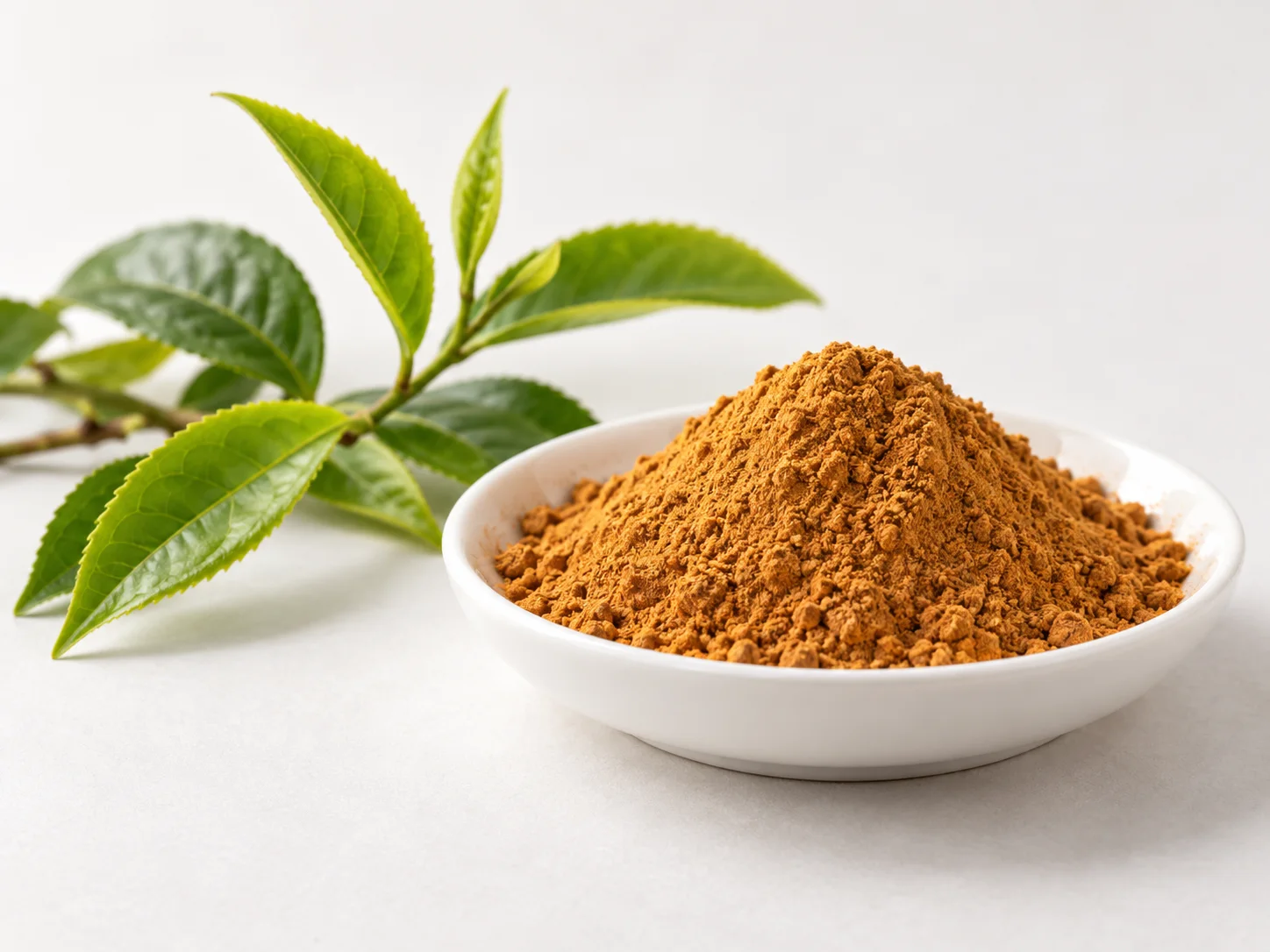
Ureda Naturals manufactures Theaflavin from green tea through controlled enzymatic conversion and refining. Available in 20%–60% assay grades with TF1, TF2A, TF2B and TF3 marker profiles, plus selectable caffeine levels for formulation-specific requirements.
| Source | Green tea (Camellia sinensis) |
|---|---|
| CAS No. | 4670-05-7 |
| Assay grades | 20%, 30%, 40%, 50%, 60% |
| Marker system | TF1, TF2A, TF2B, TF3 |
| Caffeine | 0.1%–10% |
| MOQ | 1KG |
Ureda Naturals manufactures Theaflavin, CAS No. 4670-05-7, as a standardized green-tea-derived ingredient for food, dietary supplement and cosmetic applications.
The product uses green tea as the catechin-rich starting material and is processed through controlled enzymatic conversion, refining and concentration to obtain a defined theaflavin system. The principal marker components are TF1, TF2A, TF2B and TF3.
Available grades include 20%, 30%, 40%, 50% and 60%. The product is supplied as a golden-yellow to reddish-brown powder and is soluble in water, acetic acid and n-butanol.
| Item | Specification |
|---|---|
| Product name | Theaflavin |
| CAS No. | 4670-05-7 |
| Botanical source | Green tea |
| Botanical name | Camellia sinensis |
| Main marker system | TF1, TF2A, TF2B and TF3 |
| Available assay grades | 20%, 30%, 40%, 50% and 60% |
| Appearance | Golden yellow to reddish-brown powder |
| Solubility profile | Soluble in water, acetic acid and n-butanol |
| Caffeine | 0.1%–10%, depending on the selected version |
| Applications | Food, dietary supplements and cosmetics |
The production route begins with green tea, which provides the catechin-rich starting material required for theaflavin formation.
Controlled enzymatic conversion is then used to transform the starting polyphenol system. The converted material is refined, concentrated and dried to obtain the selected Theaflavin grade.
This process means that the final ingredient is defined not only by its botanical source, but also by its theaflavin assay, TF1/TF2A/TF2B/TF3 marker profile, caffeine level, color and formulation behavior.
The 20%–60% grades are not interchangeable on a weight-for-weight basis. A higher-assay grade reduces the amount of raw material required, while a lower-assay grade increases the powder contribution to the formula.
| Target Theaflavin Active | 20% Grade | 30% Grade | 40% Grade | 50% Grade | 60% Grade |
|---|---|---|---|---|---|
| 100 mg active | 500 mg | 333 mg | 250 mg | 200 mg | 167 mg |
The actual production calculation should use the agreed release assay for the selected grade.
| Raw-Material Attribute | Customer Process Step | Potential Impact | Recommended Verification |
|---|---|---|---|
| Assay grade | Weighing, premixing and batching | Changes active dose, powder loading and caffeine contribution | Calculate the addition rate from the agreed assay and confirm active content per serving |
| TF1/TF2A/TF2B/TF3 profile | Heating, high-shear mixing and storage | May influence color, astringency and stability response | Compare batches using the same marker-reporting format |
| Golden-yellow to reddish-brown color | Beverage, capsule, tablet and cosmetic blending | Changes finished-product color and visual consistency | Establish an acceptable color range in the actual formula |
| Water solubility | Prehydration, dispersion and filtration | Affects wetting, undissolved particles and filterability | Test after acids, minerals, proteins and flavor systems are added |
| Caffeine range | Dosing and finished-product calculation | Changes total caffeine per serving | Select the caffeine specification before pilot production |
| pH and thermal exposure | Pasteurization, hot filling and storage | May affect assay recovery, color and sediment formation | Compare pre-process and post-process assay, color and clarity |
| Interaction with proteins | Protein beverages and dairy systems | May cause haze, sediment or tea-cream formation | Test the complete protein matrix rather than water alone |
For instant beverages and powdered tea drinks, evaluate wetting, dispersion, reconstitution time, undissolved particles, finished color, astringency and clarity after complete reconstitution.
Pre-dispersing Theaflavin before adding high-viscosity ingredients, proteins or mineral salts can help separate a raw-material wetting issue from a later matrix-interaction issue.
For RTD products, evaluate the ingredient after initial dispersion, acidification, thermal processing and storage. Key observations include assay recovery, color change, haze, sediment, filterability, flavor and astringency.
Higher-assay grades can reduce the quantity of raw material required per serving. During development, compare powder flow, blend uniformity, content uniformity, color transfer, excipient compatibility and caffeine contribution.
Theaflavin can be evaluated in sachets, capsules, tablets and other supplement formats. Grade selection should consider target active content, serving size, caffeine level, color tolerance and powder loading.
For cosmetic applications, evaluate formula pH, color contribution, heat exposure, emulsion stability, compatibility with botanical extracts and color change during storage.
The selected Theaflavin grade is released according to the agreed purchasing specification. The specification should identify the assay grade, assay definition, marker profile, caffeine level, appearance, color, solubility and applicable safety and microbiological requirements.
The batch COA is matched to the selected grade and reports the lot-specific results against the applicable release criteria.
Ureda Naturals can provide applicable COA, TDS, SDS, ingredient and allergen information, together with supporting quality-system and regulatory documentation.
It changes the required addition weight, active loading, powder contribution, color contribution and caffeine contribution. The addition rate should be calculated from the selected grade and agreed release assay.
No. The grade represents the declared theaflavin content of the standardized TF system. TF1, TF2A, TF2B and TF3 are individual marker components within that system.
The total assay does not fully describe the distribution of TF1, TF2A, TF2B and TF3. Differences in marker profile, processing history and storage conditions may affect finished-product color and sensory performance.
No. Caffeine is a separate specification. The selected Theaflavin grade and caffeine range should be stated independently in the purchasing specification.
Test the material before processing, after the actual heat treatment and after storage. Compare assay recovery, color, haze, sediment, filterability and astringency.
Protein and mineral components can change the dispersion and interaction environment. Theaflavin should be tested in the complete formula after protein addition, heating and storage.
A 50% or 60% grade may reduce the quantity of raw material required. The selection should still be checked against color, astringency, caffeine, powder flow and content uniformity.
Compare assay definition, marker profile, caffeine level, color, dispersion, post-process assay recovery, finished-product clarity and COA format. Nominal assay alone does not establish equivalence.
No. EGCG is an individual catechin, while Theaflavin is a standardized system containing TF1, TF2A, TF2B and TF3. Their assay calculations, color, taste and process behavior are different.
Ureda Naturals can provide the applicable COA, TDS, SDS and supporting quality or regulatory documents for the selected Theaflavin specification.
INGREDIENT PARTNER
Tell us your intended application, approximate quantity and target market. Ureda Naturals will confirm the closest grade, packaging configuration and available documentation for your project.

Scan the QR code or
search WeChat ID: 18270717590
From Natural Origin to Formulation Intent
Tell us what you’re sourcing.
