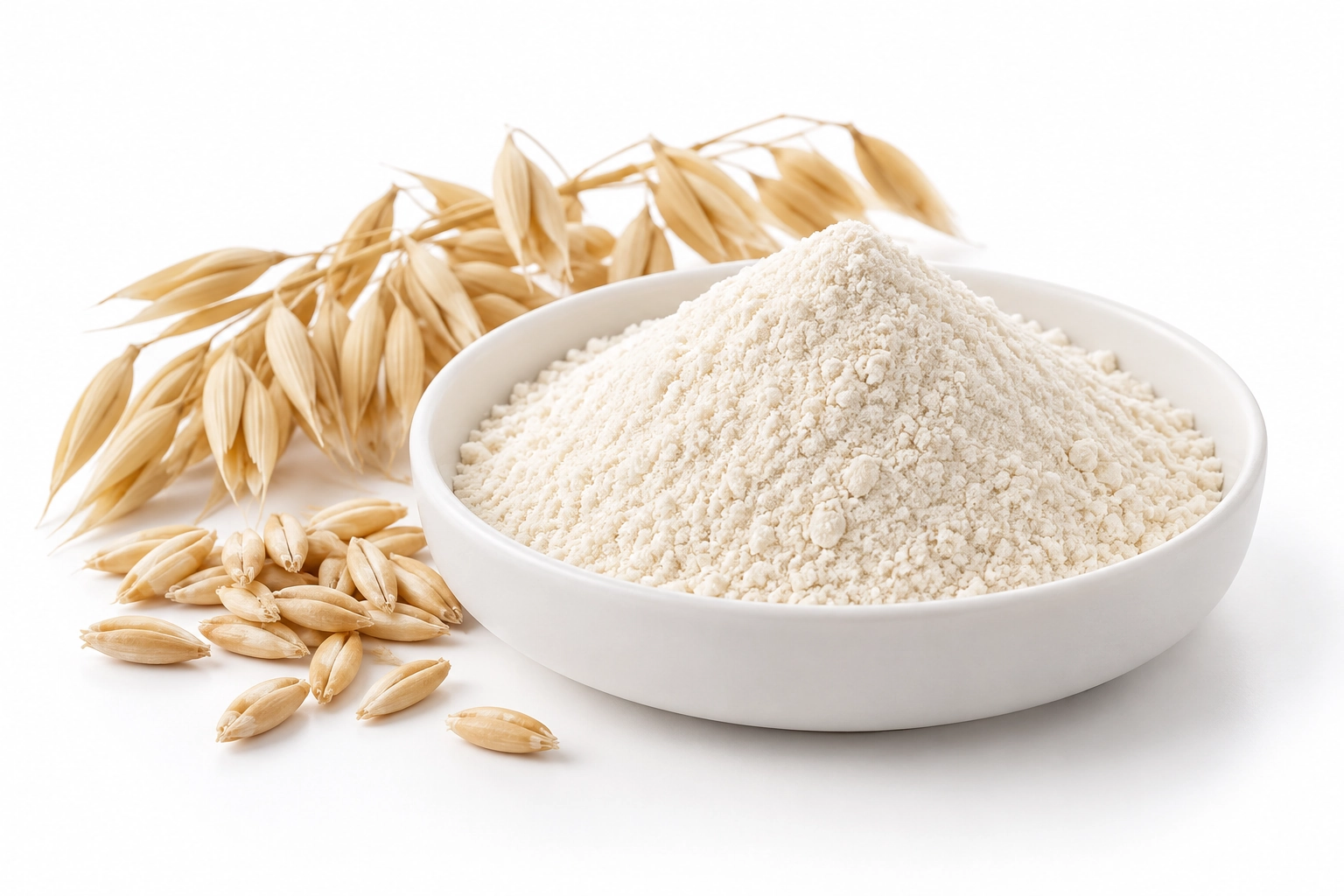
Oat Beta-Glucan is oat-derived β-(1→3)(1→4)-D-glucan, available in 70% and 80% assay grades. The range includes functional formats for applications where viscosity, dissolution, clarity, gluten content or cosmetic use is a primary formulation requirement.
Grades and Functional Formats
Assay grade and functional format serve different selection purposes: the assay grade indicates beta-glucan content, while the functional format is selected for the behavior required in the finished formulation.
| Format |
Product characteristic |
Formulation priority |
| High-viscosity |
Molecular weight >500,000 Da |
Building body and smoothness, supporting water retention in gelled products, and emulsifying or embedding oil |
| Instant |
Rapid dissolution without requiring high-temperature dissolution |
Formulations with shorter mixing or heating steps |
| Transparent |
High clarity and colorless transparency |
Products where appearance and clarity are important |
| Gluten-free |
Gluten ≤20 ppm |
Gluten-free product development |
| Cosmetic |
Cosmetic-specific oat beta-glucan format |
Personal-care formulations targeting a moisturizing profile |
Selecting Oat Beta-Glucan for a Formulation
Start with the job the ingredient must perform in the finished product. Use assay grade to calculate beta-glucan input; select the functional format according to the target texture, dissolution conditions, clarity, gluten requirement or end-use.
In food and beverage development, evaluate the ingredient in the actual formulation rather than in water alone. Addition order, mixing conditions, hydration time, temperature and the surrounding ingredients can all affect the processing result. For a useful comparison, keep the base formula and processing conditions consistent while changing one grade or format at a time.
- Set the target beta-glucan contribution and select the 70% or 80% assay grade.
- Choose the functional format according to the product’s main requirement, such as viscosity, rapid dissolution or clarity.
- Record the addition sequence, mixing conditions, temperature and hydration time during the bench trial.
- Assess the finished formulation for texture or viscosity, visible agglomerates, clarity and any relevant separation after processing and storage.
For beverages, milkshakes, solid drinks, bakery products, noodles and confectionery, the preferred format depends on the product’s target texture and manufacturing sequence. Cosmetic formulations should be assessed in their intended base and at the intended use level.
COA Specifications for 70% and 80% Grades
| Test item |
Specification |
70% grade result |
80% grade result |
Method |
| Appearance |
Light yellow or off-white powder |
Off-white powder |
Off-white powder |
Visual |
| Odor |
Characteristic |
Characteristic |
Characteristic |
Smelling |
| Particle size |
≥90% through 80 mesh |
97.8% through 80 mesh |
96.1% through 80 mesh |
Sieve |
| Purity |
≥70.0% / ≥80.0% |
72.13% |
83.63% |
AOAC 995.16 |
| Residue on ignition |
≤8.0% |
1.84% |
1.50% |
GB 5009.4 |
| Moisture |
≤5.0% |
2.85% |
3.11% |
GB 5009.3 |
| Total plate count |
≤10,000 CFU/g |
10 CFU/g |
50 CFU/g |
GB 4789.2 |
| Yeasts and molds |
≤50 CFU/g |
<10 CFU/g |
<10 CFU/g |
GB 4789.15 |
| Coliform |
≤10 CFU/g |
<10 CFU/g |
<10 CFU/g |
GB 4789.3 |
Packaging and Storage
- MOQ: 1 kg
- Packaging: 1 kg aluminum foil bag or 25 kg fiber drum
- Storage: Store in a cool, dry place.
- Shelf life: 2 years
Frequently Asked Questions
How much 70% or 80% oat beta-glucan is needed to deliver a 1% beta-glucan level?
Calculate the ingredient input as the target beta-glucan level divided by the assay strength. For a 1.0% target, the starting calculation is approximately 1.43% of the 70% grade or 1.25% of the 80% grade. The final formulation level should then be set against the required texture and processing performance.
Does the 80% grade automatically produce greater viscosity than the 70% grade?
No. The assay percentage describes beta-glucan content, not the viscosity grade. At the same ingredient dose, the 80% grade contributes more beta-glucan; viscosity selection should be based on the functional format and the target behavior in the finished formulation. The high-viscosity option is specified with a molecular weight above 500,000 Da.
When should I choose high-viscosity rather than instant oat beta-glucan?
Choose the high-viscosity format when body, smoothness or water retention in a gelled product is the main target. Choose the instant format when rapid dissolution and avoiding a high-temperature dissolution step are more important to the manufacturing process.
How should I compare grades during a beverage or gel pilot?
Use the intended product base and keep the formula, ingredient level, addition order, mixing conditions, temperature and hydration time consistent between trials. Record viscosity or texture at the same process stage, then check appearance, agglomerates and separation after the relevant heating, cooling or storage steps.
What gluten level is specified for the gluten-free oat beta-glucan format?
The gluten-free format is specified at ≤20 ppm gluten for gluten-free product development.
Can oat beta-glucan be used in cosmetic formulations?
A cosmetic-specific format is available for personal-care formulation development. Assess it in the intended cosmetic base for the required appearance, texture and moisturizing profile.

 English