
 English
English
English
L-Glutathione Reduced is a white crystalline powder supplied by Ureda Naturals for dietary supplements, functional foods and cosmetic formulations. The product is available in Food Grade and Cosmetic Grade, with a documented assay range of 98.0–102.0% on a dry basis.
The two grades share the same core chemical identity, but their intended use, documentation focus and formulation requirements are different. Selecting the correct grade at the beginning of development helps keep the raw material, finished-product process and quality documentation aligned.
| Grade | Typical finished products | Main quality focus |
|---|---|---|
| Food Grade | Capsules, tablets, sachets, powder blends and functional food systems | Assay, identity, related substances, moisture, elemental impurities and microbiological quality |
| Cosmetic Grade | Serums, gels, creams, masks and other topical formulations | Identity, assay, solution behavior, moisture, related substances and microbiological quality |
Both grades are supplied as L-Glutathione Reduced powder. The correct selection should be based on the intended finished product, processing conditions, quality specifications and regulatory documentation required for the destination market.
| Parameter | Specification |
|---|---|
| Product name | L-Glutathione Reduced |
| CAS number | 70-18-8 |
| Molecular formula | C10H17N3O6S |
| Molecular weight | 307.32 g/mol |
| Appearance | White crystalline powder |
| Water solubility | Freely soluble in water |
| Assay | 98.0–102.0% on a dry basis |
| Oxidized glutathione | Not more than 1.5% |
| Total related substances | Not more than 2.0% |
| Loss on drying | Not more than 0.5% |
| Shelf life | 36 months under the stated storage conditions |
The following table presents the Food Grade COA parameters and tested results supplied for L-Glutathione Reduced.
| Test item | Specification | Result |
|---|---|---|
| Appearance | White crystalline powder | White crystalline powder |
| Solubility | Freely soluble in water; very slightly soluble in ethanol and methylene chloride | Complies |
| Assay | 98.0–102.0% on dry basis | 99.4% |
| Optical rotation | −15.5° to −17.5° | −16.7° |
| Bulk density | Not less than 0.20 g/mL | 0.38 g/mL |
| Tapped density | Not less than 0.40 g/mL | 0.62 g/mL |
| Identification by IR | Matches the reference spectrum | Complies |
| Clarity and colour of solution | Clear and colourless | Complies |
| Chlorides | Not more than 0.02% | <0.02% |
| Sulfates | Not more than 0.03% | <0.03% |
| Ammonium | Not more than 0.02% | <0.02% |
| Iron | Not more than 0.001% | <0.001% |
| Loss on drying | Not more than 0.5% | 0.1% |
| Residue on ignition | Not more than 0.1% | 0.08% |
| Heavy metals | Not more than 10 ppm | <10 ppm |
| Arsenic | Not more than 1 ppm | <1 ppm |
| Lead | Not more than 2 ppm | <2 ppm |
| Mercury | Not more than 0.2 ppm | <0.2 ppm |
| Cadmium | Not more than 0.3 ppm | <0.3 ppm |
| Oxidized glutathione | Not more than 1.5% | 0.41% |
| Total related substances | Not more than 2.0% | 0.53% |
| Total plate count | Not more than 1,000 CFU/g | <10 CFU/g |
| Coliforms | Not more than 100 CFU/g | <10 CFU/g |
| Yeast and mold | Not more than 50 CFU/g | <10 CFU/g |
| Salmonella | Not detected | Not detected |
| Staphylococcus aureus | Not detected | Not detected |
The following table presents the Cosmetic Grade COA parameters and tested results supplied for L-Glutathione Reduced.
| Test item | Specification | Result |
|---|---|---|
| Appearance | White crystalline powder | White crystalline powder |
| Solubility | Freely soluble in water; very slightly soluble in ethanol and methylene chloride | Complies |
| Assay | 98.0–102.0% on dry basis | 99.3% |
| Optical rotation | −15.5° to −17.5° | −16.3° |
| Bulk density | Not less than 0.20 g/mL | 0.39 g/mL |
| Tapped density | Not less than 0.40 g/mL | 0.66 g/mL |
| Identification by IR | Matches the reference spectrum | Complies |
| Clarity and colour of solution | Clear and colourless | Complies |
| Chlorides | Not more than 0.02% | <0.02% |
| Sulfates | Not more than 0.03% | <0.03% |
| Ammonium | Not more than 0.02% | <0.02% |
| Iron | Not more than 0.001% | <0.001% |
| Loss on drying | Not more than 0.5% | 0.1% |
| Residue on ignition | Not more than 0.1% | 0.1% |
| Heavy metals | Not more than 10 ppm | <10 ppm |
| Arsenic | Not more than 1 ppm | <1 ppm |
| Lead | Not more than 2 ppm | <2 ppm |
| Mercury | Not more than 0.2 ppm | <0.2 ppm |
| Cadmium | Not more than 0.3 ppm | <0.3 ppm |
| Oxidized glutathione | Not more than 1.5% | 0.29% |
| Total related substances | Not more than 2.0% | 0.55% |
| Total plate count | Not more than 1,000 CFU/g | <10 CFU/g |
| Coliforms | Not more than 100 CFU/g | <10 CFU/g |
| Yeast and mold | Not more than 50 CFU/g | <10 CFU/g |
| Salmonella | Not detected | Not detected |
| Staphylococcus aureus | Not detected | Not detected |
Assay measures the amount of L-Glutathione Reduced on a dry basis, but it does not describe every quality attribute that influences formulation performance. A complete technical review should read assay together with optical rotation, infrared identity, oxidized glutathione, total related substances, loss on drying, residue on ignition, elemental impurities and microbiological results.
The reduced form contains a reactive thiol group. During storage or processing, oxygen exposure, light, moisture, temperature and the surrounding formulation can influence the balance between reduced and oxidized material. This is why two powders with similar assay values can behave differently after being dissolved or incorporated into a finished product.
FDA analytical work on glutathione has also emphasized the need to evaluate the parent compound and related impurities with a validated chromatographic method rather than relying on a single assay result.
For capsules, tablets, sachets and dry blends, the main process questions are powder flow, bulk density, blend uniformity and moisture exposure. Bulk density and tapped density help the formulator estimate fill volume and select a practical blending and filling sequence.
L-Glutathione Reduced should be introduced into a dry blend after the major carrier ingredients have been de-lumped. Excessive residence time in an open mixing environment can increase exposure to humidity and oxygen. The final blend should be evaluated for assay uniformity, moisture, flow behavior and packaging compatibility.
When L-Glutathione Reduced is dissolved into a liquid system, the development focus changes from powder handling to solution stability. The development batch should monitor dissolution time, clarity, colour, pH, dissolved oxygen exposure and assay retention during the intended holding period.
A clear solution at the time of manufacture does not by itself demonstrate long-term reduced-state retention. The finished beverage or liquid supplement should be evaluated under its actual container, filling temperature, headspace and storage conditions.
Cosmetic Grade L-Glutathione Reduced can be evaluated in serums, gels, creams, masks and other topical systems. The most important development variables are the formula pH range, water activity, oxygen exposure, light exposure, preservative system, metal-ion environment and the temperature history of the batch.
For aqueous products, prepare the required solution under controlled mixing and add it at the process stage that limits unnecessary heat and oxygen exposure. For emulsions, the addition point should be selected according to the validated cool-down and homogenization sequence of the individual formula.
Finished-product testing should include appearance, colour, odour, pH, viscosity where applicable, assay retention and oxidized glutathione or related-substance monitoring over the intended shelf-life study.
| Item | Ureda Naturals supply information |
|---|---|
| Minimum order quantity | 1 kg |
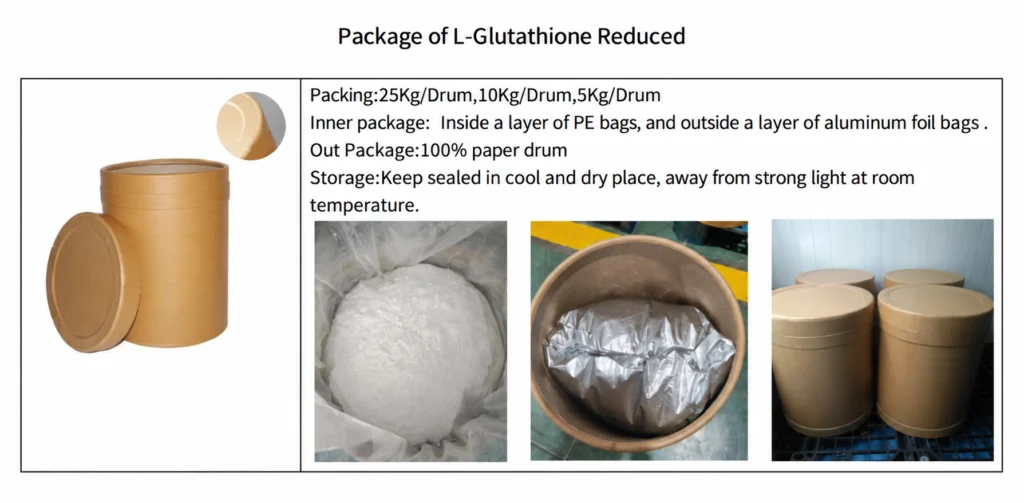
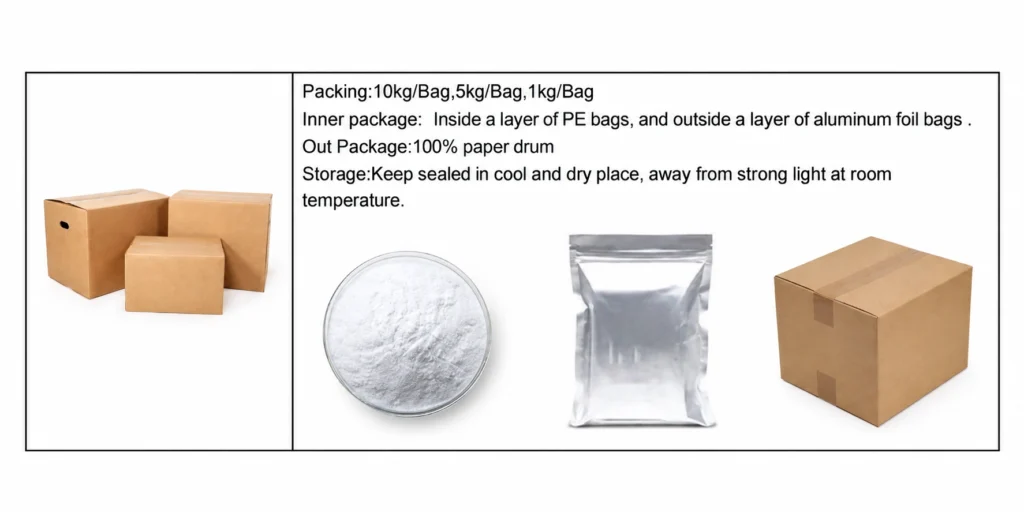
| Bag packing | 1 kg, 5 kg or 10 kg per bag |
| Drum packing | 5 kg, 10 kg or 25 kg per paper drum |
| Inner packaging | One PE bag with an outer aluminum-foil bag |
| Outer packaging | Paper drum for drum packing or carton for bag packing |
| Storage | Keep sealed in a cool and dry place, away from strong light, heat and unnecessary air exposure |
| Shelf life | 36 months under the stated storage conditions |
| Documentation category | Available documentation |
|---|---|
| Quality and manufacturing systems | GMP, FSSC 22000, ISO 9001 and HACCP |
| Religious certifications | Halal and Kosher |
| Product quality documents | Food Grade COA, Cosmetic Grade COA, TDS and SDS |
| Regulatory support | FDA or GRAS |

Assay describes the amount of L-Glutathione Reduced on a dry basis. It should be read together with identity, oxidized glutathione, total related substances, moisture, elemental impurities and microbiological quality.
Oxidized glutathione indicates the amount of material that has changed from the reduced state, while total related substances describe the broader impurity profile measured by the test method.
Clarity only describes the visible state of the solution. Oxygen, light, temperature, pH, trace metals, container headspace and holding time can still affect chemical stability.
Food Grade is intended for dietary supplements and functional food applications. Cosmetic Grade is intended for serums, gels, creams, masks and other topical formulations.
Review bulk density, tapped density, moisture and blend uniformity before finalizing the filling process. Limit unnecessary exposure to humidity and air during blending.
Evaluate dissolution time, clarity, colour, pH, dissolved oxygen exposure, container headspace and assay retention under actual filling and storage conditions.
Select the addition point according to the formula pH, temperature, mixing and homogenization sequence. Monitor appearance, pH, assay retention and related substances during stability testing.
No. Food Grade is intended for food and dietary supplement applications. Injectable development requires a separately qualified pharmaceutical-grade material with controls for sterility, endotoxin, impurities and aseptic processing.
INGREDIENT PARTNER
Tell us your intended application, approximate quantity and target market. Ureda Naturals will confirm the closest grade, packaging configuration and available documentation for your project.

