
 English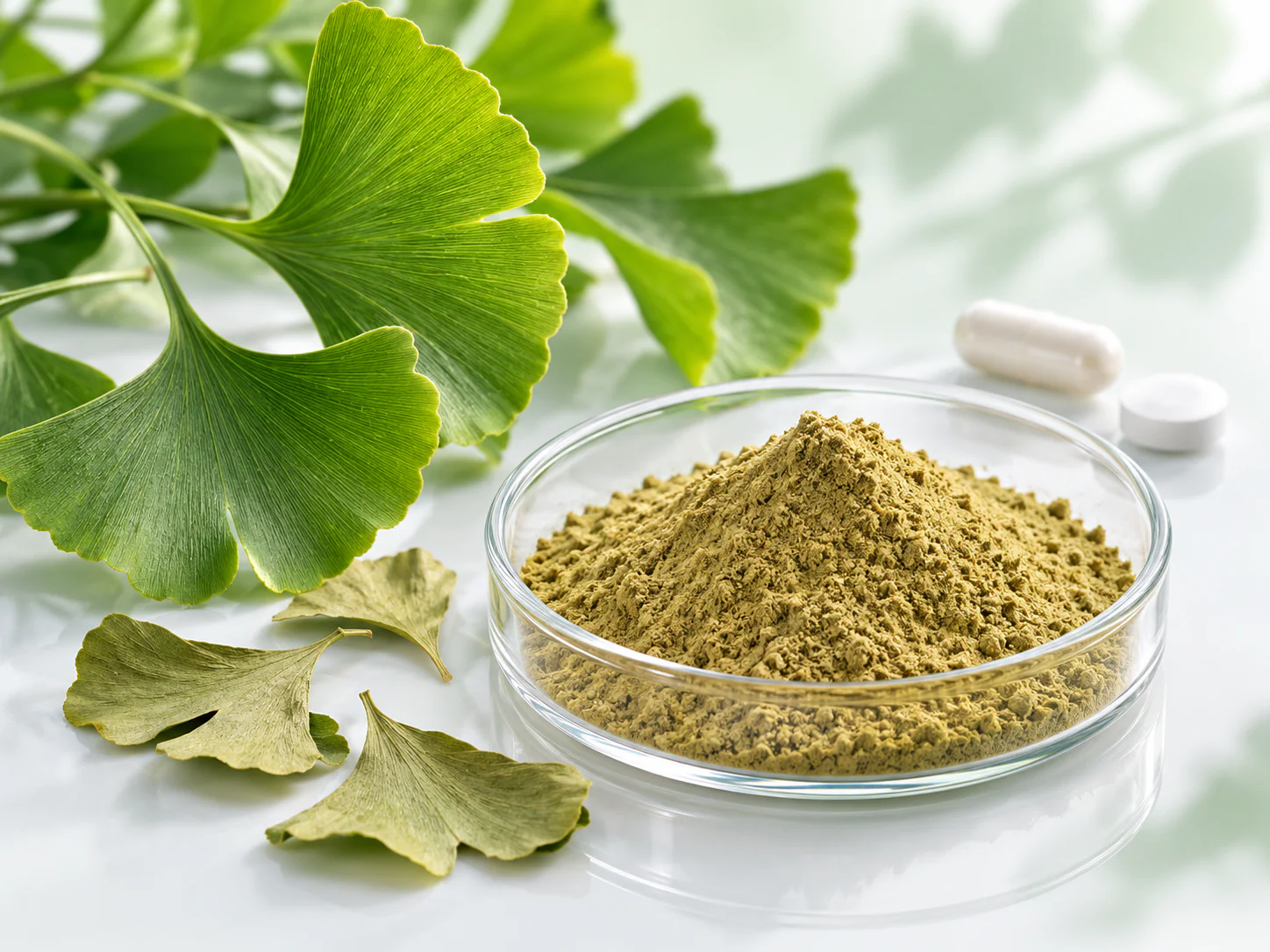
Ureda Naturals Ginkgo Biloba Leaf Extract is a standardized extract from Ginkgo biloba L. leaves, controlled for ≥24.0% total flavone glycosides, ≥6.0% total terpene lactones and ≤5 mg/kg ginkgolic acids, with additional flavonol profile and authenticity markers.
| Product Name | Ginkgo Biloba Leaf Extract |
|---|---|
| CAS No. | 90045-36-6 |
| Total Flavone Glycosides | ≥24.0% |
| Total Terpene Lactones | ≥6.0% |
| Ginkgolic Acids | ≤5 mg/kg |
| Quercetin | Kaempferol 0.8–1.2 |
Ureda Naturals Ginkgo Biloba Leaf Extract is manufactured from the leaves of Ginkgo biloba L. through controlled extraction, concentration, purification, drying and standardization.
The product is defined by a multi-parameter specification covering active composition, safety-related impurities, flavonol profile and botanical authenticity.
| Item | Specification |
|---|---|
| Product name | Ginkgo Biloba Leaf Extract |
| Botanical source | Leaves of Ginkgo biloba L. |
| CAS No. | 90045-36-6 |
| Total flavone glycosides | ≥24.0% |
| Total terpene lactones | ≥6.0% |
| Ginkgolic acids | ≤5 mg/kg |
| Additional development option | Water-soluble or water-dispersible grade under a separate specification |
| Quality attribute | Requirement | Technical significance |
|---|---|---|
| Total flavone glycosides | ≥24.0% | Controls the principal flavonol glycoside fraction. |
| Total terpene lactones | ≥6.0% | Controls a separate active fraction and must be assessed independently. |
| Ginkgolic acids | ≤5 mg/kg | Controls a safety-related alkylphenolic impurity. |
| Quercetin:Kaempferol | 0.8–1.2 | Controls the relationship between two flavonol markers. |
| Isorhamnetin:Quercetin | >0.15 | Provides an additional flavonol profile criterion. |
| Free quercetin | ≤10 mg/g | Controls the separately measured unbound quercetin fraction. |
| Free kaempferol | ≤10 mg/g | Controls the unbound kaempferol fraction. |
| Free isorhamnetin | ≤4 mg/g | Controls the unbound isorhamnetin fraction. |
| Sophoricoside | Not detected | Provides an additional botanical identity and authenticity screen. |
The starting material is the leaf of Ginkgo biloba L. Plant-part identity is important because leaves, seeds, fruits and bark have different chemical profiles and different impurity risks.
Leaf drying, storage and particle-size consistency influence extraction efficiency and marker recovery. Variability introduced before extraction cannot be corrected reliably by measuring only the final total flavone glycoside value.
The extraction process must recover both the flavonol glycoside fraction and the terpene-lactone fraction. These fractions may respond differently to solvent composition, temperature, extraction time and solid-to-liquid ratio.
Insufficient extraction may reduce one active fraction more than the other. Excessive extraction may increase non-target plant solids and increase the purification burden. For this reason, total flavone glycosides and total terpene lactones must be reviewed as separate release criteria.
The extraction liquid is concentrated before drying. Residence time and thermal exposure during concentration can influence color, odor, marker recovery and the final chemical profile.
For customer process qualification, marker recovery should be compared before and after significant heat or concentration steps. Visual appearance alone cannot confirm that the active profile has been retained.
Purification reduces non-target plant components and is important for controlling ginkgolic acids.
Insufficient purification may result in excessive ginkgolic acids, stronger color or odor, higher resinous material and poorer compatibility with the finished formulation. Over-processing may also reduce recovery of desired marker fractions. The objective is controlled removal of unwanted components while retaining the required active profile.
After concentration and drying, the extract is conditioned and blended into a commercial ingredient.
For solid formulations, customers should evaluate powder flow, caking tendency, segregation during blending, dose recovery, compression or encapsulation behavior and marker uniformity across sampling points.
Total flavone glycosides and free quercetin, kaempferol and isorhamnetin are different analytical populations.
In many compendial-style procedures, flavonol glycosides are hydrolyzed into aglycones before chromatographic quantification. Therefore, a total flavone glycoside result must not be relabeled as free quercetin or total quercetin.
The free-aglycone limits provide an additional view of the extract profile. Elevated values may be associated with hydrolysis, acidic or thermal processing, abnormal raw material or external addition of isolated flavonoids.
The required ratio is:
Quercetin ÷ Kaempferol = 0.8–1.2
This is not the same as Kaempferol divided by Quercetin. Reversing the numerator and denominator changes the acceptance range and makes the result technically incomparable.
The Isorhamnetin:Quercetin ratio is a separate profile control and must be interpreted independently.
These controls are complementary. A passing active assay cannot compensate for excessive ginkgolic acids or a failed authenticity marker.
| Application route | Suitable direction | Main technical checks |
|---|---|---|
| Capsules and tablets | Standardized dry extract | Blend uniformity, flow, compression, encapsulation and marker recovery. |
| Sachets and dry mixes | Standardized extract or dispersible grade | Wetting, reconstitution, sedimentation, color and flavor impact. |
| Beverages | Water-soluble or water-dispersible grade | Hydration, turbidity, sedimentation, filtration loss and marker recovery. |
| Botanical combinations | Multi-parameter controlled grade | Active fractions, impurity limits and profile ratios. |
| Regulated botanical products | Grade matched to the target standard | Identity, extraction process, drug-extract ratio, assay definition and impurity controls. |
The standard dry extract should not automatically be treated as a clear beverage ingredient. Liquid applications require a separately defined grade and finished-formula validation.
A meaningful supplier comparison should review botanical source, total flavone glycosides, total terpene lactones, ginkgolic acids, flavonol ratios, free aglycones, Sophoricoside, extraction and purification information, physical behavior in the intended formulation and lot-specific quality documentation.
Two suppliers reporting the same total flavone glycoside value are not necessarily supplying equivalent extracts.
Total flavone glycosides represent only one analytical dimension. Products may differ in terpene lactones, ginkgolic acids, free aglycones, flavonol ratios, non-target plant matrix and physical behavior during formulation.
No. They are independent active fractions. A material that fails the terpene-lactone requirement does not meet the complete standardized profile.
Possible causes include hydrolysis, acidic or thermal processing, abnormal leaf material or external addition of isolated flavonoids. The result should be reviewed with total flavone glycosides, flavonol ratios and process history.
The impurity-control requirement has failed. Higher flavone glycosides or terpene lactones do not offset excessive ginkgolic acids. The raw material and purification process should be investigated before release.
No. Equivalence requires comparison of the complete reference definition, extraction process, drug-extract ratio, marker system, impurity limits and analytical methods. The active-marker percentages alone are insufficient.
INGREDIENT PARTNER
Tell us your intended application, approximate quantity and target market. Ureda Naturals will confirm the closest grade, packaging configuration and available documentation for your project.

Scan the QR code or
search WeChat ID: 18270717590
From Natural Origin to Formulation Intent
Tell us what you’re sourcing.
