
 English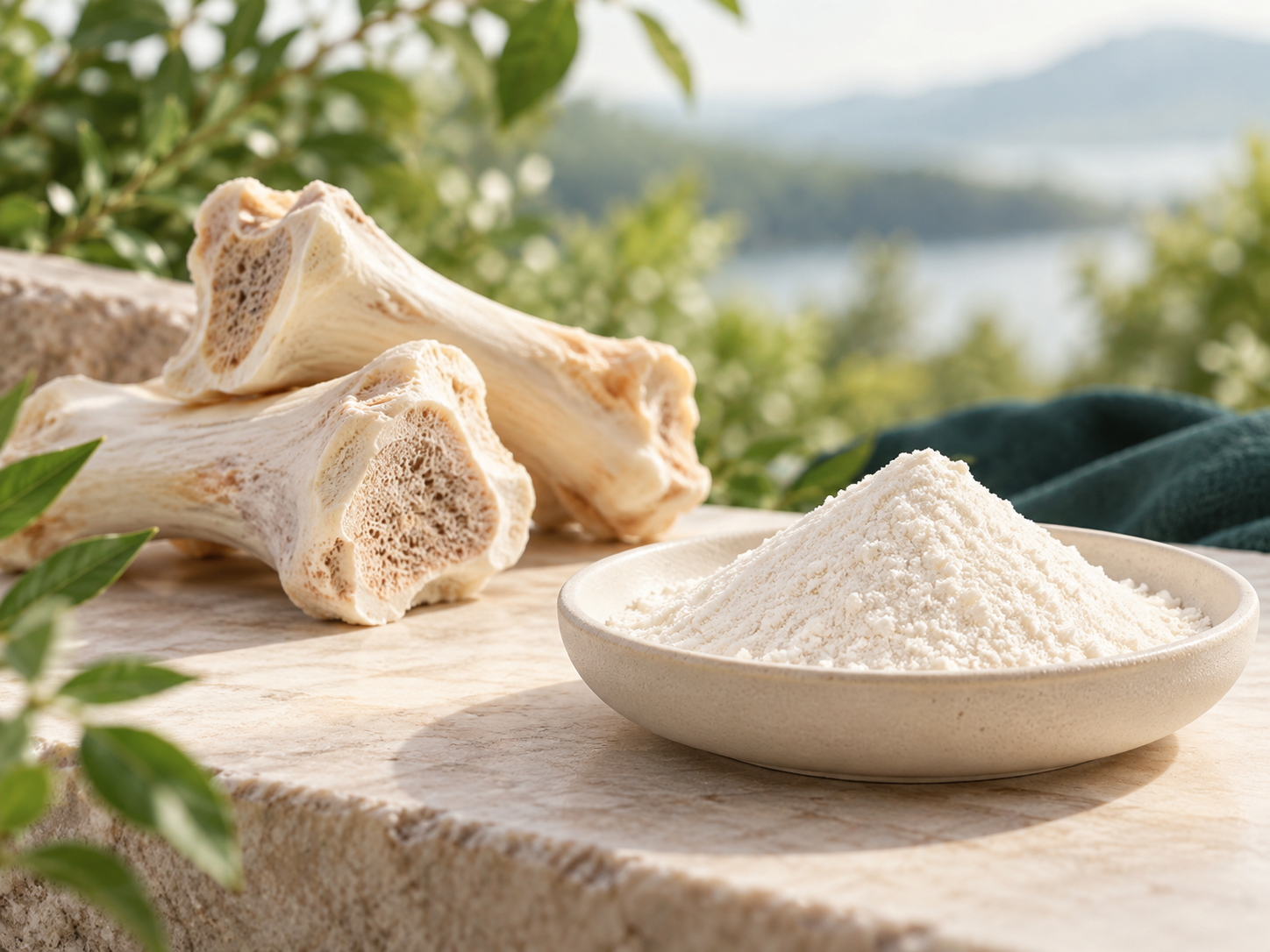
Bovine bone-derived Chondroitin Sulfate Sodium, manufactured through cooking, enzymatic hydrolysis, separation, purification, alcohol precipitation, drying, and milling. Assay is ≥95.0% on a dry basis; supplied in 25 kg drums.
| Source | Bovine bone |
|---|---|
| Assay | ≥95.0%, dry basis |
| Appearance | White to off-white powder |
| Particle size | 100% passes through an 80-mesh sieve |
| Packaging | 25 kg/drum |
Ureda Naturals manufactures bovine bone-derived Chondroitin Sulfate Sodium through cooking, enzymatic hydrolysis, separation, purification, alcohol precipitation, drying, and milling. With an assay of ≥95.0% on a dry basis, it is used in the development of capsules, tablets, granules, powdered beverages, and other nutrition products formulated for their target markets.
Chondroitin Sulfate Sodium is a sulfated acidic polysaccharide with a characteristic molecular-chain distribution and sulfation structure. For procurement, quality, and formulation teams, checking whether the assay reaches 95% is not enough to establish equivalence between suppliers.
Raw-material source, identity, nitrogen content, specific rotation, inorganic ion profile, moisture, residual solvents, and powder properties can all affect batch consistency and downstream blending, granulation, tableting, filling, and dissolution.
| Item | Product Information |
|---|---|
| Product name | Chondroitin Sulfate Sodium |
| Source | Bovine bone |
| Form | White to off-white powder |
| Assay | ≥95.0%, dry basis |
| pH | 6.0–7.0 |
| Particle size | 100% passes through an 80-mesh sieve |
| Packaging | 25 kg/drum |
| Storage | Store sealed in a cool, dry place |
| Shelf life | 2 years |
| Applications | Capsules, tablets, granules, powdered beverages, and other nutrition products |
| Test Item | Specification | Result |
|---|---|---|
| Appearance | White to off-white powder | Pass |
| Identification — liquid chromatography | Retention time corresponds to the reference standard | Pass |
| Identification — infrared absorption | IR spectrum corresponds to the reference spectrum | Pass |
| Identification — sodium reaction | Positive for sodium | Pass |
| Specific rotation | −20° to −30° | −28.4° |
| Nitrogen, dry basis | 2.5%–3.5% | 3.4% |
| pH | 6.0–7.0 | 6.3 |
| Chloride | ≤0.5% | Pass |
| Sulfate | ≤0.24% | Pass |
| Loss on drying | ≤10.0% | 9.55% |
| Residue on ignition | 20.0%–30.0% | 25.90% |
| Residual solvents | ≤0.5% | 0.19% |
| Particle size | 100% passes through an 80-mesh sieve | Pass |
| Lead | ≤0.5 mg/kg | <0.04 mg/kg |
| Total arsenic | ≤0.1 mg/kg | <0.04 mg/kg |
| Total mercury | ≤0.1 mg/kg | <0.01 mg/kg |
| Total bacterial count | ≤1,000 CFU/g | Pass |
| Yeast and mold | ≤100 CFU/g | Pass |
| Escherichia coli | Not detected | Not detected |
| Salmonella | Not detected | Not detected |
| Staphylococcus aureus | Not detected in 25 g | Not detected |
| Assay, dry basis | ≥95.0% | 96.80% |
Chondroitin Sulfate Sodium is a structurally complex polysaccharide. A white powder, water solubility, or a single assay result cannot independently confirm product identity.
Three complementary identification tests are used:
Together, these tests assess chromatographic response, structural characteristics, and salt form. Combined with specific rotation, nitrogen content, and assay, they provide a more complete quality assessment than assay alone.
When qualifying a new source or changing suppliers, compare the full identification profile and key physicochemical results rather than repeating only the assay.
The test results are 96.80% assay on a dry basis, 3.4% nitrogen on a dry basis, and a specific rotation of −28.4°.
Assay measures the target component under the specified test conditions; nitrogen content helps assess composition; and specific rotation describes an optical characteristic. A passing result for one item does not replace the others. If assay meets specification but nitrogen content or specific rotation drifts across consecutive batches, investigate whether any of the following have changed:
Quality review should consider whether key results remain consistent across batches, not just whether assay exceeds 95%.
The assay is calculated on a dry basis, which reduces the direct effect of moisture or other volatile components when comparing results. Production teams, however, weigh the material as received. For formulations that require precise control of the amount added, align the following:
Using a fixed charge weight without accounting for batch-to-batch moisture and dry-basis assay variation can create differences in the actual amount added to the finished product.
The specification for residue on ignition is 20.0%–30.0%, and the result is 25.90%.
This value is higher than that of many protein powders or botanical extracts, but it does not, by itself, indicate excessive extraneous inorganic material. Chondroitin Sulfate Sodium is a sodium salt of a sulfated polysaccharide and leaves inorganic residue after ignition.
Interpret the result by checking whether it falls within the product specification, whether it is consistent across batches, and whether it aligns with assay, chloride, and sulfate results. A direct comparison with collagen peptides or botanical extracts is not technically meaningful.
Chloride and free sulfate can be influenced by raw-material processing, pH adjustment, separation, purification, and process aids. The specifications are chloride ≤0.5% and sulfate ≤0.24%.
The sulfate test in the specification is not the same as sulfate groups bound within the Chondroitin Sulfate Sodium molecule. The former controls free sulfate and related components measured under the specified test conditions; the latter is part of the target molecular structure.
When suppliers report materially different chloride, sulfate, or residue-on-ignition results, products with the same nominal assay may still have different compositions and may behave differently in a blend.
The loss-on-drying result is 9.55%, within the specification of ≤10.0%. Moisture can also affect powder flow, caking tendency, automatic feeding, dry matter per unit weight, and the material’s condition after opening.
A compliant result does not eliminate the need to manage exposure during production. In humid conditions, prolonged exposure can lead to additional moisture uptake, bridging, adhesion, reduced flow, or weighing variation. Reseal opened material promptly and minimize exposure time.
The composition and storage condition of bovine raw material influence the load of proteins, fats, minerals, and other non-target components entering the extraction process. Receiving and preparation controls should cover source and batch traceability, transport and storage condition, cleaning and pretreatment consistency, residual fat or non-target tissue, and variation among raw-material batches.
When pretreatment is inconsistent, downstream hydrolysis, filtration, purification, and alcohol precipitation must handle a greater or less predictable impurity load.
Cooking softens the raw-material matrix and promotes target-component release, preparing the material for enzymatic hydrolysis and solid–liquid separation.
Insufficient treatment may limit release. Excessive temperature or holding time can increase the extraction of non-target components and place unnecessary stress on the polysaccharide chain. The process must balance extraction efficiency, impurity load, and structural integrity rather than maximizing extraction yield alone.
The target polysaccharide is present within a protein-containing raw-material matrix. Enzymatic hydrolysis breaks down the protein matrix, supports Chondroitin Sulfate Sodium release, and can reduce the purification load.
Hydrolysis performance depends on enzyme activity and dosage, temperature, pH, solid-to-liquid ratio, and reaction time. Insufficient hydrolysis may leave more protein-related impurities, affecting nitrogen content, color, and purification efficiency. Excessive reaction may increase small-molecule degradation products and the burden on subsequent separation.
The hydrolysis mixture may contain insoluble material, protein breakdown products, pigments, inorganic salts, and other water-soluble components. Separation and purification affect appearance, final assay, nitrogen, chloride, free sulfate, residue on ignition, and batch consistency.
If extraction yield is prioritized without sufficient separation capacity, the finished material may show lower assay, darker color, fluctuating inorganic components, or increased filtration load.
Alcohol precipitation uses differences in solubility within a specified solvent system to separate Chondroitin Sulfate Sodium from some impurities. Results can be affected by solvent concentration, addition rate, system temperature, agitation, settling time, precipitation endpoint, and solid–liquid separation efficiency.
Changes in precipitation conditions can affect yield, purity, and powder properties. After precipitation, drying must also control residual solvents. The residual-solvent result is 0.19%, within the specification of ≤0.5%.
Drying must reduce both moisture and residual solvent. Insufficient drying can increase caking and stability risks, while excessive process intensity may affect color and physical condition.
The dried material is milled and sieved to meet the requirement that 100% passes through an 80-mesh sieve. Sieve passage does not fully describe particle-size distribution, bulk density, tapped density, flow, or compressibility. These powder properties should be assessed against the customer’s dosage form and equipment.
| Process Stage | Main Control Risk | Potentially Affected Attribute or Performance |
|---|---|---|
| Raw-material receiving | Source variation, impurity load, or storage condition | Identity, assay, color, and batch consistency |
| Pretreatment and cooking | Insufficient treatment or excessive process intensity | Extraction efficiency, impurity release, and chain integrity |
| Enzymatic hydrolysis | Incomplete protein removal or excessive reaction | Nitrogen, assay, color, and purification load |
| Separation and purification | Insufficient removal of non-target components | Assay, chloride, sulfate, and residue on ignition |
| Alcohol precipitation | Unstable concentration, temperature, or endpoint | Yield, purity, residual solvents, and powder properties |
| Drying | Insufficient moisture or solvent removal | Loss on drying, residual solvents, and caking tendency |
| Milling and sieving | Unstable particle-size control | Blend uniformity, flow, and filling consistency |
| Packaging and storage | Moisture exposure, package damage, or cross-contamination | Loss on drying, microbiological quality, and powder flow |
Capsule-fill consistency depends not only on particle size but also on bulk density, flow, moisture sensitivity, and differences in particle size and density between Chondroitin Sulfate Sodium and other ingredients.
When a formula also contains glucosamine salts, minerals, or botanical extracts, the blend may segregate in the hopper, during transfer, or during filling. Before scale-up, check capsule fill against capsule volume, fill variation during continuous operation, hopper bridging, segregation after vibration or transfer, and whether recycled material changes the particle-size distribution.
Passing an 80-mesh sieve does not establish tableting performance. High-inclusion formulas may encounter poor flow, tablet-weight variation, sticking, inadequate hardness, or changes in disintegration.
For wet granulation, assess the material’s response to water or binder solution, the granulation endpoint, and drying load. For dry granulation, evaluate how roller pressure affects granule strength, fines, and disintegration. Even when assay specifications are unchanged, do not assume that a replacement supplier’s material will run with the same granulation and compression settings.
In compound powders, common challenges include moisture uptake, caking, segregation, and changes in reconstitution. When the formula includes collagen peptides, minerals, glucosamine salts, or hygroscopic sweeteners, evaluate particle-size and density matching, blend uniformity, moisture and caking tendency, package moisture barrier, reconstitution behavior, and appearance and odor after accelerated storage.
A uniform laboratory blend does not guarantee a uniform commercial batch. Transfer, holding, vibration, and filling can cause the blend to segregate again after scale-up.
During wet granulation, water uptake and tackiness can affect the wet-mass endpoint, granule strength, and drying time. Adding liquid too quickly may form localized hard agglomerates, while inadequate drying can increase moisture rebound and caking during storage.
For dry granulation, balance roller pressure, granule strength, fines, and subsequent dispersion or dissolution performance.
Chondroitin Sulfate Sodium is a negatively charged polysaccharide. In systems containing minerals, proteins, other macromolecules, or high ionic strength, interactions between components may affect the finished system.
Evaluate the actual formula for order of addition, final pH, solution clarity, viscosity change, centrifugation stability, hot–cold cycling, and flocculation or sediment during storage. Dissolution of the raw material in water alone does not establish long-term performance in every multi-ingredient liquid system.
As a Chondroitin Sulfate Sodium manufacturer, Ureda Naturals controls more than final assay. The manufacturing controls focus on the process conditions that shape assay and batch consistency:
The aim is to reduce the effect of raw-material and process variation on customer formulation and commercial manufacturing—not simply to bring an individual batch to the specification limit.
25 kg/drum
Store sealed in a cool, dry place. After opening, minimize exposure time and reseal unused material promptly to reduce moisture uptake, caking, and cross-contamination.
In humid environments or during extended production runs, monitor powder flow, hopper bridging, and fill-weight variation.
2 years
Not on assay alone. First compare raw-material source, specification basis, and the complete identification profile. Then review nitrogen, specific rotation, loss on drying, residue on ignition, chloride, sulfate, residual solvents, and particle size.
For capsules, tablets, and powder blends, also compare bulk density, flow, moisture sensitivity, and blending behavior. Complete a raw-material comparison, bench evaluation, and scale-up check under the intended equipment conditions before making a supplier change.
Assay answers how much is measured under the specified test conditions; it does not, by itself, confirm the full identity and composition profile. Liquid-chromatography retention time, infrared absorption, and the sodium reaction assess product identity, while nitrogen content and specific rotation provide additional composition and characteristic-property information.
When assay passes but other characteristic results shift from historical batches, investigate changes in raw material, hydrolysis, purification, or alcohol precipitation.
Chondroitin Sulfate Sodium contains sodium and sulfate-related structural components that contribute to inorganic residue after ignition. Assess the result against the product specification and alongside assay, chloride, sulfate, nitrogen, and consecutive-batch trends.
The value should not be judged by a simple “lower is better” rule or compared directly with protein powders and botanical extracts.
Sieve passage describes whether particles pass through a specified opening; it does not fully describe particle-size distribution, shape, density, or flow. Ingredients can still differ substantially in particle size and density, and a blend may segregate during transfer, vibration, holding, or filling.
Check samples from different mixer locations, the beginning, middle, and end of discharge, and finished filled units. Do not rely on a single sample taken immediately after mixing.
Commercial equipment differs from laboratory equipment in batch size, feeding method, speed, material residence time, and exposure to the production environment. Moisture uptake, changes in fines, flow behavior, or extended recirculation may become more significant at scale; density differences and segregation may also become more apparent during continuous transfer and filling.
Scale-up checks should cover charging, blending, transfer, holding, and filling—not only one process step.
First confirm that the incoming batch meets its identity, assay, pH, and other relevant specifications. Then prepare a single-ingredient control and add minerals, proteins, acids, or other macromolecules one at a time using the actual order of addition.
Compare the point at which turbidity appears and assess concentration, pH, temperature, and hold time. If the single-ingredient solution remains stable but changes after a specific component is added, the issue is more likely associated with formulation interactions or process conditions than with raw-material nonconformance.
A single batch COA describes the tested batch. Assess longer-term consistency by reviewing trends across consecutive batches, including assay, nitrogen, specific rotation, pH, loss on drying, residue on ignition, residual solvents, particle size, heavy metals, and microbiological results.
A result can remain within specification while moving consistently in one direction across several batches. Such a trend may warrant review of raw-material composition, hydrolysis, purification efficiency, or drying conditions before it becomes an out-of-specification result.
INGREDIENT PARTNER
Tell us your intended application, approximate quantity and target market. Ureda Naturals will confirm the closest grade, packaging configuration and available documentation for your project.

Scan the QR code or
search WeChat ID: 18270717590
From Natural Origin to Formulation Intent
Tell us what you’re sourcing.
