
 Spanish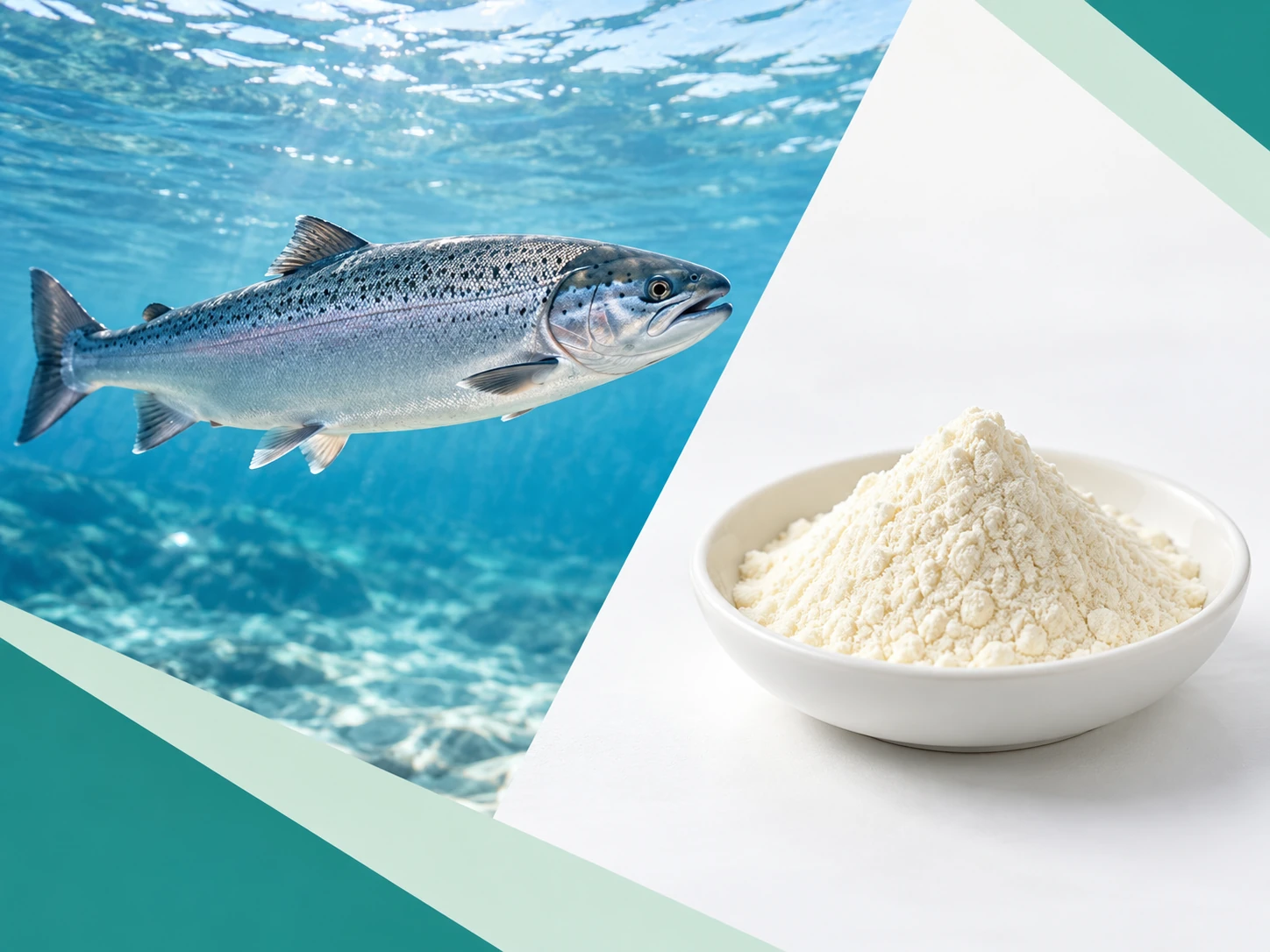
Ureda Naturals supplies salmon nasal cartilage extract powder with specification limits of ≥30% glycosaminoglycans (GAGs) and ≥30% protein on a dry basis. Designed for supplement and functional-food formulation, with fish-source declaration and bulk supply options.
| Source | Salmon nasal cartilage |
|---|---|
| Form | Powder |
| Allergen | Fish (salmon) |
| Protein | ≥30.0% on a dry basis |
| Packing | 10 kg/bag; 20 kg/bag |
Salmon nasal cartilage extract is a cartilage-derived powder with two defined composition limits: glycosaminoglycans (GAGs) at ≥30.0% and protein at ≥30.0% on a dry basis. Ureda Naturals supplies it for supplement and functional-food formulations that call for a salmon cartilage ingredient rather than a conventional fish collagen peptide.
Cartilage contains a matrix of proteins and glycosaminoglycans. The GAG specification and the dry-basis protein specification describe different parts of the ingredient’s composition; they are not interchangeable measures and should not be added together as a single “active” percentage.
GAG content is not the same as total proteoglycan content. Likewise, a total protein result does not quantify Type II collagen specifically or establish whether a collagen structure is native or undenatured. These distinctions matter when comparing this extract with purified proteoglycan, isolated chondroitin sulfate, or fish collagen peptides.
For procurement comparisons, align the source tissue, assay definition, analytical basis, and grade before comparing percentages. A matching product name alone does not establish that two materials are compositionally equivalent.
| Test item | Specification |
|---|---|
| Appearance | Powder; no visible clumps |
| Color | White to light yellow |
| Visible foreign matter | None visible |
| Protein, dry basis | ≥30.0% |
| Glycosaminoglycans (GAGs) | ≥30.0% |
| Loss on drying | ≤7.0% |
| Ash | ≤7.0% |
| Total arsenic | ≤0.9 mg/kg |
| Lead | ≤1.0 mg/kg |
| Cadmium | ≤0.1 mg/kg |
| Total mercury | ≤0.1 mg/kg |
| Chromium | ≤2.0 mg/kg |
| Total plate count | ≤1,000 CFU/g |
| Coliforms | ≤0.3 MPN/g |
| Yeast and mold | ≤25 CFU/g |
| Staphylococcus aureus | Not detected |
| Salmonella | Not detected |
When a formula is designed around a target GAG contribution, calculate the ingredient charge from the measured GAG result for the supplied lot and use the same analytical basis throughout: ingredient mass = target GAG mass ÷ measured GAG fraction. The ≥30.0% specification is an acceptance limit, not a replacement for the lot’s measured value.
Total protein can include multiple protein fractions in a cartilage-derived ingredient. If a finished-product formula, label, or technical brief requires a specific Type II collagen amount or an undenatured-structure claim, that requirement needs a corresponding product specification and analytical evidence; the total-protein limit alone cannot establish it.
For dry dosage forms, the GAG assay informs composition calculations, while powder handling determines whether the target amount can be distributed consistently through a production blend. During a pilot, check the actual blend at the intended loading and mixing sequence, then assess blend uniformity, flow, capsule fill-weight variation, or tablet compression and disintegration as applicable. If the ingredient is used at a low inclusion rate, a controlled premix can help distribute it before the full batch blend.
The loss-on-drying limit helps define incoming moisture acceptance, but it does not by itself predict flow or storage behavior in a finished blend. Keep the powder sealed during handling and evaluate the complete premix under the humidity and packaging conditions planned for production.
Do not assume that a cartilage extract will form a clear, stable solution simply because it can be incorporated into a water-based formula. First compare a water-only dispersion with the complete formulation at the intended concentration. Then add the other ingredients in the planned order and include the real heat treatment and hold time.
This comparison helps distinguish incomplete wetting or dispersion from changes introduced by the finished matrix, such as its acidity, mineral salts, proteins, or other suspended ingredients. Record visible haze, sediment, redispersibility, and appearance after processing and during the intended hold period. The result determines whether the ingredient fits the target format or whether the formula and process need adjustment.
Heat, pH, and processing time can affect protein-containing ingredients. If a product concept depends on a defined collagen structure, assess that structure with an appropriate product-specific method before and after the actual process. GAG and total-protein values alone do not establish that a native or undenatured structure is retained.
Salmon nasal cartilage extract can be evaluated for dietary supplements and functional foods, including capsule, tablet, sachet, and powder-beverage concepts. Its suitability depends on the target GAG contribution, dosage form, sensory profile, process conditions, and finished-product specification. It is a source-specific ingredient, not a direct substitute for every fish collagen peptide or isolated chondroitin sulfate.
No. Fish collagen peptides are hydrolyzed collagen ingredients, while this product is a salmon cartilage extract specified by GAG content and dry-basis protein. The source tissue, composition markers, and formulation role are different, so compare the relevant assay and intended function rather than treating the names as interchangeable.
No. GAGs are carbohydrate chains associated with proteoglycans, but a GAG result is not a direct measurement of the complete proteoglycan molecule. Use the GAG specification for GAG-based calculations; a proteoglycan claim requires a separately defined assay and specification.
No. The protein limit measures total protein on a dry basis, not a specific collagen type. It also does not establish whether Type II collagen is native or undenatured. Those claims require a dedicated product specification and suitable analytical evidence.
Use the measured GAG result for the lot and keep the calculation on the same analytical basis: ingredient mass = target GAG mass ÷ measured GAG fraction. Do not calculate from the minimum specification when a lot-specific result is available.
It can be evaluated for beverage development, but clarity and stability should be confirmed in the actual formula. Compare a water-only dispersion with the complete matrix, then assess appearance, sediment, and redispersibility after the intended heat treatment and hold period. A water test alone does not predict finished-beverage performance.
Confirm the GAG-based charge calculation, then test the powder in the intended blend and equipment. Check blend uniformity and flow; for capsules, monitor fill-weight variation, and for tablets, assess compression and disintegration in the complete formula.
INGREDIENT PARTNER
Tell us your intended application, approximate quantity and target market. Ureda Naturals will confirm the closest grade, packaging configuration and available documentation for your project.

Scan the QR code or
search WeChat ID: 18270717590
From Natural Origin to Formulation Intent
Tell us what you’re sourcing.
