
 Spanish
Spanish
Spanish
Phosphatidylserine is an anionic phospholipid used in dietary supplements, functional foods, beverages and specialized nutrition products. It is commonly produced from soy or sunflower lecithin through enzymatic conversion and supplied in powder, water-soluble and liquid forms.
Ureda Naturals manufactures soy- and sunflower-derived phosphatidylserine with assay options of 10%, 20%, 50%, 60%, 70% and 80%. Customized specifications are available for capsules, tablets, powdered nutrition products, beverages, oral liquids and softgels.
The appropriate specification depends on the finished dosage form. Assay determines the required ingredient weight, while source, phospholipid composition, carrier system and physical form influence blending, compression, dispersion, filling and oxidative stability.
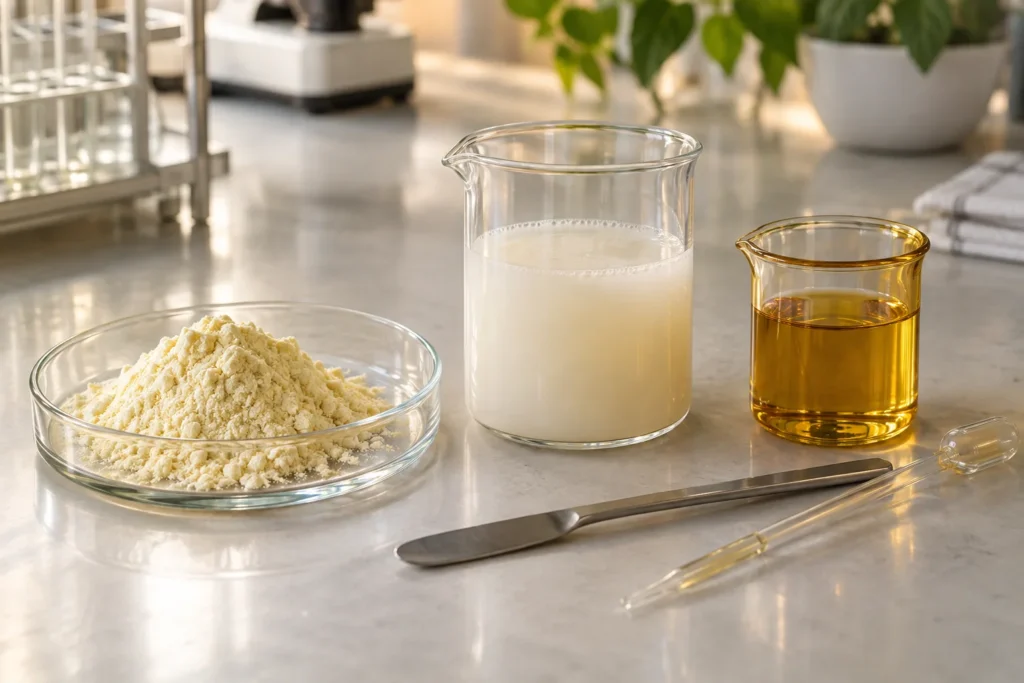
Phosphatidylserine 50%, 70% and 80% powders reduce the amount of raw material required per serving. They are particularly useful for small capsules and multi-ingredient formulas in which space must be reserved for vitamins, minerals, botanical extracts or other active ingredients.
Phosphatidylserine 20% powder can be considered when dosage-form space is less restrictive or when the formulation benefits from a larger powder contribution.
Before scale-up, evaluate:
The selected grade must deliver both the required phosphatidylserine content and acceptable performance on the intended capsule-filling or tableting equipment.
Powder grades can be incorporated into dry beverage mixes and powdered nutrition products. Development should assess both dry-blend uniformity and performance after reconstitution.
Key observations include wetting time, lump formation, sedimentation, surface oil and uniformity during consumption. Standard powder may be suitable when the product is mainly handled as a dry blend. A water-soluble grade is generally more appropriate when dispersion after reconstitution is critical.
Water-soluble phosphatidylserine is intended for water-based systems such as functional beverages, oral liquids and liquid milk.
Its suitability depends on the complete formulation, including pH, minerals, proteins, hydrocolloids, heat treatment and storage conditions. Dispersion in room-temperature water alone does not predict stability in a finished beverage.
Liquid phosphatidylserine is designed for softgels and other oil-based delivery systems. An MCT carrier can improve flow and simplify transfer and filling, but the carrier ratio also affects phosphatidylserine concentration and required capsule fill weight.
Development should evaluate viscosity, filling temperature, phase stability, shell compatibility and oxidation control under the intended production and storage conditions.
The assay determines the theoretical amount of ingredient required to deliver the target phosphatidylserine dose.
For a finished product designed to provide 100 mg of phosphatidylserine per serving:
| Phosphatidylserine Assay | Theoretical Ingredient weight |
|---|---|
| 20% | 500 mg |
| 50% | 200 mg |
| 70% | Approximately 143 mg |
| 80% | 125 mg |
This difference affects capsule size, capsule count, tablet weight, excipient space and room for additional active ingredients.
Higher assay is most valuable when dosage-form capacity is limited. Where capacity is less restrictive, the final choice should also consider powder handling, formulation cost and manufacturing performance.
Both soy- and sunflower-derived phosphatidylserine can be used in dietary supplements and functional foods. The choice influences source declaration, allergen control, phospholipid composition and product positioning.
Soy-derived phosphatidylserine has an established supply chain and is widely used in capsules, tablets, powders and liquid formulations. Product qualification should include source, GMO and allergen documentation required for the destination market.
Sunflower-derived phosphatidylserine supports formulations positioned without soy ingredients. Replacing a soy grade with a sunflower grade requires more than matching the declared assay.
The replacement grade should be compared for:
Products with the same phosphatidylserine assay may still behave differently during manufacturing.
The following specification limits and batch results summarize the principal controls for phosphatidylserine 50% and 70% powder grades.
| Test Item | 50% Specification | 50% Batch Result | 70% Specification | 70% Batch Result |
|---|---|---|---|---|
| Phosphatidylserine assay | ≥50.0% | 52.8% | ≥70.0% | 71.4% |
| Water | ≤2.0% | 0.699% | ≤2.0% | 0.61% |
| Peroxide value | ≤5.0 meq/kg | 0 | ≤5.0 meq/kg | 0 |
| Acetone-insoluble matter | ≥95.0% | 98.5% | ≥95.0% | 98.5% |
| n-Hexane | ≤25 mg/kg | Not detected | ≤25 mg/kg | Not detected |
| Total plate count | ≤1,000 CFU/g | 270 CFU/g | ≤1,000 CFU/g | 30 CFU/g |
| Yeast and mold | ≤100 CFU/g | <10 CFU/g | ≤100 CFU/g | <10 CFU/g |
| Coliforms | ≤10 CFU/g | <10 CFU/g | ≤10 CFU/g | <10 CFU/g |
| Salmonella | Absent | Not detected | Absent | Not detected |
| Staphylococcus aureus | Absent | Not detected | Absent | Not detected |
| Lead | ≤1.0 mg/kg | Not detected | ≤1.0 mg/kg | Not detected |
| Arsenic | ≤0.4 mg/kg | Not detected | ≤0.4 mg/kg | 0.0106 mg/kg |
| Mercury | ≤0.1 mg/kg | Not detected | ≤0.1 mg/kg | Not detected |
| Cadmium | ≤0.1 mg/kg | Not detected | ≤0.1 mg/kg | Not detected |
Assay establishes the quantity required in the finished formula. Water and peroxide value help assess handling and oxidation control, while microbiological, residual-solvent and heavy-metal results support batch release and raw-material qualification.
Liquid phosphatidylserine requires controls suited to an oil-based system.
| Test Item | Specification | Batch Result |
|---|---|---|
| Phosphatidylserine assay | 20% grade | 21.7% |
| Water | ≤2.0% | 0.178% |
| Peroxide value | ≤5.0 mmol/kg | 0.94 mmol/kg |
| Acid value | ≤36 mg KOH/g | 16 mg KOH/g |
| Total plate count | ≤1,000 CFU/g | <10 CFU/g |
| Yeast and mold | ≤100 CFU/g | <10 CFU/g |
| Coliforms | ≤10 CFU/g | <10 CFU/g |
| Salmonella | Absent | Not detected |
| Staphylococcus aureus | Absent | Not detected |
In addition to release parameters, softgel development should examine viscosity, carrier composition, filling temperature and phase stability.
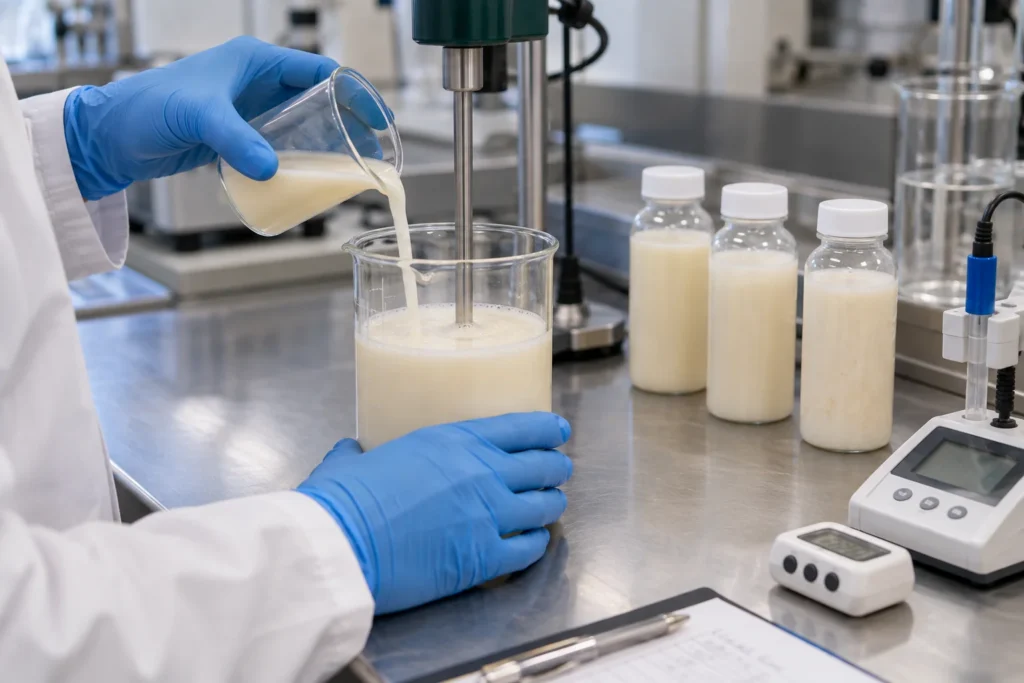
A water-soluble phosphatidylserine grade must remain acceptably dispersed through mixing, heat treatment, filling and storage. Initial dispersion does not by itself demonstrate finished-product stability.
Calculate the required ingredient quantity from the target phosphatidylserine content and selected assay. Increasing the addition level may affect viscosity, flavor, appearance and physical stability.
Evaluation should use the complete beverage formula because acids, salts, minerals, proteins, sugars and hydrocolloids can alter dispersion behavior.
Monitor:
Prepare a controlled pre-dispersion before adding phosphatidylserine to a highly acidic, mineral-rich or protein-rich phase. This reduces local concentration gradients and agglomeration.
Homogenization pressure, number of passes, temperature, holding time and cooling rate should be evaluated as one processing sequence. Shelf-life testing should use the intended formula, packaging and storage conditions.
Liquid phosphatidylserine simplifies incorporation into an oil-based softgel fill, but its processing window must be controlled.
Increasing the MCT carrier ratio can improve flow but lowers the phosphatidylserine delivered per gram of fill. The formulation must balance target dose, capsule capacity, viscosity and filling performance.
Insufficient temperature can increase viscosity and cause transfer or fill-weight variation. Excessive heat increases oxidative exposure. The selected temperature should provide stable flow with the shortest practical thermal hold.
Observe the fill for sedimentation, separation, crystallization and concentration changes during holding and after production interruptions.
Compatibility testing should use the intended gelatin or plant-based shell and evaluate sealing, shell hardness and storage stability. Oxygen exposure during raw-material storage, heating, transfer, filling and final packaging should be controlled as a continuous process.
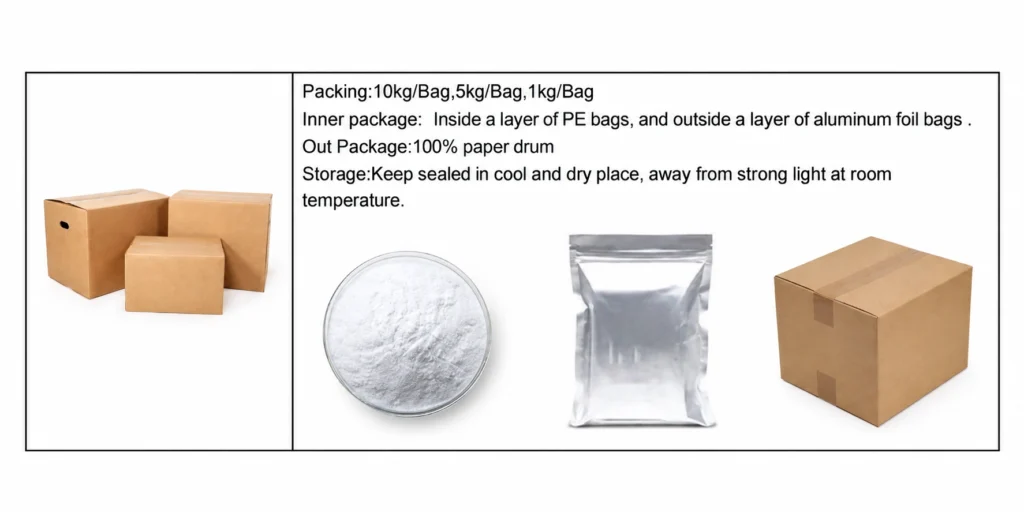
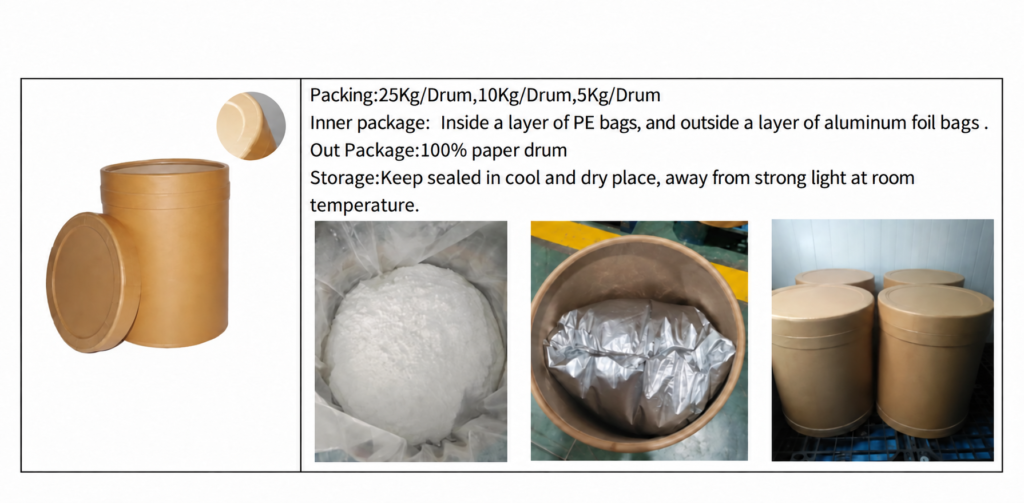
| Item | Available Configuration |
|---|---|
| MOQ | 1 kg |
| Bag Packing | 1 kg, 5 kg or 10 kg per bag |
| Drum Packing | 5 kg, 10 kg or 25 kg per paper drum |
| Inner Package | One inner PE bag with one outer aluminum-foil bag |
| Outer Package | Paper drum for drum packing; carton for bag packing |
| Storage | Keep sealed in a cool, dry place away from strong light at room temperature |
| Documentation category | Available documentation |
|---|---|
| Quality and manufacturing systems | GMP, FSSC 22000, ISO 9001 and HACCP |
| Religious certifications | Halal and Kosher |
| Product documents | COA, TDS and SDS |
| Source documentation | GMO and allergen documentation |
| United States regulatory support | FDA , GRAS |
Assay measures phosphatidylserine concentration but does not describe the complete physical structure of the powder. Source, carrier composition, particle-size distribution, moisture, density and drying process can influence flow, segregation, die filling and compression.
When changing suppliers or grades, compare manufacturing performance in addition to assay and price.
Homogenization can reduce the size of dispersed particles or droplets, but it cannot correct inadequate wetting or interfacial stability. A standard powder may appear dispersed immediately after mixing and later produce sediment, surface oil or flocculation.
Beverage development must evaluate the ingredient together with the acids, minerals, proteins, hydrocolloids, heat process and intended storage period.
An MCT carrier can reduce viscosity and improve transfer and filling. Increasing the carrier proportion, however, reduces the amount of phosphatidylserine delivered per gram and may require a larger capsule fill.
Carrier ratio should therefore be selected together with the target dose, capsule capacity, filling temperature and required phase stability.
Compare powder flow, density, color, odor, phospholipid composition and oxidative stability. Capsules and tablets should be checked for blend uniformity, fill-weight consistency and compression behavior.
For beverage and liquid products, repeat dispersion, heat-treatment and storage-stability testing. Source, GMO and allergen declarations must also be updated.
INGREDIENT PARTNER
Tell us your intended application, approximate quantity and target market. Ureda Naturals will confirm the closest grade, packaging configuration and available documentation for your project.

