
 Spanish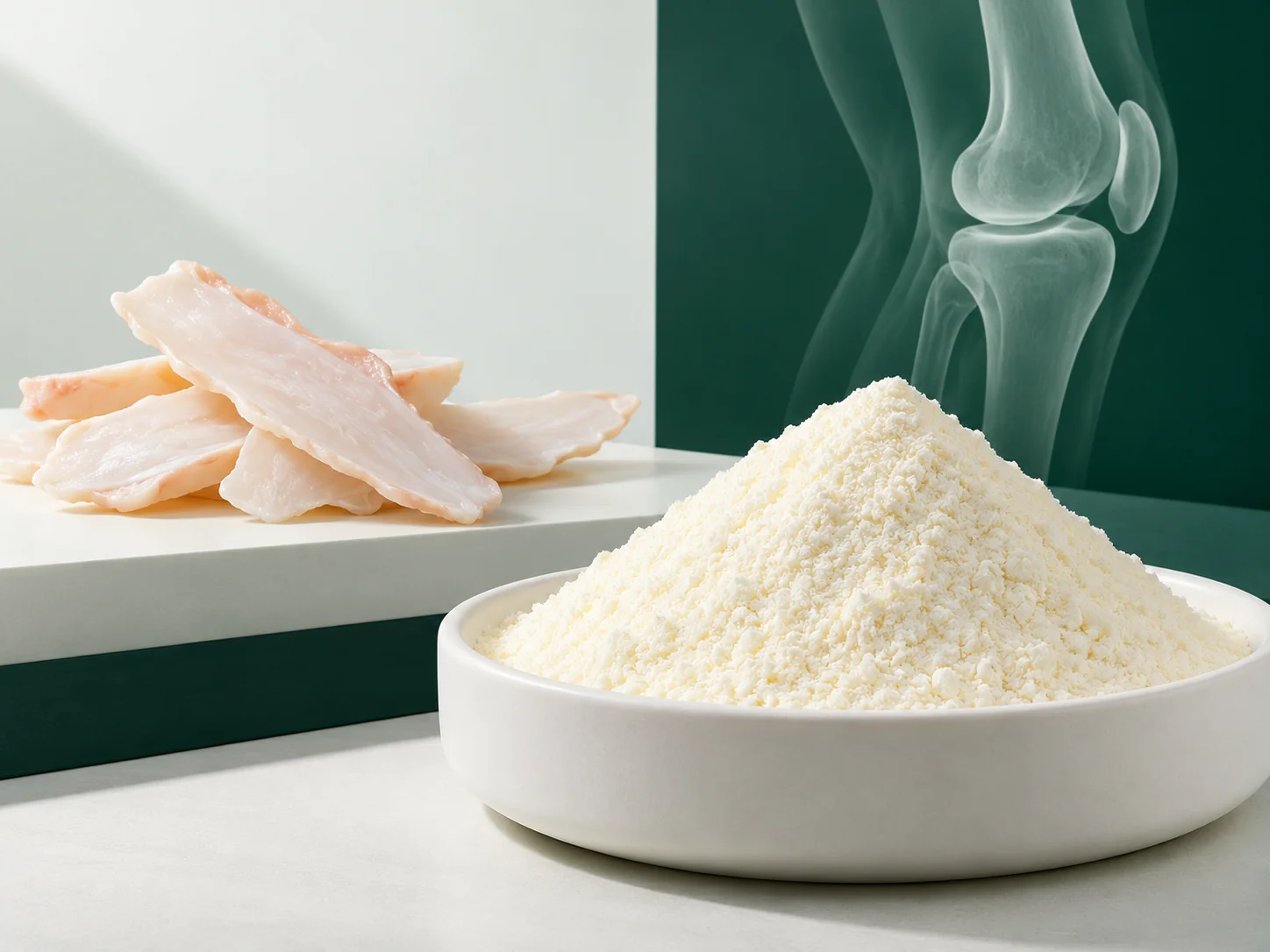
Ureda Naturals manufactures water-soluble Low Molecular Weight Type II Collagen from chicken sternal cartilage through controlled hydrolysis, decolorization, nanofiltration, concentration and spray drying. The powder combines not less than 55% protein, 20% acid mucopolysaccharides and 4.5% hydroxyproline for joint nutrition capsules, tablets, granules and powdered beverages.
| Source | Chicken Sternal Cartilage |
|---|---|
| Type | Hydrolyzed Type II Collagen |
| Protein | ≥55.0% on Dry Basis |
| Acid Mucopolysaccharides | ≥20.0% |
| Hydroxyproline | ≥4.5% on Dry Basis |
| Packaging | 15 kg/drum |
Unlike conventional collagen peptides controlled mainly by total protein, this hydrolyzed Type II Collagen is specified for protein, acid mucopolysaccharides and hydroxyproline. This three-part composition profile helps buyers distinguish a chicken cartilage matrix from ordinary fish or bovine collagen peptides.
| Item | Product Information |
|---|---|
| Product Name | Low Molecular Weight Type II Collagen |
| Raw Material | Chicken sternal cartilage |
| Product Type | Hydrolyzed Low Molecular Weight Type II Collagen |
| Appearance | White to light yellow powder |
| Protein | ≥55.0% on dry basis |
| Acid Mucopolysaccharides | ≥20.0% |
| Hydroxyproline | ≥4.5% on dry basis |
| Characteristic Low-Molecular-Weight Fraction | Acid mucopolysaccharide fraction below 8,000 Da |
| Particle Size | 100% through 40 mesh |
| Bulk Density | ≥0.18 g/mL |
| Packaging | 15 kg/drum |
| Storage | Keep sealed in a cool, dry place |
| Shelf Life | 2 years |
Low Molecular Weight Type II Collagen is designed for formulations that require a hydrolyzed, water-soluble chicken cartilage ingredient rather than a conventional Type I collagen peptide or an undenatured Type II Collagen.
This product should not be substituted on an equal-weight basis for undenatured Type II Collagen. Undenatured grades are designed around preservation of the native triple-helical conformation and require a different identity test, specification and formulation strategy.
A separate component-specific specification is also required when a finished product needs to declare an exact amount of chondroitin sulfate or hyaluronic acid. Total acid mucopolysaccharides cannot be used as a direct substitute for either individual assay.
Conventional fish and bovine collagen peptides are commonly evaluated through total protein, hydroxyproline and peptide molecular weight. Low Molecular Weight Type II Collagen originates from chicken sternal cartilage and also contains cartilage-derived acid mucopolysaccharides.
Its composition is therefore evaluated through three connected parameters:
Reviewing these parameters together gives buyers a more meaningful composition profile than protein alone. A high-protein collagen peptide without a defined acid mucopolysaccharide specification is not automatically equivalent to a hydrolyzed chicken cartilage matrix.
| Comparison | Low Molecular Weight Type II Collagen | Undenatured Type II Collagen |
|---|---|---|
| Ingredient Type | Hydrolyzed chicken cartilage matrix | Type II Collagen with a preserved native conformation |
| Processing Objective | Reduce molecular size and obtain a water-soluble powder | Maintain the native triple-helical structure and associated conformation |
| Primary Quality Focus | Protein, acid mucopolysaccharides, hydroxyproline, molecular-weight definition and powder properties | Undenatured Type II Collagen content and conformation-specific identity |
| Formulation Approach | Used as a hydrolyzed cartilage-derived ingredient | Used according to its structure-specific specification and formulation target |
| Equal-Weight Substitution | No | No |
A purchasing specification that states only “Type II Collagen” may result in technically different ingredients being compared as though they were interchangeable. The specification should identify the hydrolyzed or undenatured form, animal source, composition requirements, molecular-weight definition and intended dosage form.
The protein specification is ≥55.0% on a dry basis, with a batch result of 70.4%. Protein indicates the overall level of protein and peptide material, but it does not independently define a chicken cartilage matrix. It should be interpreted together with hydroxyproline and acid mucopolysaccharides.
The acid mucopolysaccharide specification is ≥20.0%, with a batch result of 22.5%. This parameter distinguishes the cartilage-derived matrix from conventional collagen peptides that are controlled primarily by protein.
Acid mucopolysaccharides represent a broader component category. A result of 20% acid mucopolysaccharides must not be relabeled as 20% chondroitin sulfate or 20% hyaluronic acid. A component-specific assay is required when either individual compound will be declared in the finished product.
The hydroxyproline specification is ≥4.5% on a dry basis, with a batch result of 5.6%. Hydroxyproline is a characteristic amino acid associated with collagen-derived proteins. It supports composition assessment but does not replace the full identity and composition specification.
If protein remains within specification while hydroxyproline or acid mucopolysaccharides show a sustained shift from historical ranges, the raw-material ratio, hydrolysis endpoint and separation recovery should be reviewed.
The characteristic acid mucopolysaccharide fraction is controlled below 8,000 Da. This value refers to the specified fraction and should not be interpreted as meaning that every peptide, polysaccharide and soluble solid in the product is below 8,000 Da.
Before comparing molecular-weight claims from different suppliers, buyers should confirm:
Molecular weight is also not the only factor controlling dissolution. Particle size, agglomeration, spray-drying conditions, water temperature, addition rate and mixing energy all influence wetting and dissolution time.
| Test Item | Specification | Batch Result |
|---|---|---|
| Color | White or light yellow | Pass |
| Taste and Odor | Characteristic taste and odor | Pass |
| Condition | No visible extraneous matter | Pass |
| Protein, Dry Basis | ≥55.0 g/100 g | 70.4 g/100 g |
| Acid Mucopolysaccharides | ≥20.0 g/100 g | 22.5 g/100 g |
| Fat | ≤2.0 g/100 g | 0.2 g/100 g |
| Hydroxyproline, Dry Basis | ≥4.5 g/100 g | 5.6 g/100 g |
| Loss on Drying | ≤5.0 g/100 g | 4.6 g/100 g |
| Ash | ≤10.0 g/100 g | 9.5 g/100 g |
| Particle Size | 100% through 40 mesh | Pass |
| Bulk Density | ≥0.18 g/mL | 0.35 g/mL |
| Lead | ≤0.5 mg/kg | <0.5 mg/kg |
| Cadmium | ≤0.1 mg/kg | <0.1 mg/kg |
| Chromium | ≤2.0 mg/kg | <2.0 mg/kg |
| Total Arsenic | ≤0.5 mg/kg | <0.5 mg/kg |
| Total Mercury | ≤0.3 mg/kg | <0.3 mg/kg |
| Total Plate Count | ≤1,000 CFU/g | 100 CFU/g |
| Yeasts and Molds | ≤25 CFU/g | <10 CFU/g |
| Coliforms | ≤0.3 MPN/g | <0.3 MPN/g |
| Salmonella and Staphylococcus aureus | Negative | Negative |
Fat is limited to ≤2.0%, with a batch result of 0.2%. A low fat level helps reduce the potential contribution of lipid oxidation to odor changes, but finished-product sensory stability also depends on oxygen exposure, packaging barrier performance, temperature and open-bag handling.
Loss on drying is limited to ≤5.0%, with a batch result of 4.6%. Moisture affects dry-matter content, caking tendency, hopper flow and dosing consistency. Prolonged exposure in a humid production area may cause bridging, adhesion or weight variation even when the incoming material meets specification.
Ash is limited to ≤10.0%, with a batch result of 9.5%. Ash should be interpreted within the composition of a chicken cartilage-derived matrix rather than treated as a universal “lower is always better” parameter.
For mineral-rich beverages or reconstituted powders, the ionic contribution of the complete formulation should be considered because it may influence clarity, viscosity and sediment formation.
Passing a 40-mesh screen controls visibly coarse particles but does not fully describe particle-size distribution, fines, flow or compressibility. Bulk density supports initial estimates of capsule fill volume, mixer loading and segregation risk, while final equipment settings must be established using the complete formulation.
Chicken sternal cartilage contains collagen proteins, proteoglycans, acid mucopolysaccharides, fat, minerals and associated tissue. Cartilage proportion, residual tissue, fat level and storage condition affect the composition and impurity load entering hydrolysis.
Consistent raw-material sorting helps reduce variation in protein-to-mucopolysaccharide ratio, color, odor, filtration load and ash.
Hydrolysis releases cartilage-derived peptides and polysaccharide components and produces a water-soluble low-molecular-weight ingredient. Enzyme activity, dosage, pH, temperature, solid-to-liquid ratio and reaction time influence the final composition.
Insufficient hydrolysis may reduce component release and filtration performance. Excessive hydrolysis may shift molecular-weight distribution and increase the small-molecule load entering membrane separation. The endpoint is therefore assessed through component recovery, filtration behavior, molecular-weight distribution and sensory condition rather than reaction time alone.
Decolorization controls color and selected sensory compounds, while nanofiltration supports separation, purification and control of the low-molecular-weight fraction. Membrane selectivity, transmembrane pressure, temperature, feed concentration and fouling condition influence the relative recovery of proteins and acid mucopolysaccharides.
Feed solids and viscosity influence atomization and drying behavior. Spray-drying conditions affect residual moisture, color, particle distribution, bulk density, wetting and caking tendency. Stable control is required to maintain both chemical composition and downstream powder performance.
Capsule size should be selected from the loose and tapped density of the complete blend rather than the ingredient alone. Formulations containing dense minerals, glucosamine salts or fine botanical extracts should be evaluated for hopper bridging, segregation and fill-weight drift during continuous operation.
Water solubility does not guarantee direct-compression performance. The combination of peptides and acid mucopolysaccharides may develop tackiness after contact with water or binder solution.
Wet granulation should control liquid addition rate and endpoint to avoid local over-wetting and hard agglomerates. After drying, evaluate fines, granule strength, flow, tablet weight, hardness, sticking and disintegration. Direct compression and dry granulation require separate assessment of compressibility, density and lubricant sensitivity.
Reconstitution should be evaluated as four separate stages: wetting, dispersion, dissolution and standing stability.
| Observed Issue | Primary Factors to Investigate |
|---|---|
| Powder remains on the surface | Surface wetting, addition method, water temperature and mixing energy |
| Lumps or fish-eyes form | Rapid addition, locally high concentration or simultaneous addition with gums and proteins |
| Persistent turbidity | Formula pH, minerals, proteins and insoluble excipients |
| Sediment develops during standing | Ionic interactions, incomplete dispersion or formation of component complexes |
| Caking during storage | Moisture, environmental humidity, hygroscopic ingredients and packaging barrier |
Acid mucopolysaccharides are charged polymeric components. Calcium, magnesium, proteins, acidulants and other polysaccharides may alter clarity, viscosity or sedimentation through changes in pH and ionic strength.
When an instability occurs, prepare a single-ingredient control and add the remaining components one at a time in the intended manufacturing sequence. Record pH, turbidity, viscosity, flocculation and centrifuged sediment after each addition. This separates an ingredient dissolution issue from a formula interaction or process-order problem.
Confirm chicken sternal cartilage origin, hydrolyzed product identity, protein, acid mucopolysaccharides, hydroxyproline, molecular-weight definition, fat, moisture, ash, particle size, bulk density and applicable animal-origin documentation.
Compare the new sample with the approved reference under identical conditions for appearance, odor, wetting, dissolution, solution clarity, bulk and tapped density, moisture response, flow and compatibility with critical formulation components.
Verify addition, blending, transfer, holding, granulation, tableting or filling on the intended equipment. Sample the beginning, middle and end of discharge or packaging to determine whether segregation develops after mixing.
Final approval should also include finished-product content uniformity, reconstitution or disintegration, sensory condition and storage performance.
Minimize exposure after opening and reseal unused material promptly to reduce moisture uptake, caking, odor absorption and cross-contamination.
Supporting documentation can include the batch COA, TDS, SDS, animal-origin information, allergen and GMO information, and applicable quality-system documents.
No. Hydroxyproline, molecular-weight definition, fat, moisture, ash, particle distribution, bulk density and sensory characteristics may still differ. Capsules, tablets and powdered beverages should also be compared under the same formulation and equipment conditions before substitution.
Acid mucopolysaccharides represent a broader component category, while chondroitin sulfate is a specific compound within that category. The analytical targets and methods are different. A component-specific chondroitin sulfate result is required when calculating or declaring chondroitin sulfate in a finished product.
Review the sample preparation, separation system, reference standards, detector and result definition. A report that gives only one average molecular-weight number without identifying the analyzed fraction cannot establish whether the value represents Type II Collagen peptides, acid mucopolysaccharides or total soluble components.
Compare the result with multiple previous batches and review protein, acid mucopolysaccharides and raw-material records at the same time. Rising ash together with declining target components may justify investigation of cartilage proportion, raw-material preparation or membrane purification. A stable ash trend with stable composition indicates a different situation from a sudden process shift.
Commercial production adds transfer, free fall, vibration, holding and longer circulation. Differences in particle size and density can cause segregation after the blending endpoint. Scale-up sampling should cover different mixer positions, early, middle and late discharge, the holding hopper and finished packs.
First verify that the ingredient batch meets its specification and prepare a single-ingredient control solution. Add minerals, proteins, acidulants and other polymers one at a time in the actual manufacturing order. If the control remains stable and turbidity begins after a specific addition, investigate formula interaction, pH, ionic strength and addition conditions before concluding that the ingredient is nonconforming.
A sustained change in the relationship among protein, acid mucopolysaccharides and hydroxyproline may indicate a change in raw-material composition or hydrolysis recovery. Rising ash together with lower acid mucopolysaccharides may point to separation or purification changes. Simultaneous movement in moisture, bulk density and dissolution behavior is more consistent with concentration, atomization or spray-drying variation.
INGREDIENT PARTNER
Tell us your intended application, approximate quantity and target market. Ureda Naturals will confirm the closest grade, packaging configuration and available documentation for your project.

Scan the QR code or
search WeChat ID: 18270717590
From Natural Origin to Formulation Intent
Tell us what you’re sourcing.
