
 Spanish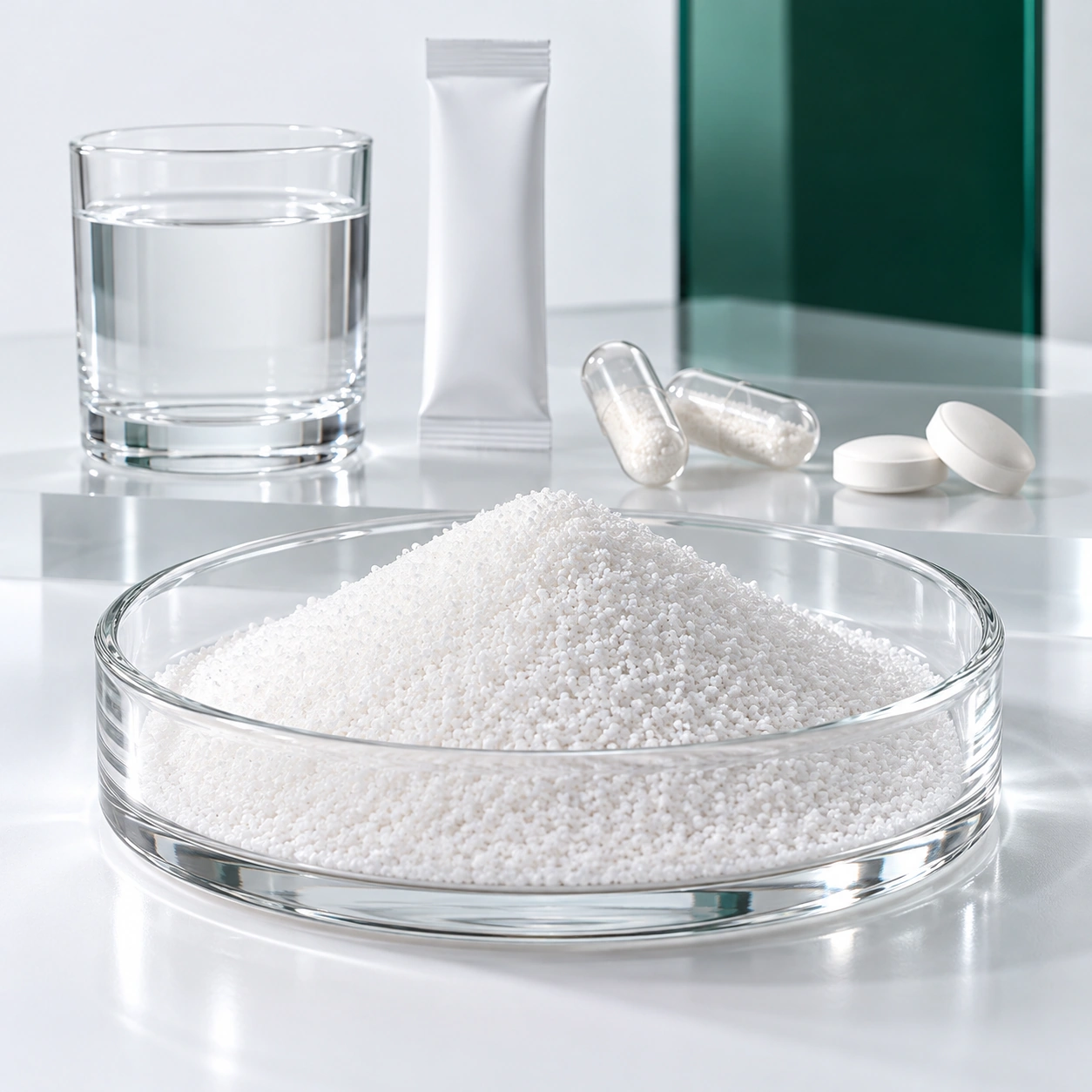
Ureda Naturals manufactures γ-Aminobutyric Acid (GABA) with an assay of not less than 99.0%. Controlled for moisture, ash, chloride, solution transmittance, pH and microbiological quality, this grade is designed for capsules, tablets, stick packs, dry blends and qualified food and beverage formulations.
| Product Name | γ-Aminobutyric Acid (GABA) |
|---|---|
| CAS NO: | 56-12-2 |
| Assay | ≥99.0% |
| Form | White particles or granules |
| MOQ | 1kg |
γ-Aminobutyric Acid, commonly abbreviated as GABA, is a non-protein amino acid used in nutritional supplements, functional foods and formulated beverages. Ureda Naturals manufactures GABA with an assay of not less than 99.0%, supported by controls for moisture, ash, chloride, solution transmittance, pH and microbiological quality.
This grade is primarily suited to capsules, tablets, stick packs and dry blends. Powdered beverages can normally be developed through routine formulation trials. Clear ready-to-drink beverages, gummies, protein systems and other thermally processed formulations require additional matrix-specific validation.
The standard COA establishes the chemical and microbiological quality of the incoming material. Particle size, bulk density, flow, incorporation time and process recovery should be added to the purchasing specification when they directly affect the selected manufacturing process.
| Product name | γ-Aminobutyric Acid (GABA) |
|---|---|
| Chemical name | 4-Aminobutanoic acid |
| CAS number | 56-12-2 |
| Molecular formula | C4H9NO2 |
| Molecular weight | 103.12 g/mol |
| Ingredient class | Non-protein amino acid |
| Commercial form | White particles or granules |
| Assay | ≥99.0% |
| Test Item | Specification |
|---|---|
| Color | White or light yellow |
| Physical form | Crystal, crystalline powder or particles |
| Odor | No odor |
| Visible foreign matter | None visible |
| Assay | ≥99.0% |
| Loss on drying | ≤1.0% |
| Ash | ≤0.1% |
| Chloride | ≤0.02% |
| Light transmittance | ≥98.0% |
| pH | 6.5–7.5 |
| Aerobic plate count | ≤1,000 CFU/g |
| Coliform bacteria | ≤10 CFU/g |
| Yeast and mold | ≤50 CFU/g |
Lot-specific values are reported on the Certificate of Analysis supplied with the corresponding shipment.
The standard grade is principally suited to capsules, tablets, stick packs, sachets, dry premixes and powdered nutritional formulations. These applications still require confirmation of particle size, density and flow when dosage-unit uniformity or high-speed filling is critical.
Powdered beverages should be checked under the intended serving and reconstitution conditions. Relevant observations include incorporation time, reconstitution appearance, sediment after standing, final pH, taste and GABA recovery during storage.
Additional development is required for clear ready-to-drink beverages, acidified beverages, gummies, chewables, protein systems, mineral-rich liquids and other thermally processed foods. In these products, acids, reducing sugars, proteins, minerals, flavors and heat treatment can alter processing behavior or finished-product performance.
The standard COA is the starting point. The final technical agreement should add the physical and functional attributes that control the customer’s manufacturing process.
| Control Category | Standard Raw-Material Control | Add for Solid Dosage Forms | Add for Liquid or Heat-Processed Products |
|---|---|---|---|
| Identity and assay | Required | Required | Required |
| Loss on drying | Required | Required | Required |
| Ash and chloride | Required | Usually sufficient | Important for clear or lightly flavored systems |
| Transmittance | Required | Secondary | Important for clear-beverage screening |
| pH | Required | Secondary | Important during formulation development |
| Particle-size distribution | Application control | Important | Relevant to incorporation rate |
| Bulk and tapped density | Application control | Important for filling and segregation | Usually secondary |
| Flowability | Application control | Important for filling and compression | Usually secondary |
| Dissolution or incorporation time | Finished-product control | Useful for reconstituted products | Important |
| Turbidity and sediment | Finished-product control | After reconstitution where relevant | Required for clear liquid systems |
| Thermal recovery | Finished-product control | Process-dependent | Required when heating is used |
| Color development | Finished-product control | Process-dependent | Important in heated sugar systems |
These additional parameters do not replace the standard COA. They convert the general GABA grade into an application-specific purchasing specification.
| Raw-Material Property | Manufacturing Step | Possible Process or Product Effect | Recommended Verification |
|---|---|---|---|
| Particle size | Premixing, conveying and filling | Segregation, dusting, slow incorporation or dosage variation | Sieve analysis and stratified fill testing |
| Bulk density | Capsule filling and volumetric dosing | Capsule-size limitation or variable fill weight | Bulk/tapped density and machine trial |
| Flow behavior | Hopper discharge and die filling | Bridging, interrupted feeding or weight variation | Flow testing and production-line observation |
| Moisture | Storage, dispensing and blending | Caking, adhesion or reduced flow | Moisture and flow after controlled exposure |
| Assay | Formula calculation | Incorrect theoretical GABA contribution | Calculate against the agreed minimum assay |
| Transmittance | Liquid preparation | Raw-material haze or color contribution | Defined solution test followed by full-formula testing |
| Heat exposure | Pasteurization, gummy cooking or baking | Reduced recovery or color development | Assay before and after the critical heat step |
| Packaging barrier | Storage and transport | Moisture uptake and physical-property change | Packaging-integrity and retained-sample monitoring |
The chemical specification confirms the composition of the incoming ingredient. The physical specification determines how consistently it can move through the customer’s manufacturing process.
The quantity of GABA that fits into a capsule depends on bulk density as well as assay. A change in particle structure or packing behavior can alter the required capsule size and the consistency of volumetric filling.
Capsule trials should determine bulk and tapped density, flow through the dosing system, target fill weight, capsule size, fill-weight variation, blend uniformity and finished-capsule disintegration. When GABA is blended with low-density botanical extracts or high-density minerals, segregation should be evaluated during transfer and hopper residence.
High chemical purity does not establish direct-compression performance. Tablet behavior depends on the physical form of GABA and the complete excipient system.
Direct compression can be evaluated when the final blend provides acceptable flow, compactability, hardness, friability, weight uniformity and disintegration. Granulation may be preferable when the direct-compression blend exhibits poor die filling, segregation, capping, lamination, insufficient hardness or excessive friability.
A change from direct compression to granulation requires renewed testing of GABA recovery, granule moisture, compression behavior, unit uniformity and disintegration.
A composite blend can meet the average GABA assay while individual sticks remain inconsistent. This is most likely when GABA and the other ingredients differ substantially in particle size or density.
Reconstitution should be evaluated using the intended serving quantity, water volume, water temperature and consumer mixing method. Testing in a large volume of purified laboratory water may conceal problems that appear in the commercial use condition.
The development study should record incorporation time, visible particles, sediment, final pH, taste and GABA recovery after storage.
The ≥98.0% raw-material transmittance requirement is a useful screening control, but it does not guarantee that the finished beverage will remain transparent.
A clarity investigation should distinguish three possible failure modes:
The finished beverage should be evaluated for initial turbidity, post-process turbidity, visible sediment, color change, clarity at the intended storage temperature and GABA recovery through shelf life.
Protein, mineral and hydrocolloid systems require separate trials because their behavior depends on pH, ionic environment and heating conditions.
A controlled comparison of the base formula with and without GABA should monitor viscosity, sedimentation, phase separation, flocculation, heat stability, final pH, sensory change and GABA recovery. Results obtained in one protein or mineral system should not be transferred directly to a materially different formulation.
Gummy, chewable and nutrition-bar processes may expose GABA to concentrated solids, acids and heat. The relevant variable is the complete time–temperature–pH profile rather than the peak temperature alone.
Because GABA contains a reactive amino group, formulations containing reducing sugars should be evaluated for non-enzymatic browning. The practical risk depends on sugar composition, temperature, hot-hold duration, pH, moisture or water activity and storage conditions.
Development batches should compare GABA addition before and after the most severe heating stage where the process permits. The selected addition point must provide complete distribution without compromising microbial control.
The finished-product study should include GABA assay before and after processing, color measurement, flavor assessment, water activity or moisture and GABA recovery during storage.
GABA lacks a strong native chromophore for routine UV measurement. Finished-food analysis commonly uses derivatization before chromatographic determination. Complex matrices require their own validated sample preparation because a method suitable for raw GABA cannot automatically be transferred to gummies, protein drinks, botanical blends or high-sugar products.
An apparent reduction in GABA can result from actual manufacturing loss, incomplete extraction, inconsistent derivatization, instability of the prepared derivative, interference from other amino compounds, co-elution or non-representative sampling.
The investigation should compare:
Good recovery from the spiked processed matrix, combined with a lower result in the original processed sample, supports a process-loss investigation. Poor spike recovery indicates that extraction, derivatization or matrix interference should be addressed first.
| Controlled by the Raw-Material Specification | Confirmed in the Customer’s Finished Product |
|---|---|
| Appearance and physical form | Blend and dosage-unit uniformity |
| Odor and visible foreign matter | Capsule or tablet processability |
| GABA assay | Reconstitution behavior |
| Loss on drying | Beverage turbidity and sediment |
| Ash and chloride | Taste and sensory compatibility |
| Solution transmittance | Heat-process recovery and color development |
| pH under the defined test condition | Finished-product assay recovery |
| Microbiological limits | Stability through the intended shelf life |
After opening, minimize environmental exposure, use clean and dry dispensing equipment, reseal the remaining material promptly and protect it from humid air and contamination.
The technical agreement should define the raw-material transmittance test conditions, particle size where it affects incorporation, dissolution time and acceptable solution appearance. The finished-product protocol should separately define initial turbidity, post-process turbidity, sediment, color and shelf-life clarity. Raw-material transmittance should not be used as the finished-beverage clarity criterion.
The limits should be established against the intended equipment and the physical characteristics of the other ingredients. Capsule projects should prioritize density and filling consistency; tablet projects should also evaluate flow and compactability; stick packs should emphasize segregation and dosage-unit uniformity. A numerical limit should be adopted after pilot-scale performance confirms that it controls the relevant process risk.
Compare pre-process material, finished product and a GABA-spiked finished-product matrix. Poor recovery from the spiked matrix indicates an extraction, derivatization or interference problem. Acceptable spike recovery with reduced native GABA supports investigation of the manufacturing process. Sampling uniformity and derivative stability should be controlled before the results are interpreted.
The study should reproduce the commercial sugar composition, pH, solids level, heating profile, hot-hold time and cooling process. Evaluate GABA recovery, color, flavor and water activity immediately after production and through shelf life. Where feasible, compare early and late GABA addition to determine whether unnecessary thermal exposure can be reduced.
The standard specification is insufficient whenever physical or functional behavior directly controls manufacturing performance. Examples include high-speed encapsulation, direct compression, low-dose stick packs, clear beverages and thermally processed sugar systems. These projects require additional limits or validation for particle size, density, flow, incorporation, turbidity, heat recovery or color development according to the dosage form.
INGREDIENT PARTNER
Tell us your intended application, approximate quantity and target market. Ureda Naturals will confirm the closest grade, packaging configuration and available documentation for your project.

Scan the QR code or
search WeChat ID: 18270717590
From Natural Origin to Formulation Intent
Tell us what you’re sourcing.
