
 Spanish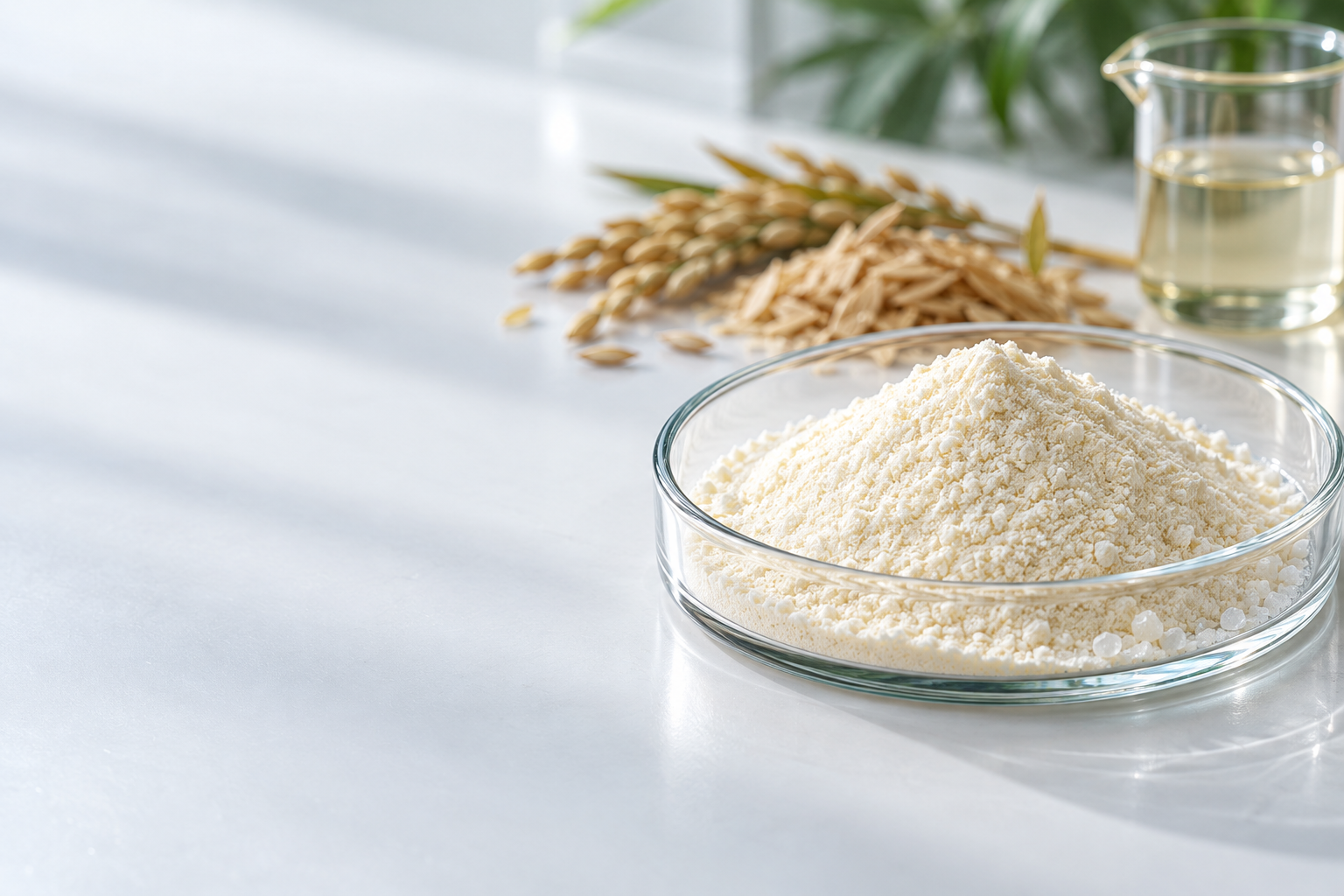
Ureda Naturals Natural Ferulic Acid is a rice-bran-derived Ferulic Acid / trans-Ferulic Acid ingredient, CAS No. 537-98-4, with assay ≥99.0%, loss on drying ≤0.5% and a melting range of 170–174°C. It is supplied for cosmetic antioxidant and photostability systems and selected natural vanillin development routes.
| Source | Rice bran |
|---|---|
| Chemical identity | Ferulic Acid / trans-Ferulic Acid |
| CAS No.: | 537-98-4 |
| Assay: | ≥99.0% |
| Appearance | White or pale-yellow powder |
Ureda Naturals Natural Ferulic Acid is a rice-bran-derived ferulic acid ingredient manufactured for cosmetic formulation, antioxidant system development and selected natural vanillin production routes.
The product is identified as Ferulic Acid / trans-Ferulic Acid, CAS No. 537-98-4, with an assay of not less than 99.0%. It is supplied as a white or pale-yellow powder with no noticeable odor or taste.
| Item | Specification |
|---|---|
| Product name | Natural Ferulic Acid |
| Chemical identity | Ferulic Acid / trans-Ferulic Acid |
| CAS No. | 537-98-4 |
| Molecular formula | C₁₀H₁₀O₄ |
| Relative molecular mass | 194.18 g/mol |
| Source | Rice bran |
| Appearance | White or pale-yellow powder |
| Odor and taste | Odorless and tasteless |
| Ferulic acid assay | ≥99.0% |
| Loss on drying | ≤0.5% |
| Melting point | 170–174°C |
Natural Ferulic Acid and rice bran extract should not be treated as interchangeable materials.
| Material | Composition basis | Best suited for | Main consideration |
|---|---|---|---|
| Natural Ferulic Acid | Defined ferulic acid, ≥99.0% | Cosmetic actives and natural vanillin development | Predictable active input and lower botanical matrix variability |
| Rice Bran Extract | Mixed rice-bran constituents | Botanical extract formulations | Composition, color and odor may vary with extraction and concentration |
| Synthetic Ferulic Acid | Defined ferulic acid from a synthetic route | Applications without natural-origin requirements | Does not provide rice-bran source positioning |
Natural and synthetic ferulic acid have the same chemical identity when they contain the same molecule. CAS No. 537-98-4 identifies the chemical substance, while the natural-origin distinction depends on rice-bran source, manufacturing route and traceability.
Assay defines the amount of ferulic acid available for formulation or downstream conversion calculations. It is especially important when the customer needs a defined active concentration, consistent batch charging or a reproducible substrate for natural vanillin development.
Assay does not independently describe moisture, residual solvent, color, solid form or finished-formula stability.
Loss on drying is a physical-condition control. A low value supports consistent weighing, reduces moisture-related caking and improves powder handling during storage and batching.
The melting range provides an additional identity and solid-state consistency check. When reviewed together with HPLC assay, it can help identify incomplete purification, unexpected crystal behavior or lot-to-lot thermal differences.
Melting point is not a direct measurement of antioxidant activity.
The specified material is a white or pale-yellow powder with no noticeable odor or taste. These characteristics are relevant when the ingredient is used in clear cosmetic products, low-odor formulations or flavor-related development.
Ferulic acid assay is typically controlled by reversed-phase HPLC with UV or diode-array detection. HPLC helps distinguish the target ferulic acid peak from other phenolic components that may be present in less-purified rice-bran materials.
Natural Ferulic Acid is used in the development of antioxidant serums, creams, emulsions, botanical active blends, vitamin C formulations and vitamin C–vitamin E systems.
The final formulation result depends on solvent selection, pH, temperature, oxygen exposure, light and packaging. The raw-material assay alone cannot predict finished-product stability.
Free ferulic acid has limited intrinsic water solubility. Direct addition to water may cause incomplete dissolution, temporary clarity followed by precipitation or crystal formation during cooling.
When used with ascorbic acid and tocopherol, the development team should monitor active retention, color change, clarity, precipitation, pH drift and stability under light and accelerated-temperature conditions.
Ferulic Acid is not a standalone regulated UV filter. Its role in cosmetic development is associated with antioxidant and photostability-support systems.
Ferulic acid is a defined precursor for selected natural vanillin bioconversion routes. Depending on the microorganism, enzyme system and process conditions, ferulic acid may be converted toward vanillin through intermediate steps.
Vanillic acid and vanillyl alcohol may also appear as competing or downstream products, so a high assay should be supported by process-specific analytical monitoring.
| Process variable | Why it matters |
|---|---|
| Ferulic acid concentration | Defines substrate loading |
| Residual ferulic acid | Shows conversion completeness |
| Vanillin formation | Measures target-product generation |
| Vanillic acid | Indicates an oxidation-side pathway |
| Vanillyl alcohol | Indicates a reduction-side pathway |
| pH and temperature | Affect enzyme or microorganism activity |
| Color and odor | Indicate possible non-target carryover |
Natural Ferulic Acid should be stored sealed, dry and protected from direct light.
The product qualification file includes the agreed product specification and the lot-specific COA for the supplied material.
Choose Natural Ferulic Acid when the process requires a defined ferulic acid concentration, repeatable dosing and lower botanical matrix variability. Choose rice bran extract when the formulation is intended to retain a wider mixture of rice-bran components.
No. CAS No. 537-98-4 identifies the ferulic acid molecule. The rice-bran source determines the natural-origin positioning and traceability, not the molecular formula.
Assay measures chemical concentration, not finished-formula solubility. Solvent capacity, pH, temperature, dilution and cooling can change the dissolved state of ferulic acid. A high-assay powder may therefore still require controlled solubilization.
Monitor ferulic acid depletion, vanillin formation, vanillic acid, vanillyl alcohol, pH, temperature and color. These measurements show whether the selected process is converting the substrate toward the intended product.
No. HPLC provides chemical identity and assay information, while the melting range provides a separate check on solid-state consistency. The two controls are complementary and should not be treated as interchangeable.
INGREDIENT PARTNER
Tell us your intended application, approximate quantity and target market. Ureda Naturals will confirm the closest grade, packaging configuration and available documentation for your project.

Scan the QR code or
search WeChat ID: 18270717590
From Natural Origin to Formulation Intent
Tell us what you’re sourcing.
