
 Spanish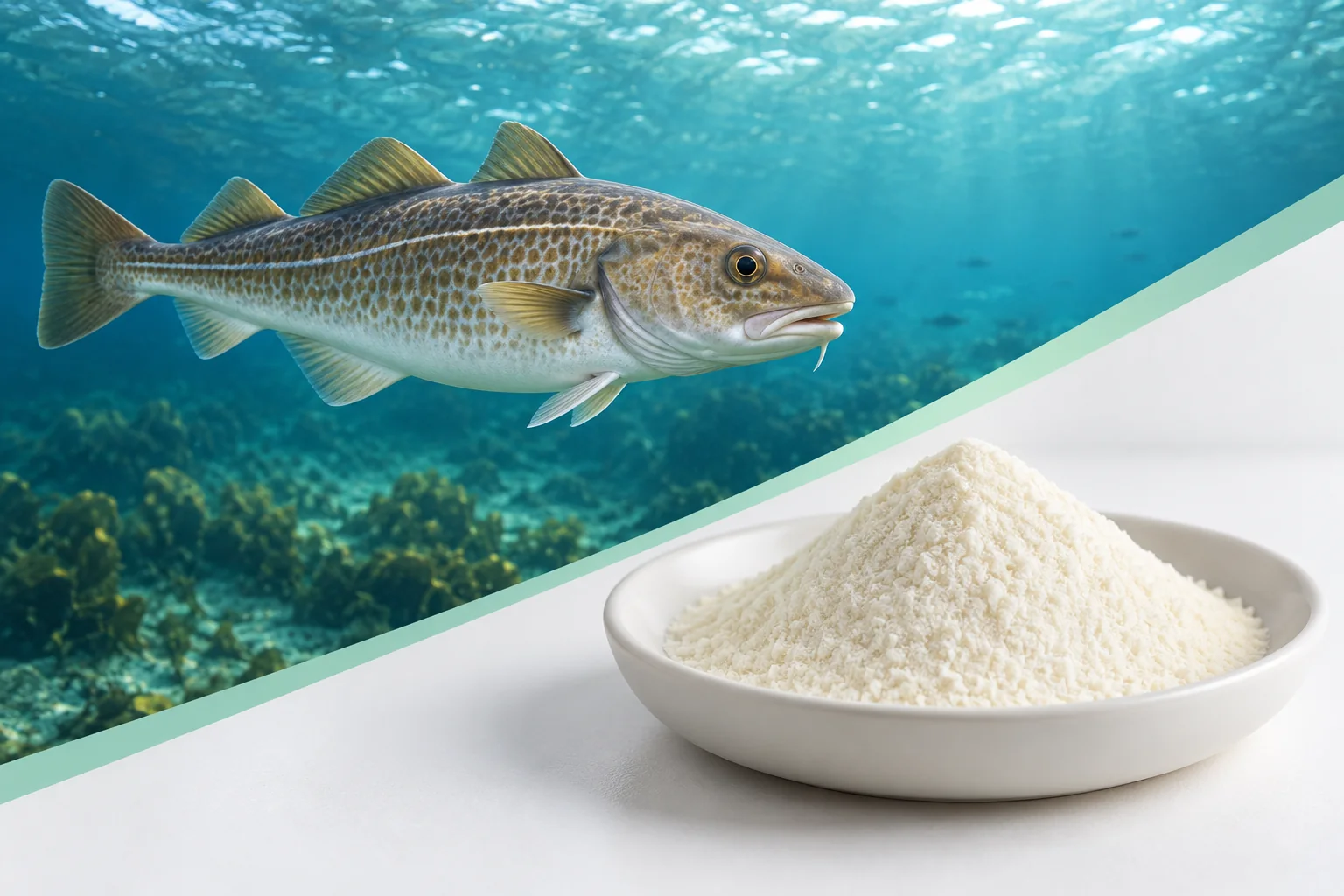
Ureda Naturals manufactures Cod Collagen Peptides from traceable deep-sea cod skin. Available as powder or granules, with ≥90.0% protein on a dry basis and ≥90.0% of peptide fractions below 10,000 Da.
| Source | Allergen source: Fish (cod) |
|---|---|
| Form | Powder or granules |
| Protein | ≥90.0% (dry basis) |
| MOQ | 1kg |
| Packaging | 10 kg/bag or 20 kg/bag |
Cod Collagen Peptides are produced from traceable deep-sea cod skin through enzymatic hydrolysis, refining, concentration and spray drying. The result is a hydrolyzed collagen ingredient available as powder or granules for beverage, food and dietary supplement formulation. Its specification defines both protein content and the proportion of peptide fractions below 10,000 Da, giving formulators two distinct measures for ingredient qualification.
Unlike the broad label “marine collagen,” Cod Collagen Peptides identify both the fish source and the raw-material part: cod skin. Cod skin collagen is predominantly Type I collagen and has a characteristic amino-acid profile that includes glycine, proline and hydroxyproline.
Hydroxyproline is useful as a collagen-composition indicator, but it should not be treated as a standalone proof of species or source. For supplier qualification, assess it alongside the cod-skin origin and traceability documents, protein content, peptide-size specification and the applicable analytical methods.
Hydrolyzed collagen peptides are not selected for the gel strength associated with gelatin. If a formulation depends on gel formation or structural setting, Cod Collagen Peptides should not be treated as a gram-for-gram gelatin replacement without separate functional testing.
| Test Item | Specification | Test Method |
|---|---|---|
| Appearance | Powder or granules; no visible foreign matter | In-house method |
| Color | White or yellowish | In-house method |
| Peptide fraction below 10,000 Da | ≥90.0% | GB 31645 |
| Protein (dry basis) | ≥90.0% | GB 5009.5 |
| Hydroxyproline (dry basis) | ≥7.0% | GB/T 9695.23 |
| Moisture | ≤7.0% | GB 5009.3 |
| Ash | ≤7.0% | GB 5009.4 |
| Arsenic | ≤0.9 mg/kg | GB 5009.11 |
| Lead | ≤1.0 mg/kg | GB 5009.12 |
| Cadmium | ≤0.1 mg/kg | GB 5009.15 |
| Methylmercury | ≤0.1 mg/kg | GB 5009.17 |
| Chromium | ≤2.0 mg/kg | GB 5009.123 |
| Total plate count | ≤1,000 CFU/g | GB 4789.2 |
| Coliforms | Not detected | GB 4789.3 |
| Mould and yeast | ≤50 CFU/g | GB 4789.15 |
| Staphylococcus aureus | Not detected | GB 4789.10 |
| Salmonella | Not detected | GB 4789.4 |
Protein is reported on a dry basis so the result is not directly diluted by the moisture level in the sample. Hydroxyproline adds a collagen-related compositional measure. The two values answer different questions: protein describes the overall protein content on the stated basis, while hydroxyproline helps assess the collagen-characteristic amino-acid profile.
The ≥90.0% specification describes the proportion of measured peptide material below the stated molecular-mass threshold. It is not the same as an average molecular weight, a peak molecular weight or a specific collagen-tripeptide (CTP) content. When comparing supplier data, align the measurement definition and method before treating two percentages as equivalent.
Peptide-size distribution can inform ingredient selection, but it does not by itself predict taste, dissolution speed or clarity in a finished product. Those outcomes also depend on the formulation and processing conditions.
Moisture is relevant to powder storage and handling: changes in moisture can affect caking and flow during weighing or feeding. Ash provides an indication of inorganic residue and can matter when the finished formula has limits on taste, mineral load or total solids. Heavy-metal and microbiological limits support raw-material qualification, but they do not replace the finished product’s own quality and release requirements.
Cod skin supplies the collagen, while its condition at receipt sets the starting point for odor, color and purification. Inadequate control of storage time or temperature can allow raw-material deterioration or lipid oxidation to affect sensory quality. Residual lipid, non-collagen material and inorganic matter can also increase the refining burden or influence color and ash.
Pretreatment therefore has to balance removal of unwanted material with recovery of the collagen-rich fraction. The objective is not simply to maximize cleaning intensity: excessive processing can reduce target-material recovery, while insufficient pretreatment can carry avoidable odor, color or residue into hydrolysis.
Hydrolysis converts longer collagen chains into shorter peptides. Enzyme selection, reaction pH, temperature, substrate concentration and time are process variables that determine the hydrolysis endpoint and resulting peptide distribution. If hydrolysis is insufficient, more higher-molecular-mass material may remain; stronger hydrolysis can increase the proportion of smaller peptides but may also change bitterness and moisture sensitivity.
For this reason, peptide distribution should be controlled against the defined specification rather than inferred from the word “hydrolyzed.” The analytical result and sensory performance are separate checks: meeting a molecular-mass limit does not, on its own, establish the flavor profile required by a finished beverage or supplement.
After hydrolysis, separation and refining help remove residual material that can affect color, odor or ash. Concentration and spray drying then convert the liquid peptide stream into a powder. Moisture and powder handling characteristics are influenced by drying and subsequent powder processing, so the final material should be assessed in the form and equipment used by the customer.
“Water-soluble” and “fast to disperse under production conditions” are not interchangeable descriptions. A powder may dissolve in water yet still require a controlled wetting and mixing sequence in a high-solids or multi-ingredient formula.
| Form | Typical formulation consideration | What to verify on the production line |
|---|---|---|
| Powder | Suitable for preblending with other dry ingredients and for powder-based formulations. | Compare particle size and bulk density with the other blend components; check flow, dusting and blend uniformity. |
| Granules | May be preferred where feeding, metering or powder-dust control is a priority. | Confirm granule size, bulk density, wetting and feeding behavior on the intended equipment; these properties should not be assumed from the word “granules” alone. |
The form should be selected against the customer’s mixer, feeder and filling process. A material that handles well on a bench may behave differently when conveyed or metered at production scale, particularly if its particle-size distribution or bulk density differs from the rest of the blend.
Water solubility is a useful starting property, not a guarantee of a clear or stable finished beverage. Acids, mineral salts, proteins, hydrocolloids, plant ingredients, flavor systems and total solids can change the appearance or dispersion of the complete matrix. Heat treatment and storage can reveal changes that are not visible immediately after mixing.
A practical screening sequence is to compare the ingredient in process water with the complete formula at the intended use level. Observe wetting and dispersion first, then check turbidity or clarity, sedimentation, re-dispersibility, color and odor after the planned thermal process and during storage. This helps distinguish an initial hydration issue from an interaction that appears only after other ingredients or processing steps are introduced.
For instant powders and sachets, particle-size and bulk-density differences between Cod Collagen Peptides and the other ingredients can contribute to segregation during blending, transfer or filling. Review the blend after the actual handling route, not only at the mixer outlet. Sampling at the beginning, middle and end of a filling run can show whether the ingredient remains uniformly distributed through the process.
For capsules, the relevant questions include powder flow, feeder consistency and fill-weight variation at the planned machine speed. For tablets, confirm how the selected grade behaves in the complete formula during compression, then assess hardness, friability and disintegration against the product’s requirements. These are formulation and line-performance checks; they should not be inferred from protein content or peptide-size distribution alone.
Gummies and cooked food systems expose peptides to concentrated solids, acidity and heat. Evaluate color, flavor and texture after the actual cooking or heating step and through the intended storage period. In nutrition bars, moisture migration and interactions with sugars, polyols, fats, fibers and other proteins can affect firmness or stickiness over time, so the finished matrix—not the ingredient in isolation—is the appropriate basis for selection.
No. It is a fraction-based specification: it reports the proportion of measured peptide material below the stated threshold. An average or peak molecular-weight value describes a different metric. Compare the analytical definition and method—GB 31645 for this specification—before comparing figures from different suppliers.
Not on the basis of this specification alone. A ≥90.0% fraction below 10,000 Da does not establish a particular collagen-tripeptide percentage or a GPH peptide content. If a formulation depends on those specific fractions, request the corresponding measurement and compare it separately.
No. Clarity depends on the complete beverage matrix and process, not only on the ingredient’s behavior in water. Compare the ingredient in the intended formula at the target use level, then evaluate it after the actual heat treatment and during storage for turbidity, sedimentation, re-dispersibility, color and odor.
Not automatically. Source, protein basis, peptide-size metric, sensory profile and powder-handling properties may differ. Requalify the replacement against the target protein or peptide contribution, allergen and labeling requirements, and the finished product’s processing and sensory criteria rather than relying on equal weight alone.
Do not treat hydrolysis as proof that fish-allergen labeling is unnecessary. This ingredient is derived from cod skin. Assess the ingredient and manufacturing process against the requirements of the destination market, including cross-contact controls and finished-product labeling.
No. Methylmercury and total mercury are different analytical measures. The listed limit applies to methylmercury under GB 5009.17; it should not be presented as a total-mercury result unless total mercury is separately specified and tested.
INGREDIENT PARTNER
Tell us your intended application, approximate quantity and target market. Ureda Naturals will confirm the closest grade, packaging configuration and available documentation for your project.

Scan the QR code or
search WeChat ID: 18270717590
From Natural Origin to Formulation Intent
Tell us what you’re sourcing.
