


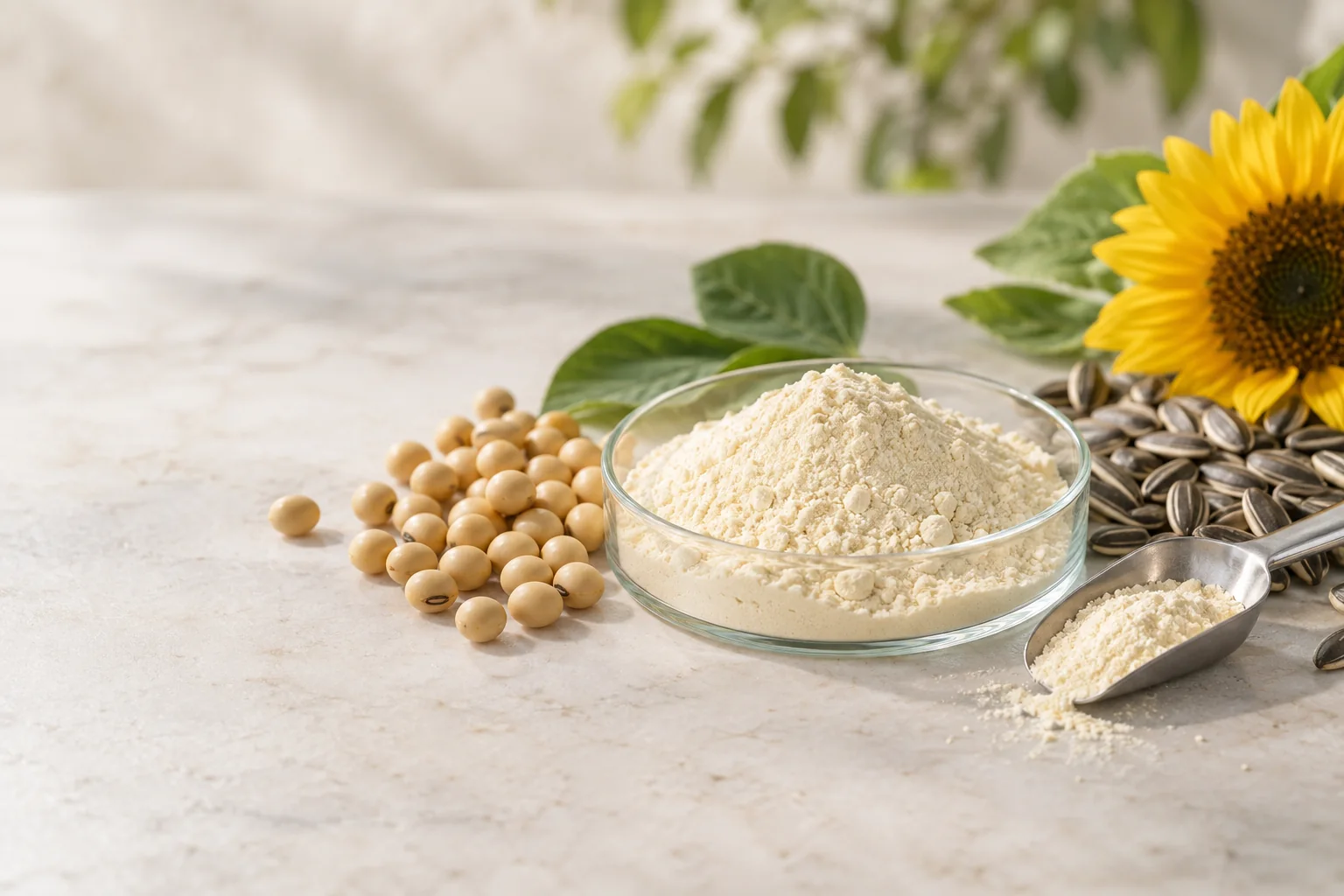
Soy and sunflower phosphatidylserine can be used in similar product concepts, but source is only one part of the qualification decision. Assay, carrier, physical form, oxidation control, labeling documentation, target format and finished-product process can have a greater practical effect on development than the source name alone.
Define what the assay means
Phosphatidylserine is a phospholipid material, and commercial products may be supplied at different assay levels and in different carriers. A 50% powder, a 70% powder, a water-dispersible format and a liquid preparation are not equivalent additions. The amount of raw material needed to deliver a target phosphatidylserine amount changes with the assay basis and carrier.
Before comparing quotations, ask whether the assay is expressed as phosphatidylserine, a phospholipid fraction, or another analytical basis. The method, reference standard and sample preparation should be stated on the specification or COA.
Soy versus sunflower: what changes in the project
Source can affect allergen review, labeling strategy, market positioning and the supplier documentation required for approval. Soy-derived material may require a more detailed allergen assessment in markets where soy is a regulated allergen. Sunflower-derived material may be chosen when the formulation brief prefers a non-soy source, but it still requires current identity, allergen and composition documentation.
Neither source is automatically superior for every application. The choice should be connected to the target market, claim boundaries, carrier, assay and process.
Powder, water-dispersible and liquid formats
Dry powder is often considered for capsules, tablets and dry blends. Water-dispersible material may be considered for beverages or oral liquids, where wetting, dispersion, sediment and sensory properties must be tested. Liquid phosphatidylserine can be relevant to softgels or oil-based systems, but carrier oil, viscosity, fill temperature and shell compatibility become central questions.
The current Ureda Phosphatidylserine product page lists soy and sunflower sources and several formats. Use the product page for current commercial options; use this Resource article to structure the source-and-format decision.
Processing controls that matter
For dry blends, evaluate flow, bulk density, segregation, blend uniformity and the effect of the carrier on capsule or tablet weight. For beverages, test the full matrix with the intended mixing order, pH, salts, proteins, flavors and storage temperature. For liquid products, test phase behavior, oxidation, filling and package compatibility.
Phospholipids can be sensitive to oxidation, so the package, headspace, oil quality and storage conditions should be reviewed together. A color or odor observation can support the investigation, but it does not replace an assay or oxidation test.
A supplier-qualification checklist
Request:
- exact source and source-specific allergen statement;
- phosphatidylserine assay and analytical method;
- carrier and non-active composition;
- physical form, particle-size or viscosity information;
- peroxide or oxidation-related data where relevant;
- microbiological limits and contaminant controls;
- packaging, storage and shelf-life information;
- current COA, TDS, SDS and regulatory documents for the target market.
If the material is intended for a beverage, ask for a sample and test it in the finished matrix. A supplier’s water beaker demonstration cannot replace a real beverage trial.
Avoid confusing source with claim support
Choosing sunflower phosphatidylserine instead of soy phosphatidylserine may simplify an allergen or label discussion, but it does not by itself prove a health benefit, superior absorption or better finished-product performance. Those claims require separate evidence and jurisdiction-specific review.
Final decision rule
Select the source and format together. Approve the material only when the assay basis, carrier, physical behavior, documentation and target-market requirements align. A technically sound comparison asks not only where the phosphatidylserine comes from, but how it will be delivered, tested and controlled in the final product.
Technical references
- USP-NF phosphatidylserine monograph information
- FDA GRAS notice for phosphatidylserine from lecithin
- Phosphatidylserine processing and source comparison discussion
Need help comparing soy and sunflower phosphatidylserine formats? Contact Ureda Naturals.
