


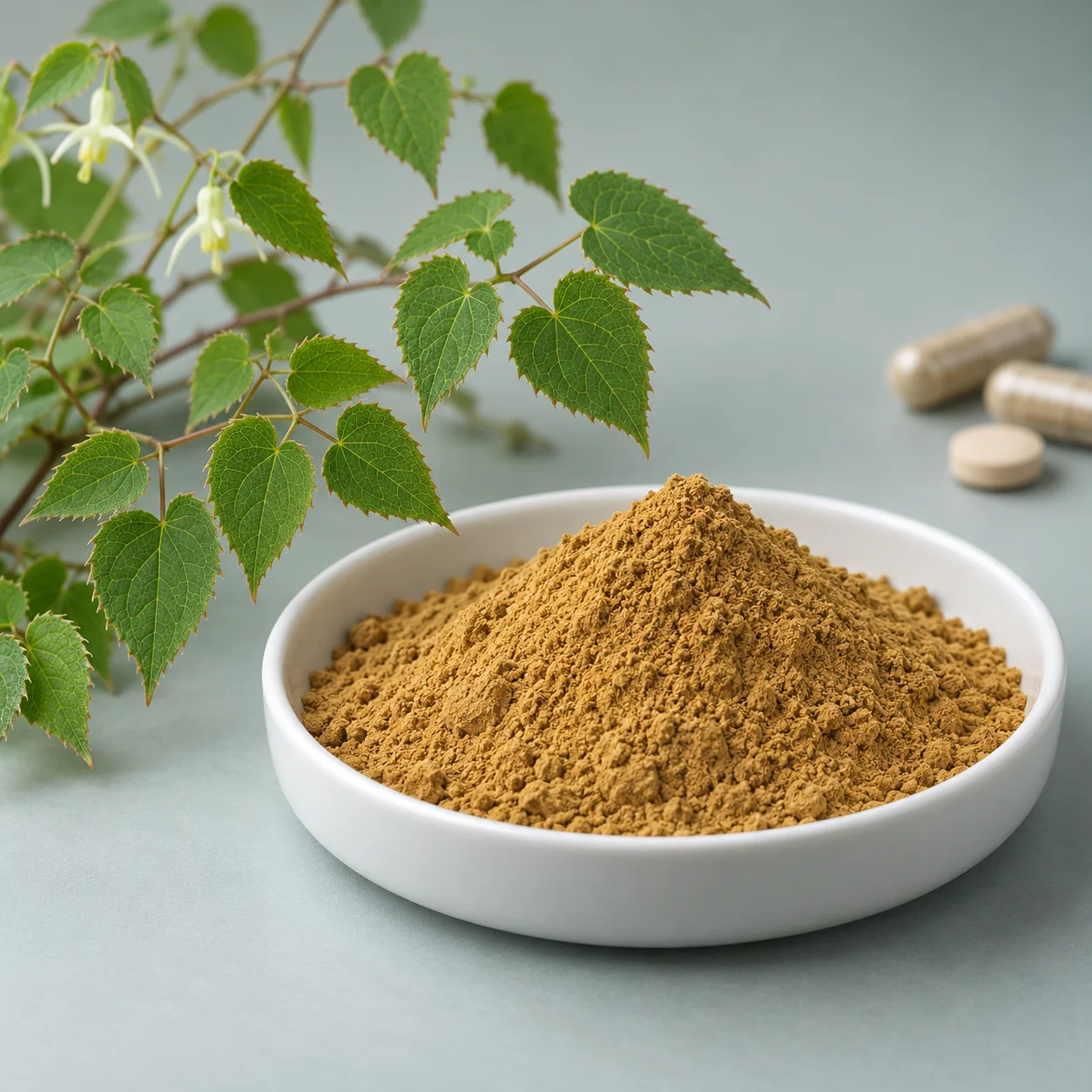
The high Icariin concentration reduces the amount of broader botanical matrix entering a formula but increases sensitivity to low-dose distribution, powder consolidation and process loss. Limited aqueous solubility also makes dosage-form selection and finished-product performance testing critical.
Product Profile
| Product name | Epimedium Extract (Icariin 98%) |
|---|---|
| Active compound | Icariin |
| CAS number | 489-32-7 |
| Molecular formula | C33H40O15 |
| Molecular weight | 676.66 g/mol |
| Botanical source | Epimedium brevicornu Maxim. |
| Plant part | Leaf |
| Extraction solvents | Water and ethanol |
| Assay | ≥98.0% Icariin by HPLC |
| Appearance | Brown-yellow powder |
| Particle size | 100% through 80 mesh |
| Identification | Positive by TLC |
| Packaging | 25 kg cardboard drum with double-layer inner bags |
| Shelf life | 24 months |
| Storage | Cool, dry and protected from strong light and heat |
Grade Identity
| Material | Defining specification | Technical distinction |
|---|---|---|
| Epimedium Extract (Icariin 98%) | Purified Epimedium leaf extract standardized to ≥98.0% Icariin | Provides a defined, high-purity Icariin input |
| Standardized Epimedium extract | Botanical extract adjusted to a lower declared Icariin level | Introduces more accompanying botanical constituents |
| Total Epimedium flavonoids | Combined flavonoid-group assay | The reported percentage does not equal Icariin content |
| Icariside II | Deglycosylated Icariin-related compound | Different identity and analytical response |
| Icaritin | Icariin aglycone | Different physicochemical behavior |
Replacing a lower-assay standardized Epimedium extract with the 98% Icariin grade changes the constituent profile, ingredient mass and active-to-carrier ratio. Existing blend, recovery and stability data must therefore be revalidated.
Application Fit
| Finished-product format | Technical assessment | Critical control |
|---|---|---|
| Dry-filled capsules | Suitable after blend qualification | Segregation, feeding and dosage-unit uniformity |
| Tablets | Suitable after process qualification | Granulation recovery, compression and dissolution |
| Reconstituted sachets | Suitable for suspension-format products | Wetting, sedimentation and delivered dose |
| Suspension liquids | Feasible with an engineered vehicle | Rheology, settling and filling uniformity |
| Clear aqueous liquids | Requires a separate delivery system | Dissolved fraction and precipitation control |
| Gummies | Requires matrix-specific validation | Heat recovery, cooling behavior and unit uniformity |
Critical Manufacturing Controls
Low-Inclusion Blending
The high assay reduces the quantity of extract added to the production batch. A qualified premix is required when direct addition cannot produce acceptable Icariin uniformity.
- Define the carrier and active-to-carrier premix ratio.
- Control the addition sequence and blender fill level.
- Establish the mixing endpoint from multi-location assay results.
- Compare uniformity before discharge and after transfer.
- Test units from the beginning, middle and end of filling.
Increased assay variation after additional mixing or handling indicates re-segregation.
Density and Consolidation
- Bulk density: 0.4521 g/mL
- Tapped density: 0.5932 g/mL
- Hausner ratio: approximately 1.31
- Carr index: approximately 23.8%
The measured consolidation can affect hopper discharge, volumetric feeding, capsule filling and separation from formulation components with different density. Production trials should reproduce expected vibration, hopper residence and transfer conditions.
Particle-Size Control
The 80-mesh specification excludes coarse particles but does not define D10, D50, D90, fine-particle fraction, agglomeration or specific surface area.
Where particle behavior affects premixing, feeding, wetting, dissolution or suspension stability, purchasing limits should be established from full particle-size and application-performance data.
Process Recovery
| Sampling stage | Primary failure identified |
|---|---|
| Dispensed material | Weighing or starting-potency error |
| Initial premix | Incomplete distribution or container retention |
| Multiple final-blender locations | Blend non-uniformity |
| Discharged blend | Transfer-induced segregation |
| Material at filling equipment | Hopper or feeding instability |
| Beginning, middle and end of filling | Progressive segregation or settlement |
| Before and after filtration | Insoluble-particle or filter retention |
| Finished-product extraction | Matrix-related analytical recovery |
Dosage-Form Development
Capsules
Evaluate premix uniformity, segregation after transfer, hopper consolidation, fill-weight variation, dosage-unit Icariin content and dissolution. Capsule weight and Icariin content must be evaluated separately.
Tablets
Evaluate recovery after granulation and drying, active migration during drying, uniformity after lubrication, assay after compression and finished-tablet dissolution. Hardness, friability and disintegration do not establish Icariin release.
Suspensions and Reconstituted Powders
Measure wetting, agglomeration, sedimentation, sediment compactness, redispersibility, concentration during filling or consumption and the dose remaining in the preparation container.
Clear Aqueous Systems
Establish equilibrium solubility, dissolved Icariin after validated phase separation, filtration recovery, dilution stability, temperature-cycle stability, pH and electrolyte effects, storage precipitation and filling-stage concentration.
Gummies
Control the addition stage, maximum temperature, exposure time, post-heating recovery, distribution before depositing, cooling precipitation, individual-piece content and storage stability.
Specification and COA
| Test | Specification | COA result | Method |
|---|---|---|---|
| Appearance | Brown-yellow powder | Conforms | Visual |
| Icariin | ≥98.0% | 98.21% | HPLC |
| Particle size | 100% through 80 mesh | Conforms | ChP 2020 |
| Identification | Positive | Positive | TLC |
| Moisture | ≤5.0% | 3.59% | ChP 2020 |
| Total ash | ≤5.0% | 1.87% | ChP 2020 |
| Bulk density | Report value | 45.21 g/100 mL | ICH Q4B Annex 13 |
| Tapped density | Report value | 59.32 g/100 mL | ICH Q4B Annex 13 |
| Total heavy metals | ≤10 ppm | Conforms | ChP 2020 |
| Lead | ≤2.0 mg/kg | Conforms | GB 5009.12 |
| Arsenic | ≤1.0 mg/kg | Conforms | GB 5009.11 |
| Mercury | ≤0.3 mg/kg | Conforms | GB 5009.17 |
| HCH | ≤0.2 mg/kg | Conforms | GB 5009.19 |
| DDT | ≤0.2 mg/kg | Conforms | GB 5009.19 |
| Total plate count | ≤1,000 CFU/g | Conforms | GB 4789.2 |
| Yeast and mold | ≤100 CFU/g | Conforms | GB 4789.15 |
| Coliforms | ≤10 MPN/100 g | Conforms | GB 4789.3 |
| Staphylococcus aureus | Negative | Conforms | GB 4789.10 |
| Salmonella | Negative | Conforms | GB 4789.4 |
Analytical and Source Qualification
Source comparison should use the same Icariin reference standard, assigned standard potency, sample preparation, assay calculation and chromatographic method.
- Confirm Icariin peak identity and separation from adjacent peaks.
- Compare main-peak purity and non-main peak distribution.
- Evaluate replicate preparation precision.
- Compare particle size, density and manufacturing behavior.
- Confirm recovery in the intended process and finished-product matrix.
The finished-product method must demonstrate extraction recovery from the actual matrix before it is used to assess manufacturing loss.
Selection Summary
| Select this grade when | Select another format when |
|---|---|
| A defined high-purity Icariin input is required | A broad Epimedium botanical profile is required |
| Low botanical-matrix contribution is important | The accompanying botanical matrix is part of the product concept |
| The product uses a qualified dry-dose process | Direct aqueous dispersibility is required |
| A dedicated delivery system can be developed | A ready-to-use soluble or dispersible system is required |
Technical FAQ
Which attributes should be included in a quality agreement after pilot validation?
Include only attributes shown to affect manufacturing or finished-product performance. These may include Icariin assay, specified related peaks, D10/D50/D90, density range, moisture and residual ethanol. Each added limit should be supported by blend, feeding, recovery, dissolution or stability data.
Which raw-material changes should trigger customer requalification?
Requalification should be considered after changes to botanical species, plant part, extraction or purification process, manufacturing site, solvent system, HPLC method, reference standard, particle-size process or drying process. The comparison should address the risk introduced by the specific change.
How should a laboratory premix be transferred to commercial scale?
Preserve or evaluate premix concentration, blender working volume, fill level, addition sequence, mixing intensity, discharge pattern, transfer distance and hopper residence. Commercial sampling must include discharged material and finished units.
How should colour variation be investigated when Icariin assay still complies?
Compare botanical raw-material source, related-peak distribution, moisture, particle-size distribution, drying conditions and storage exposure. Use chromatographic and physical comparison to determine whether the difference originates from related constituents, processing history or particle characteristics.
What evidence is required before approving an alternative source?
Combine aligned-method identity and assay, chromatographic-profile comparison, physical-property comparison, contaminant compliance, pilot-process recovery, finished-product uniformity and dosage-form-specific performance data.
