
 Spanish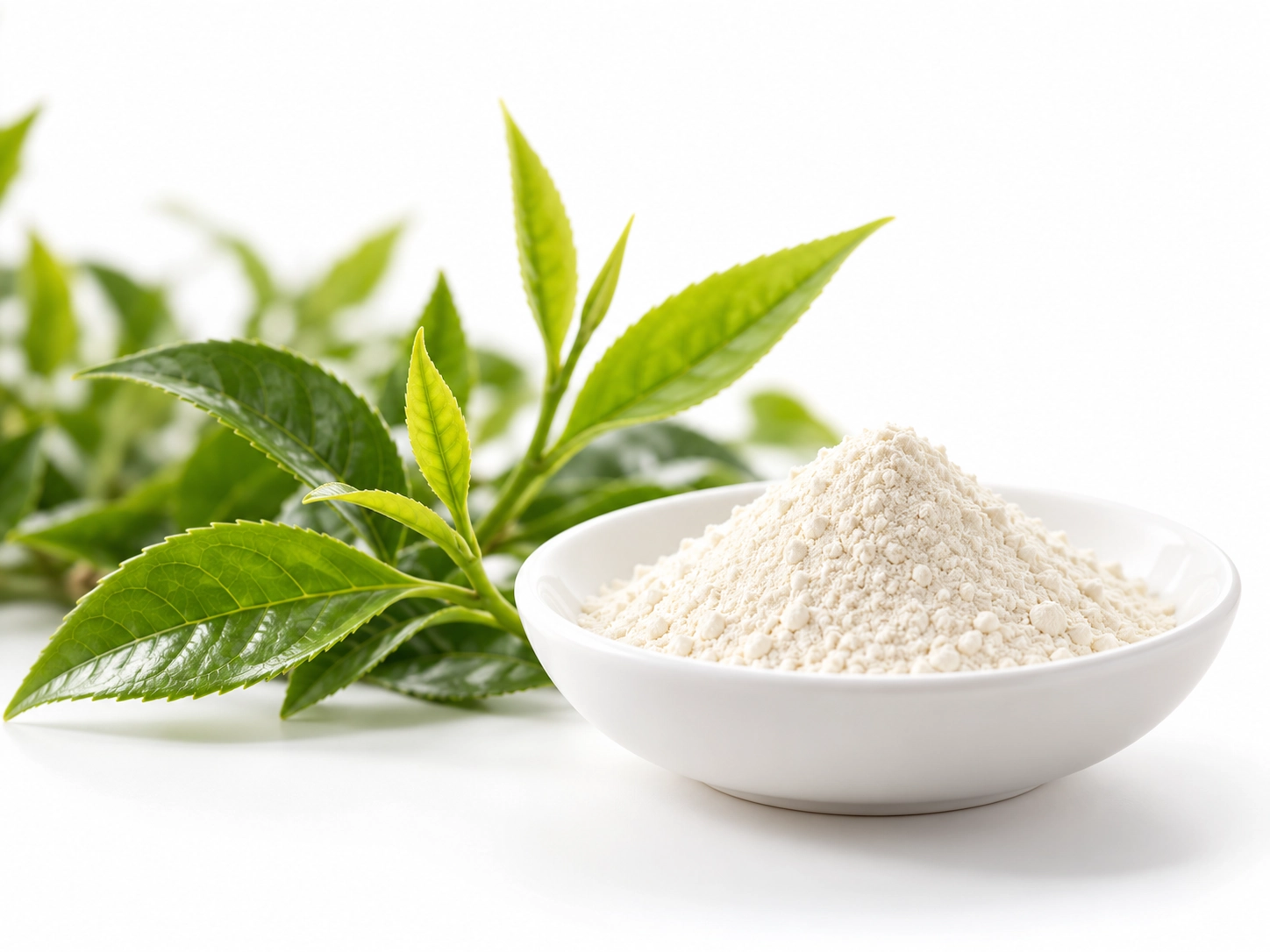
Ureda Naturals supplies green tea–derived Epicatechin Gallate (ECG), CAS No. 1257-08-5, in ECG90 and ECG98 grades. Both grades are off-white to white powders with caffeine controlled at ≤0.1%.
| Source | Green tea |
|---|---|
| CAS No | 1257-08-5 |
| ECG90 | ECG ≥90%, dry basis |
| ECG98 | ECG ≥98%, dry basis |
| Caffeine | ≤0.1% |
Ureda Naturals supplies green tea–derived Epicatechin Gallate (ECG), CAS No. 1257-08-5, in ECG90 and ECG98 grades. Both grades are supplied as off-white to white powder, with ECG content controlled on a dry basis and caffeine controlled at ≤0.1%.
| Item | ECG90 | ECG98 |
|---|---|---|
| Product identity | Epicatechin Gallate (ECG) | Epicatechin Gallate (ECG) |
| CAS No. | 1257-08-5 | 1257-08-5 |
| Source | Green tea | Green tea |
| Appearance | Off-white to white powder | Off-white to white powder |
| ECG content, dry basis | ≥90% | ≥98% |
| Caffeine | ≤0.1% | ≤0.1% |
| MOQ | 1 kg | 1 kg |
| Storage | Cool, dry and sealed | Cool, dry and sealed |
A defined ECG grade is controlled against the content of one identified catechin. Total tea polyphenols represent a mixture of multiple tea constituents and cannot be converted directly into an ECG-equivalent value.
A defined ECG ingredient requires more than extraction of green tea solids. The target catechin is enriched from the botanical matrix, caffeine is controlled as a separate quality attribute, and the concentrated fraction is converted into the commercial powder form.
| Supplier-side control | Product attribute | Downstream relevance |
|---|---|---|
| Catechin fractionation | Defined ECG assay | Determines active input and finished-product calculation |
| Caffeine control | ≤0.1% caffeine limit | Controls caffeine contribution to the formula |
| Concentration control | Assay consistency | Supports formulation calculation |
| Drying and powder formation | Off-white to white powder | Affects transfer, premixing and feeding behaviour |
The two grades have the same chemical identity but different minimum ECG assays.
Required raw material = Target ECG amount ÷ Minimum ECG assay
A grade change affects raw-material addition mass, premix concentration, feeder loading and finished-product assay calculation. ECG90 and ECG98 are not gram-for-gram substitutes.
Caffeine must be calculated separately from ECG assay.
| Ingredient | Full name | CAS No. | Identity |
|---|---|---|---|
| ECG | Epicatechin Gallate | 1257-08-5 | Gallated catechin |
| EGCG | Epigallocatechin Gallate | 989-51-5 | Different gallated catechin |
| EC | Epicatechin | 490-46-0 | Non-gallated catechin |
| Tea polyphenols | Multi-component tea fraction | Varies | Mixture of tea constituents |
| Raw-material attribute | Customer process step | Potential impact | Verification approach |
|---|---|---|---|
| ECG assay, dry basis | Weighing and premixing | Incorrect active input or finished-product assay | Calculate from the minimum assay and test pilot blend uniformity |
| Caffeine limit | Formula release and label control | Unplanned caffeine contribution | Include caffeine in the raw-material and finished-product calculation |
| Powder form | Transfer and feeding | Dusting, segregation or unstable feeder performance | Compare feeding behaviour on the actual production equipment |
| ECG grade | Premix and scale-up | Different material loading and concentration | Compare ECG90 and ECG98 at the same target ECG dose |
| Liquid dispersion behaviour | Pre-dispersion and mixing | Differences in clarity, sediment or dispersion time | Test both grades under identical pH, solids, mixing and addition conditions |
| Thermal exposure | Pasteurisation, hot-fill or holding | Changes in ECG recovery or catechin profile | Compare ECG results before and after the actual temperature–time process |
Review weighing accuracy, feeder consistency, premix distribution, blend uniformity, content uniformity, disintegration, dissolution and finished-product ECG assay.
Review premix distribution, segregation during conveying, filling consistency and finished-sachet assay.
Compare ECG90 and ECG98 at the same target ECG concentration under the actual pH, solids level, addition sequence, mixing conditions and thermal profile. Record dispersion time, clarity, sediment and ECG recovery before and after processing.
Review carrier compatibility, colour contribution, dispersion or dissolution, pH compatibility, finished-formula stability and active recovery after processing and storage.
Use the target ECG amount divided by the minimum assay of the selected grade. For a 100 mg ECG target, ECG90 requires at least 111.1 mg raw material, while ECG98 requires at least 102.0 mg.
At a 100 mg ECG target, ECG90 contributes up to approximately 0.111 mg caffeine at the 0.1% maximum caffeine limit. ECG98 contributes up to approximately 0.102 mg under the same calculation.
Total tea polyphenols represent multiple tea constituents, while ECG assay measures one defined catechin. A total-polyphenol result cannot be converted directly into an ECG value.
Not automatically. The raw-material mass, premix concentration, feeder loading and finished-product calculation change when the grade changes. The replacement requires recalculation and process verification.
Compare both grades at the same target ECG concentration under the actual pH, solids level, addition sequence, mixing conditions and thermal profile. Measure dispersion time, clarity, sediment and post-process ECG recovery.
Use the actual pasteurisation, hot-fill or holding profile. Compare pre-process and post-process ECG recovery together with appearance, clarity, sediment and, where required, the catechin profile.
Assay and caffeine are only the chemical controls. The process should also be checked for powder transfer, feeder consistency, blend uniformity, content uniformity, fill-weight consistency, disintegration, dissolution and finished-product ECG assay.
ECG assay measures chemical content. It does not define particle-size distribution, bulk density, flowability, dusting or segregation. These physical properties must be evaluated separately when they affect production equipment.
They have different chemical identities and CAS numbers. The analytical procedure must distinguish the individual catechins; the result for one cannot be used as the release result for another.
ECG98 is preferable when the formula has a tight fill-weight limit, a high ECG target, limited space for active ingredients or a requirement for a lower raw-material addition mass.
INGREDIENT PARTNER
Tell us your intended application, approximate quantity and target market. Ureda Naturals will confirm the closest grade, packaging configuration and available documentation for your project.

Scan the QR code or
search WeChat ID: 18270717590
From Natural Origin to Formulation Intent
Tell us what you’re sourcing.
