
 Spanish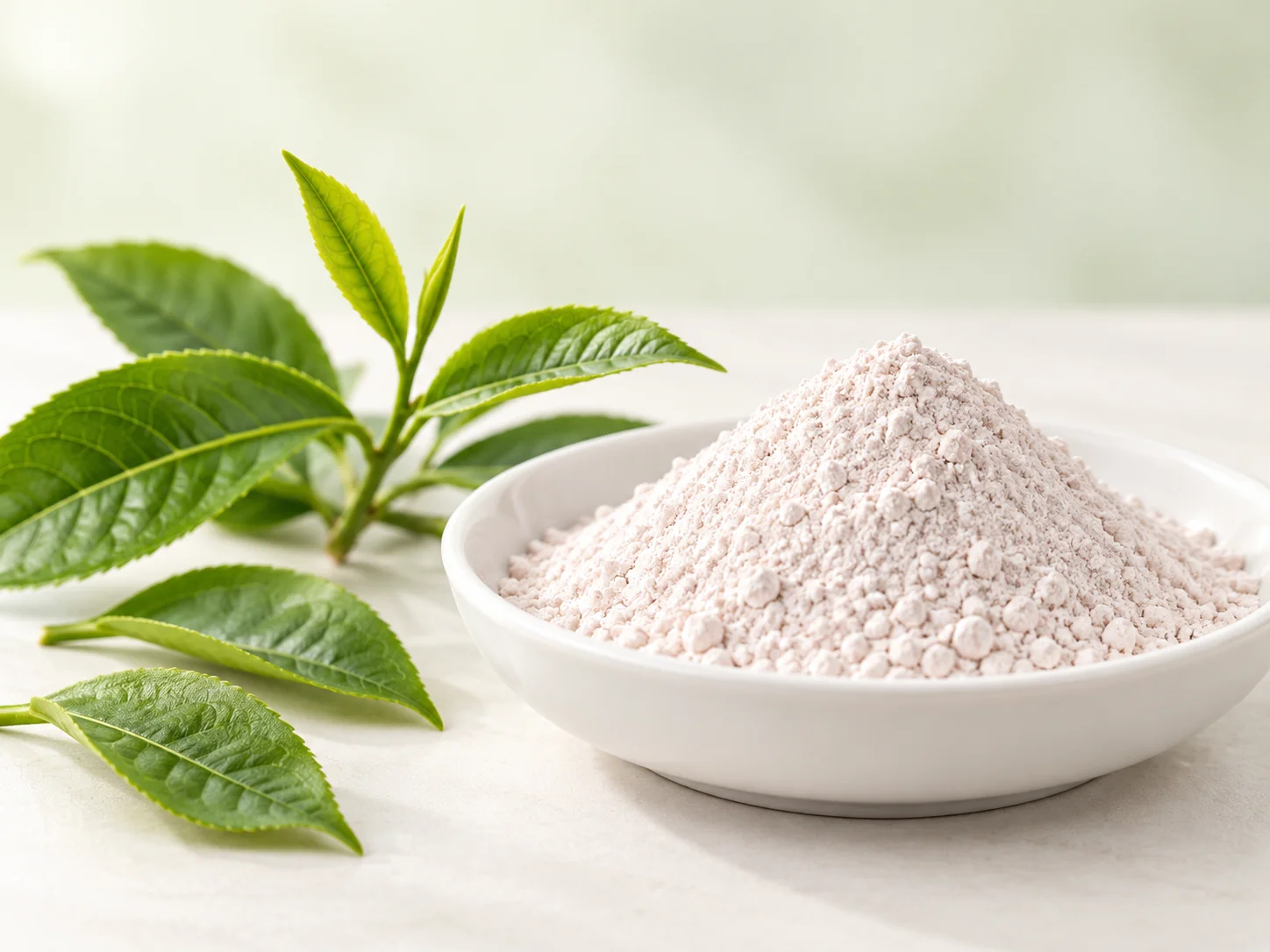
Epigallocatechin Gallate (EGCG) is a standardized green tea extract supplied in powder form, available in 90%, 95% and 98% assay grades, with caffeine controlled at ≤0.1% for food, dietary supplement and cosmetic formulations.
| Source | Green tea |
|---|---|
| Active ingredient | Epigallocatechin Gallate (EGCG) |
| Assay grades | ≥90%, ≥95%, ≥98% |
| CAS No | 989-51-5 |
| MOQ | 1KG |
Ureda Naturals manufactures Epigallocatechin Gallate (EGCG), a standardized green tea extract supplied in powder form for food, dietary supplement and cosmetic formulations. Available assay grades include 90%, 95% and 98%, with caffeine controlled at no more than 0.1%.
The ingredient is intended for buyers who require a defined EGCG input rather than a general green tea powder or broad tea polyphenol specification.
| Item | Specification |
|---|---|
| Product name | Epigallocatechin Gallate (EGCG) |
| Form | Powder |
| Source | Green tea |
| CAS No. | 989-51-5 |
| Appearance | Grayish-white to pale pink powder |
| Caffeine | ≤0.1% |
| Grade | EGCG assay | Caffeine | Typical formulation fit |
|---|---|---|---|
| EGCG 90 | ≥90% | ≤0.1% | Standardized supplement and functional-food formulas |
| EGCG 95 | ≥95% | ≤0.1% | Higher active concentration with balanced powder loading |
| EGCG 98 | ≥98% | ≤0.1% | High-potency formulas with limited fill-weight space |
The selected assay affects the amount of ingredient required to deliver the same EGCG target. For a theoretical target of 100 mg EGCG, the starting calculation is:
| Assay grade | Ingredient amount for 100 mg EGCG | Formulation consideration |
|---|---|---|
| 90% | Approximately 111.1 mg | Higher ingredient loading |
| 95% | Approximately 105.3 mg | Balanced active concentration and loading efficiency |
| 98% | Approximately 102.0 mg | Lowest ingredient quantity for the same nominal target |
Use the selected assay grade for formula calculations, pilot production, finished-product testing and label calculations.
EGCG assay identifies the level of epigallocatechin gallate. It is not interchangeable with total catechins, total tea polyphenols or a general green tea extract percentage.
| Specification term | Meaning | Buyer relevance |
|---|---|---|
| EGCG assay | Level of the defined EGCG compound | Used for active-content calculation |
| Total catechins | Combined level of several catechin compounds | Used when the formula is based on a broader catechin profile |
| Total tea polyphenols | Broader polyphenol measurement | Should not replace an EGCG assay |
The caffeine specification of ≤0.1% limits the caffeine contribution from the Epigallocatechin Gallate (EGCG) ingredient.
For the finished formula, calculate total caffeine from all sources, including tea flavor, coffee, guarana, green coffee and other caffeine-containing ingredients.
EGCG is often used at a relatively low inclusion rate compared with the main excipients. Premixing and blend uniformity therefore influence finished-product consistency.
For powdered beverage systems, evaluate EGCG after mixing with sweeteners, acids, flavors, minerals, proteins and other active ingredients. A water-only test does not represent the complete formula.
For liquid products, assess not only whether EGCG enters the liquid phase, but also whether the process maintains acceptable assay, color, clarity and sediment behavior through filling and storage.
| Process point | What to evaluate | Decision supported |
|---|---|---|
| After ingredient addition | Wetting, visible particles and dispersion time | Whether premixing or staged addition is needed |
| After pH adjustment | Color, haze, precipitation and pH-related changes | Whether the selected pH is suitable |
| After thermal processing | Assay, color, clarity and sediment | Whether the heating profile is compatible |
| After filling and storage | Appearance, sediment, container interaction and assay trend | Whether packaging and storage conditions are suitable |
Epigallocatechin Gallate (EGCG) can be evaluated in water-based serums, emulsions, masks and other cosmetic systems.
Check color drift, pH compatibility, precipitation, odor change and interaction with emulsifiers, polymers, preservatives and mineral ingredients. For clear or lightly colored products, even a small change in haze or tone may affect the finished-product specification.
A purchasing specification for the selected EGCG grade should identify:
Ureda Naturals supports B2B qualification with product specifications, batch COA, TDS, SDS and application-related technical documentation. Quality-system and market documents can be organized for GMP, FSSC 22000, ISO 9001, HACCP and applicable Halal or Kosher requirements.
Epigallocatechin Gallate, abbreviated as EGCG, is a defined catechin compound associated with green tea. The supplied ingredient is standardized according to its EGCG assay.
No. EGCG 98% refers to the assay of epigallocatechin gallate. Green tea polyphenols 98% refers to a broader polyphenol specification. They are different purchasing specifications.
It limits the caffeine contribution from the EGCG ingredient. The finished product’s total caffeine depends on all caffeine-containing ingredients in the complete formula.
Select the grade according to the target EGCG amount, available fill weight, excipient space and cost structure. The 98% grade uses the least ingredient quantity for the same nominal EGCG target.
Evaluate dispersion, pH, color, clarity, sediment, assay and appearance after the actual mixing, heating, filling and storage steps.
Typical documents include the product specification, batch COA, TDS, SDS and application-related quality or regulatory documentation required for the target market.
INGREDIENT PARTNER
Tell us your intended application, approximate quantity and target market. Ureda Naturals will confirm the closest grade, packaging configuration and available documentation for your project.

Scan the QR code or
search WeChat ID: 18270717590
From Natural Origin to Formulation Intent
Tell us what you’re sourcing.
