
 Spanish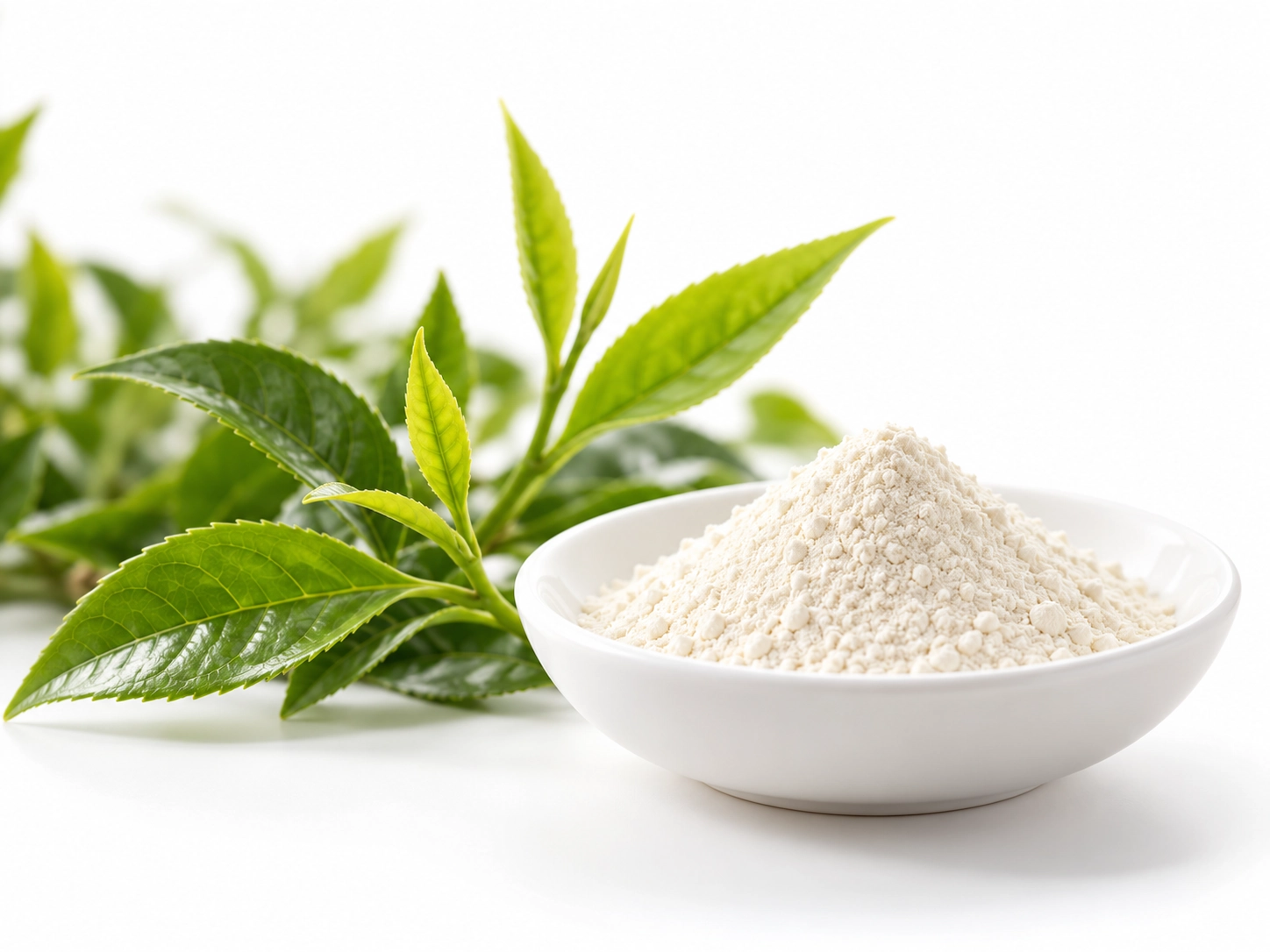
Ureda Naturals manufactures Epicatechin (EC), a green tea-derived extract standardized to 90%, 95%, or 98% EC on a dry basis. The off-white powder has caffeine controlled at ≤0.1% and is developed for dietary supplements, functional foods, beverage systems, and cosmetic formulations.
| Source | Green tea |
|---|---|
| CAS No | 490-46-0 |
| Caffeine | ≤0.1% |
| EC Grades | 90%, 95%, 98% on a dry basis |
| MOQ | 1 kg |
Ureda Naturals manufactures Epicatechin (EC), a green tea-derived epicatechin extract standardized to 90%, 95%, or 98% EC on a dry basis. The material is supplied as an off-white powder with caffeine controlled at ≤0.1% for dietary supplement, functional food, beverage, and cosmetic formulation development.
Epicatechin (EC) is a defined flavan-3-ol catechin derived from green tea. Ureda Naturals supplies standardized EC grades for formulations that require a controlled EC marker rather than a broad total-polyphenol declaration.
EC is a specific compound. It is not interchangeable with EGCG, ECG, EGC, total catechins, or total tea polyphenols. Each represents a different analytical target, so the selected marker must remain consistent from purchasing and formula calculation through finished-product release.
The material is supplied as an off-white powder and is described as water-soluble. Water solubility alone does not determine the clarity, sedimentation, or storage stability of a finished beverage or cosmetic formula. Those results depend on the complete formulation and manufacturing process.
| Item | Specification |
|---|---|
| Product name | Epicatechin (EC) |
| CAS No. | 490-46-0 |
| Source | Green tea |
| Molecular formula | C15H14O6 |
| Form | Powder |
| Appearance | Off-white powder |
| Epicatechin content | 90%, 95%, or 98% on a dry basis |
| Caffeine | ≤0.1% |
| EC Grade | Formulation Positioning | Suitable When |
|---|---|---|
| EC 90% | Balanced active concentration and powder loading | The formula can accommodate a higher ingredient addition |
| EC 95% | Intermediate active density | The project requires a balance between EC concentration, loading, and cost |
| EC 98% | High active density with lower carrier contribution | The formula requires a concentrated EC input or a lower total powder addition |
For a theoretical target of 100 mg EC, the approximate ingredient quantities are:
| Selected Grade | Approximate Quantity Before Process-Loss Adjustment |
|---|---|
| EC 90% | 111.1 mg |
| EC 95% | 105.3 mg |
| EC 98% | 102.0 mg |
Formula calculations should use the minimum contracted assay of the selected grade. Finished-product recovery and content uniformity should then be checked using the customer’s actual manufacturing process.
| Material | Analytical Identity | Why It Is Not Interchangeable with EC |
|---|---|---|
| Epicatechin (EC) | A defined catechin marker | The target assay is EC itself |
| EGCG | A different gallated catechin | It has a different molecular identity and assay target |
| Total catechins | A combined group of catechin compounds | The total value does not show how much EC is present |
| Total tea polyphenols | A broader group of tea constituents | It cannot be used to calculate or release a specific EC dose |
| Raw-Material Factor | Customer Process Step | Observable Risk | Buyer Action |
|---|---|---|---|
| EC assay grade | Weighing and dosing | Incorrect active loading | Calculate from the minimum assay of the selected grade |
| Particle-size or flow differences | Dry blending | Segregation or fill variation | Use geometric dilution and blend-uniformity checks |
| Wetting and dispersion behavior | Beverage premix | Floating particles, haze, or sediment | Test the complete formula rather than water alone |
| pH, minerals, proteins, and fibers | Liquid formulation | Precipitation or loss of clarity | Screen pH and ingredient addition order |
| Heat and holding time | RTD processing and storage | Color drift or EC recovery change | Check the product after thermal processing and storage |
EC is often used at a controlled inclusion level because the selected grade contains a high proportion of the target marker. When the EC addition is small compared with the total batch, differences in particle size, bulk density, flow, or electrostatic behavior between EC and the carrier system can increase the risk of segregation.
If EC results vary across the blend, the buyer should review the pre-blend ratio, addition sequence, mixing time, transfer conditions, and powder-flow behavior.
A water-only beaker test is not a substitute for a full-formula beverage evaluation. Acidulants, minerals, proteins, fibers, sweeteners, flavors, and other botanical ingredients can change wetting, dispersion, haze, sedimentation, color, and recovery.
A useful beverage pilot should record:
| Manufacturing Stage | Observable Result | Formulation Decision |
|---|---|---|
| Premix and addition | Floating particles, clumps, or slow wetting | Use a premix or staged addition when required |
| pH adjustment | Color change, haze, or precipitation | Define a suitable pH operating range |
| Mineral or protein addition | Sediment, flocculation, or loss of clarity | Review ingredient compatibility and addition order |
| Thermal processing | Color change or altered EC recovery | Confirm compatibility with the selected heat profile |
| Holding and storage | Sediment, color drift, or assay change | Review packaging and storage conditions |
EC can be used in the development of serums, emulsions, masks, and other cosmetic formats. Clear or translucent products require particular attention to color, haze, precipitation, pH compatibility, and storage stability.
For opaque emulsions, the main checks may include compatibility with polymers, surfactants, oils, minerals, preservatives, and the selected pH range. The same EC grade may perform acceptably in an opaque emulsion but require additional formulation work for a clear serum.
| Quality Area | Buyer Purpose |
|---|---|
| Product specification | Defines release requirements for the selected EC grade |
| Lot-specific COA | Reports test results for the corresponding shipment |
| Assay basis and method | Confirms how EC content is calculated and reported |
| Caffeine specification | Controls caffeine contribution from the green tea ingredient |
| Physical quality | Supports powder handling, blending, filling, and dispersion |
| Moisture and ash | Supports storage and non-active residue evaluation |
| Particle size and bulk density | Helps assess flow, filling, blending, and reconstitution |
| Heavy metals, pesticides, and residual solvents | Supports safety and regulatory review |
| Microbiological quality | Supports food, supplement, and cosmetic release |
| TDS and SDS | Supports formulation, handling, transport, and internal approval |
Ureda Naturals supports purchasing review with the applicable specification, lot-specific COA, TDS, SDS, and quality-system documentation for the selected EC grade.
The appropriate grade should be selected according to the required EC dose, powder loading, caffeine limit, dosage form, processing conditions, and finished-product appearance.
The EC percentage refers to the Epicatechin assay on a dry basis. It does not represent total tea polyphenols, total catechins, or EGCG content.
Choose EC 90% when the formula can accommodate a higher ingredient addition, EC 95% when a balanced active concentration is required, and EC 98% when the formula needs higher EC density with less carrier contribution.
No. Epicatechin and EGCG are different catechins with different molecular identities and assay targets. They should be purchased and released under separate specifications.
No. Water-solubility behavior does not guarantee clarity in a finished beverage. Acids, minerals, proteins, fibers, flavors, heat treatment, holding time, and storage can affect haze and sedimentation.
The main observations are wetting time, dispersion, undissolved particles, haze, sediment, color change, EC recovery, and stability after the intended processing and storage conditions.
Yes. EC can be evaluated in serums, emulsions, masks, and other cosmetic formats. Clear systems require particular attention to color, haze, precipitation, pH compatibility, and storage stability.
The purchasing review normally uses the specification for the selected EC grade, the corresponding lot-specific COA, TDS, SDS, and applicable quality documentation.
For quotation, sampling, or technical review, specify the required EC grade, target dosage form, EC assay, caffeine limit, estimated order quantity, and packaging preference.
INGREDIENT PARTNER
Tell us your intended application, approximate quantity and target market. Ureda Naturals will confirm the closest grade, packaging configuration and available documentation for your project.

Scan the QR code or
search WeChat ID: 18270717590
From Natural Origin to Formulation Intent
Tell us what you’re sourcing.
