


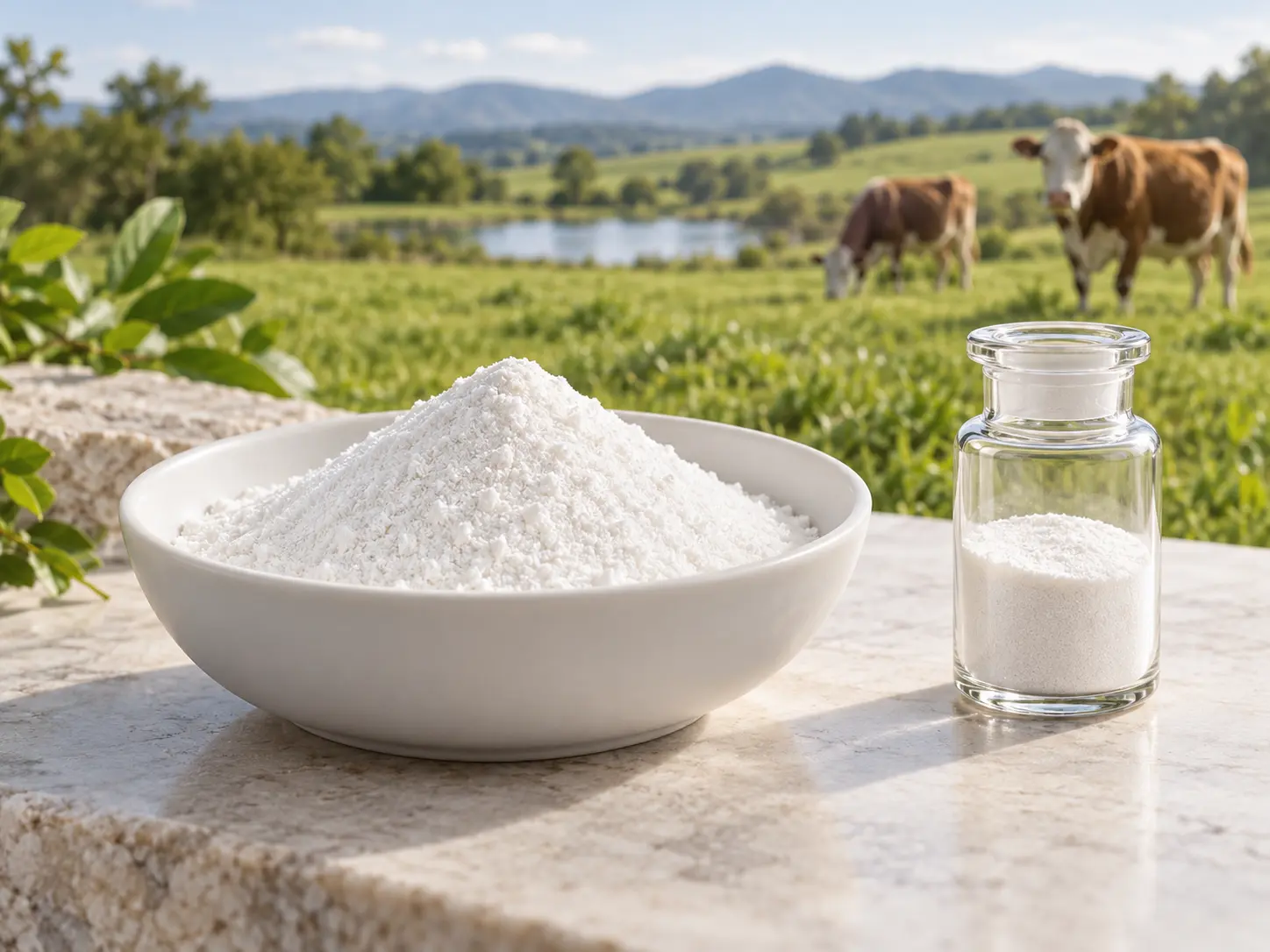
Pure Bovine Chondroitin Sulfate Sodium Manufacturer
Ureda Naturals is a pure bovine chondroitin sulfate sodium manufacturer supplying material produced from bovine cartilage. The manufacturing process combines cooking, plant-protease enzymolysis, separation, purification, alcohol precipitation, drying and milling to obtain a controlled white or almost white powder.
For professional buyers, chondroitin sulfate sodium quality should not be assessed by assay alone. Source identity, electrophoretic profile, residual protein, solution clarity, moisture, inorganic composition, bulk density and microbiological control all affect raw-material qualification and downstream manufacturing performance.
This page therefore presents not only the product specification, but also the technical relationships between the production process, analytical results and potential behavior in capsules, tablets, powder blends and reconstituted systems.
Product Overview
| Product name | Pure Bovine Chondroitin Sulfate Sodium |
|---|---|
| CAS number | 9082-07-9 |
| Raw-material source | Bovine cartilage |
| Appearance | White or almost white powder |
| Assay specification | ≥95.0% on the dried basis |
| Supplied batch result | 96.80% |
| Processing | Cooking, plant-protease enzymolysis, separation, purification, alcohol precipitation, drying and milling |
| Packaging | 25 kg/drum |
| Storage | Store sealed in a cool, dry place |
| Shelf life | 2 years |
Why Bovine Source Control Matters
Chondroitin sulfate sodium can be produced from cartilage obtained from different animal species. Differences in biological source may be associated with different compositional characteristics, impurity profiles and analytical behavior. A product described as pure bovine therefore requires more than a high assay result.
A technically meaningful bovine-source control system should combine raw-material documentation, supplier qualification, traceability, segregated handling and appropriate analytical verification. These measures help reduce the risk of substitution or unintended cross-species introduction during sourcing, storage and manufacturing.
According to the product technical information, bovine cartilage is used as the starting material and pig-specific DNA is controlled below the detection limit. Species-specific DNA control provides useful molecular evidence, but it should be interpreted as one part of the broader source-control system rather than as a substitute for traceability and manufacturing segregation.
Key Elements of Source Assurance
- Documented bovine cartilage as the starting material
- Raw-material supplier qualification and traceability
- Controlled storage and material identification
- Measures designed to prevent cross-species introduction
- Species-specific analytical verification where required
- Batch documentation consistent with the supplied material
Plant-Protease Enzymolysis and Controlled Purification
In bovine cartilage, chondroitin sulfate is associated with a complex extracellular matrix containing proteins and other structural components. Manufacturing must release and recover the target fraction while reducing residual proteins, insoluble matter and non-target components.
Plant-protease enzymolysis is used to hydrolyze proteinaceous matrix components under controlled processing conditions. This supports subsequent solid-liquid separation and purification. The performance of this stage cannot be judged from process description alone; it should also be reflected in the finished material’s protein limit, clarity, identification profile and assay.
- Bovine cartilage preparationThe cartilage raw material is inspected, identified and prepared for controlled processing.
- Cooking and matrix conditioningThermal processing softens and conditions the cartilage matrix before enzymatic treatment.
- Plant-protease enzymolysisProteinaceous matrix components are hydrolyzed to facilitate the release and recovery of the chondroitin-containing fraction.
- SeparationUndissolved cartilage matter and other process solids are separated from the liquid fraction.
- PurificationResidual proteins, color bodies and other non-target components are progressively reduced.
- Alcohol precipitationThe chondroitin sulfate sodium fraction is recovered from the purified solution.
- DryingMoisture is reduced to produce a stable powder within the specified loss-on-drying limit.
- MillingThe dried material is milled to obtain a consistent powder suitable for handling and further formulation.
Complete COA Specifications and Detection Results
The following table retains all supplied certificate-of-analysis test items, specifications and detection results.
| Test Item | Specification | Detection Result |
|---|---|---|
| Appearance | White or almost white powder | Pass |
| Clarity at 420 nm | Absorbance ≤0.35 | 0.09 |
| Identification — Liquid Phase | Consistent with the retention time of the reference substance | Pass |
| Identification — IR Spectrum | Consistent with the reference sample spectrum | Pass |
| Identification — Sodium Salt Reaction | Positive sodium salt reaction | Pass |
| Specific Rotation | −20° to −30° | −28.4° |
| pH | 5.5–7.5 | 6.3 |
| Chloride | ≤0.5% | Pass |
| Sulfate Radical | ≤0.24% | Pass |
| Limit of Protein | ≤3.0% | Pass |
| Loss on Drying | ≤12.0% | 9.55% |
| Residue on Ignition | 20.0%–30.0% | 25.90% |
| Electrophoresis | ≤2% | Pass |
| Bulk Density | ≥0.6 g/mL | 0.71 g/mL |
| Total Bacterial Count | ≤1,000 CFU/g | Pass |
| Yeasts and Molds | ≤100 CFU/g | Pass |
| Escherichia coli | Negative | Negative |
| Salmonella Species | Negative | Negative |
| Staphylococcus aureus | Negative/25 g | Negative |
| Assay on the Dried Basis | ≥95.0% | 96.80% |
How to Interpret the Quality Profile
Assay Should Not Be Evaluated in Isolation
The supplied batch assay is 96.80% on the dried basis, exceeding the specification of 95.0%. This result quantifies chondroitin sulfate sodium after correcting for the contribution of moisture.
Assay does not independently establish animal source, molecular-weight distribution, residual protein, solution appearance or processing behavior. A reliable technical evaluation should therefore combine assay with identification, electrophoresis, protein, clarity, moisture, residue on ignition and microbiological results.
Three Complementary Identification Tests
The specification uses three identification approaches because each confirms a different aspect of the material:
- Liquid-phase identification compares chromatographic retention behavior with a reference substance.
- Infrared identification compares the material’s infrared spectral fingerprint with the reference sample.
- Sodium salt reaction confirms that the material is present in the sodium salt form.
Concordant results across these tests provide stronger identity evidence than reliance on one analytical response.
Clarity at 420 nm
The clarity specification is an absorbance of ≤0.35 at 420 nm. The supplied batch result is 0.09. Under the specified test conditions, this measurement provides information about solution color and the presence of suspended or incompletely removed matter.
The low batch result supports effective separation and purification. It is especially relevant when visible color or solution appearance matters in downstream development. It does not guarantee that every finished liquid formulation will remain clear because final appearance also depends on concentration, pH, minerals, flavors and other formulation components.
Protein Limit
Bovine cartilage contains a substantial protein matrix. The protein specification of ≤3.0% therefore provides an important indication of enzymolysis and purification efficiency.
Protein should be assessed together with assay and clarity. A high assay result alone does not demonstrate that residual proteinaceous material has been adequately controlled.
Electrophoresis Limit
The electrophoresis specification of ≤2% controls components that migrate differently from the principal chondroitin sulfate sodium fraction under the defined analytical conditions. It functions as a related-component or non-main-band control.
This limit should not be restated as “98% assay.” Electrophoretic composition and quantitative assay represent different quality attributes and should remain separate during technical evaluation.
Residue on Ignition
The supplied batch result for residue on ignition is 25.90%, within the specified range of 20.0%–30.0%. This value may appear high when compared with unrelated botanical or protein ingredients, but chondroitin sulfate sodium is a sulfated sodium salt and is expected to leave an inorganic residue after ignition.
The result should therefore be assessed against the product-specific range. Within this context, residue on ignition helps monitor consistency in salt form and overall inorganic composition.
Loss on Drying and Bulk Density
The loss-on-drying result is 9.55%, within the maximum limit of 12.0%. Moisture control contributes to storage stability, weighing consistency and powder handling.
The bulk-density result is 0.71 g/mL, above the minimum specification of 0.6 g/mL. Bulk density affects capsule volume estimation, hopper loading, premix preparation, packaging volume and transport efficiency.
Bulk density does not replace direct measurements of particle-size distribution, flowability or compressibility. Those properties should be evaluated separately when they are critical to the intended manufacturing process.
Quality Indicators as a Connected Control System
| Quality Dimension | Relevant Indicators | Technical Significance |
|---|---|---|
| Material identity | Liquid-phase identification, IR spectrum and sodium salt reaction | Confirms chromatographic behavior, spectral identity and sodium form |
| Source control | Bovine cartilage traceability and species-specific control | Supports verification of the declared animal source |
| Principal component | Assay on the dried basis | Quantifies chondroitin sulfate sodium after moisture correction |
| Related components | Electrophoresis | Controls electrophoretically separated non-main components |
| Purification efficiency | Protein limit and clarity at 420 nm | Provides information about residual protein, color and suspended matter |
| Salt and inorganic profile | Residue on ignition, chloride and sulfate radical | Monitors the sodium-salt matrix and selected inorganic residues |
| Powder handling | Loss on drying and bulk density | Supports assessment of storage, dosing, filling and packaging behavior |
| Microbiological quality | Total count, yeasts, molds and specified pathogens | Evaluates microbiological control of the finished powder |
Formulation and Downstream Manufacturing Considerations
Capsule Formulations
For capsule development, formulators should consider target dosage, capsule size, bulk density, flow behavior and the amount of excipient required to maintain fill-weight consistency.
The measured bulk density of 0.71 g/mL provides an initial basis for estimating capsule fill volume. It does not by itself establish production-scale flowability, so trial filling should still evaluate hopper behavior, weight variation and the influence of lubricants or flow aids.
Tablet Formulations
A high chondroitin sulfate sodium assay does not mean that the powder is automatically suitable for direct compression. Tablet development should evaluate compressibility, lubricant sensitivity, granulation behavior, hardness, friability and disintegration.
Depending on tablet weight, formulation composition and equipment, granulation or functional excipients may be needed to achieve consistent compression and mechanical strength.
Powder Blends and Sachets
In multi-ingredient powder systems, differences in particle size and density can increase segregation risk. Development work should assess mixing sequence, blend uniformity, filling consistency and the compatibility of chondroitin sulfate sodium with other ingredients.
The packaging system should also be selected with consideration for environmental moisture and the intended storage period.
Liquid and Reconstituted Systems
The 420 nm clarity result provides a useful raw-material baseline, but finished-system clarity must be evaluated separately. Chondroitin sulfate sodium is a charged macromolecular ingredient, so pH, electrolyte concentration, calcium or magnesium salts, acids, flavors and other polymers may influence appearance and solution behavior.
Bench-scale compatibility and stability testing should be performed under the actual formulation conditions before commercial production.
Packaging and Storage
| Standard packaging | 25 kg/drum |
|---|---|
| Storage conditions | Keep sealed and store in a cool, dry place |
| Shelf life | 2 years |
After opening, the inner packaging should be resealed promptly to limit prolonged exposure to environmental moisture. Storage areas should remain clean, dry and protected from direct heat and sunlight.
Technical FAQ
What does “pure bovine” mean for chondroitin sulfate sodium?
“Pure bovine” refers to the declared animal source rather than to assay alone. The starting material is bovine cartilage, while source integrity should be supported by traceability, controlled handling and appropriate species-specific verification. According to the product technical information, pig-specific DNA is controlled below the detection limit. This analytical control complements the broader source-management system.
Why are liquid-phase, infrared and sodium-reaction identification tests all included?
The three tests confirm different aspects of identity. Liquid-phase testing compares chromatographic retention behavior, infrared analysis compares the overall spectral fingerprint, and the sodium reaction confirms the salt form. Concordant results provide stronger identity evidence than a single test used alone.
Does the 96.80% assay define the product’s molecular-weight distribution?
No. The 96.80% result quantifies chondroitin sulfate sodium on the dried basis under the specified assay conditions. It does not define average molecular weight, molecular-weight distribution, chain-length profile or viscosity. If those characteristics are critical to a formulation, they require separate analytical methods and specifications.
What does the electrophoresis limit of ≤2% indicate?
It limits components that migrate differently from the principal chondroitin sulfate sodium fraction under the specified electrophoretic conditions. It is a related-component control and should not be converted into an assay value. A material can meet its assay requirement while still requiring a separate electrophoretic-composition assessment.
Why is residue on ignition specified at 20.0%–30.0%?
Chondroitin sulfate sodium is a sulfated sodium salt and therefore leaves an expected inorganic residue after ignition. The specified range controls consistency in the salt and inorganic profile. The supplied batch result of 25.90% is within this range and should not be judged against limits intended for unrelated botanical or protein ingredients.
Can the 420 nm clarity result predict performance in a finished liquid product?
It provides a useful baseline for the raw material’s solution color and clarity under the specified conditions, but it cannot predict every finished formulation. Final clarity may change with concentration, pH, electrolytes, minerals, acids, flavors and interactions with other charged ingredients. Compatibility and stability testing should therefore use the actual formula.
Which parameters should be prioritized during incoming raw-material evaluation?
A technically balanced incoming-control program should review identity, source documentation, assay, electrophoresis, protein, clarity, loss on drying, residue on ignition, bulk density and microbiological quality. Additional testing may be selected according to the dosage form, target market and risk assessment. Relying only on assay may overlook differences in source integrity, purification efficiency and manufacturing behavior.
