
 Spanish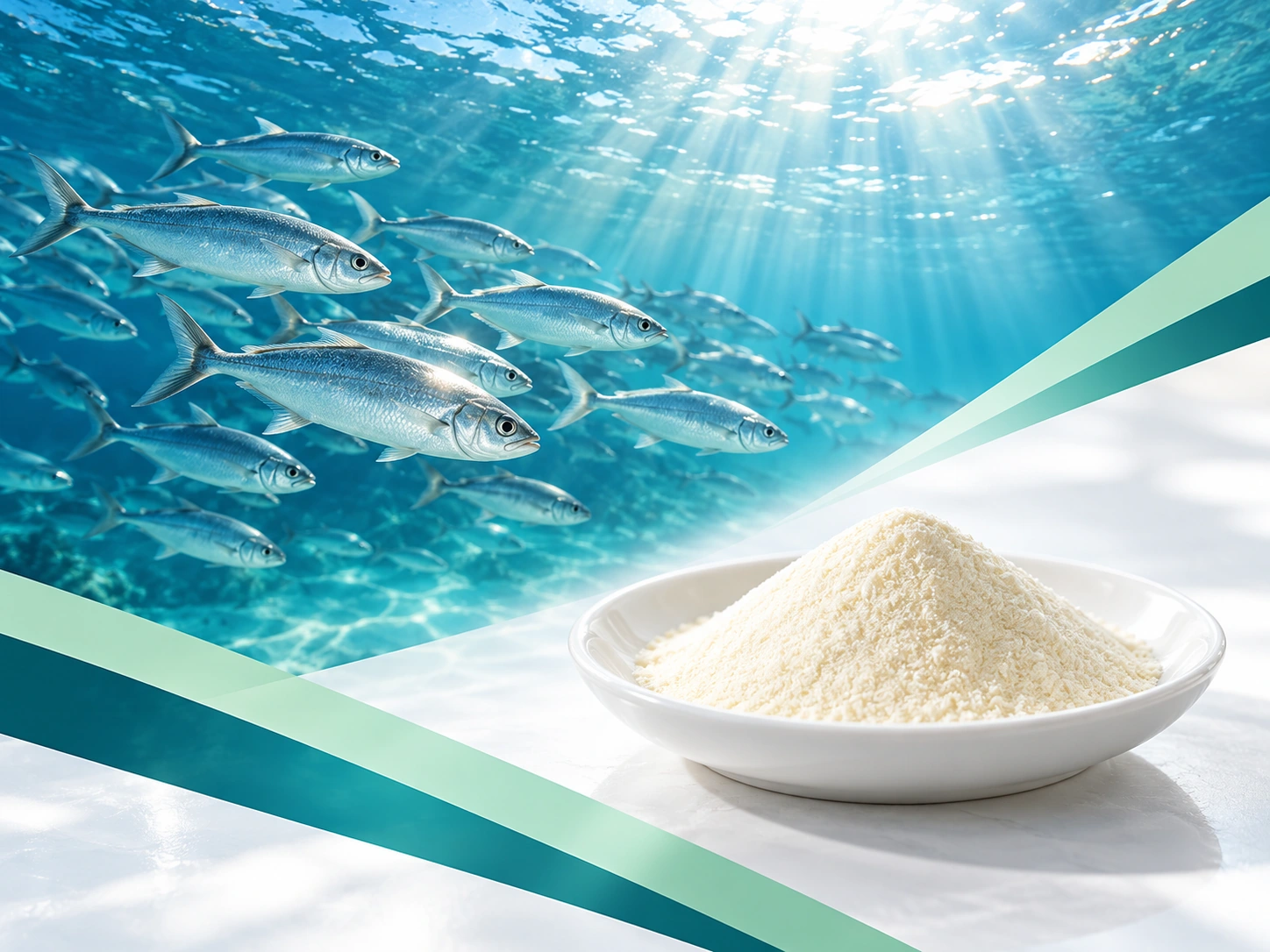
Fish-skin-derived collagen peptide produced through controlled hydrolysis and refining. Available as powder or granules, with ≥90% protein (dry basis) and an average molecular weight of ≤1,000 Da for beverage and supplement formulations.
| Allergen: | Fish |
|---|---|
| Source | Fish skin |
| Protein | ≥90.0% (dry basis) |
| Average molecular weight | ≤1,000 Da |
| Form | Powder or granules |
| Packaging | 10 kg/bag or 20 kg/bag |
Fish Collagen Peptide is produced from fish skin through controlled hydrolysis, decolorization, deodorization, separation and refining, concentration, and spray drying. Powder and granule forms are available for use in beverage, nutrition, and supplement formulations.
| Test Item | Specification | Result |
|---|---|---|
| Color | White to light yellow | Pass |
| Odor | Characteristic odor | Pass |
| Condition | Powder or granules; no visible foreign matter | Pass |
| Protein, dry basis | ≥90.0 g/100 g | 97.7 g/100 g |
| Average molecular weight | ≤1,000 Da | Pass |
| pH, 1% aqueous solution | 5.0–7.0 | 5.6 |
| Hydroxyproline, dry basis | ≥3.0 g/100 g | 7.9 g/100 g |
| Loss on drying | ≤5.0 g/100 g | 4.7 g/100 g |
| Ash | ≤3.0 g/100 g | 0.5 g/100 g |
| Lead | ≤0.5 mg/kg | <0.04 mg/kg |
| Cadmium | ≤0.1 mg/kg | <0.003 mg/kg |
| Chromium | ≤2.0 mg/kg | <0.5 mg/kg |
| Total arsenic | ≤0.1 mg/kg | <0.04 mg/kg |
| Total mercury | ≤0.1 mg/kg | <0.01 mg/kg |
| Total bacterial count | ≤1,000 CFU/g | <100 CFU/g |
| Yeast and mold | ≤100 CFU/g | <100 CFU/g |
| Coliform bacteria | ≤0.3 MPN/g | Not detected |
| Staphylococcus aureus | Negative in 25 g | Not detected |
| Salmonella | Negative in 25 g | Not detected |
An average molecular weight of ≤1,000 Da describes the average of the measured peptide population; it does not mean that every peptide molecule is below 1,000 Da. Average molecular weight, peak molecular weight, and the proportion of peptides within a defined molecular-weight range are different measurements. When comparing suppliers, confirm that the same definition and analytical basis are being used.
A lower average molecular weight may support dispersion and dissolution in water, but it does not by itself predict clarity, taste, hygroscopicity, or powder flow in a finished formulation. The suitable hydrolysis profile depends on the target dosage form and sensory requirements.
Protein is reported on a dry basis, reducing the effect of moisture differences on the comparison. Hydroxyproline provides a collagen-associated composition marker. The two values describe different quality attributes: protein content does not establish peptide distribution, while hydroxyproline should not be used alone to calculate collagen purity.
The pH specification is measured in a 1% aqueous solution. It is a raw-material control value, not the pH of a finished beverage. Acids, minerals, plant extracts, vitamins, flavors, and other proteins can shift the pH and alter the appearance of the final system.
Loss on drying and ash also affect formulation decisions. Moisture is relevant to powder flow, caking, and storage; ash indicates the overall inorganic residue and can influence taste and the formulation window, particularly in mineral-containing or high-solids products.
“Characteristic odor” does not mean odorless. Fish-skin condition, residual lipids, hydrolysis, deodorization, refining, and drying can all influence sensory properties. Evaluate the ingredient at the intended inclusion level in the complete formulation, because acidification, heating, and storage may change how fish-derived notes are perceived.
Fish skin can contain residual lipids, pigments, non-collagen proteins, and minerals in addition to collagen. Raw-material condition and preparation influence the starting point for hydrolysis and refining. Inadequate removal of residual lipids may contribute to oxidation-related notes, while excessive processing can reduce collagen recovery. Preparation therefore needs to balance impurity removal, yield, color, and sensory quality.
Hydrolysis conditions—including enzyme selection, pH, temperature, substrate concentration, and reaction time—shape the peptide profile. Insufficient hydrolysis can leave a greater proportion of larger fragments; more extensive hydrolysis can lower average molecular weight but may also affect bitterness, moisture uptake, and powder handling.
For formulation teams, the useful comparison is not simply “lower versus higher molecular weight.” Compare the molecular-weight definition alongside taste, dissolution behavior, moisture, and performance in the intended dosage form.
Decolorization, deodorization, separation, and refining influence the color, odor, ash, and aqueous appearance of the ingredient. These steps need to reduce unwanted components without unnecessary loss of target peptides.
Concentration and spray drying then convert the refined hydrolysate into a powder. Drying and subsequent granulation can affect moisture, particle size, bulk density, flow, dusting, and wetting. These properties matter during blending and automated filling, so evaluate the physical form using the customer’s actual equipment and process conditions.
Select the form based on the blend, target dose, packaging format, and mixing or filling equipment—not appearance alone.
Assess the ingredient at the planned use level in the complete formula. Check wetting, dispersion, foam, color, odor, turbidity, and sediment—not only whether the powder dissolves in plain water. Acids, minerals, plant polyphenols, other proteins, hydrocolloids, flavor carriers, and high total solids can change the finished system.
For pasteurized, hot-filled, or otherwise heat-treated products, compare appearance and sensory properties before and after processing and during storage. A solution that looks clear immediately after mixing may not remain clear after heating or holding.
In dry blends, particle-size and bulk-density differences can cause segregation during transfer, vibration, hopper residence, or continuous filling. Pilot runs should compare blend uniformity and fill or assay results at the beginning, middle, and end of a run. Premixing, particle-size matching, or granulation may help when the blend shows separation.
For capsules, bulk density and flow affect capsule size, fill weight, and the room available for other ingredients. Confirm the fill on the intended capsule and equipment rather than inferring it from protein content.
For tablets, assess flow, compressibility, sticking, hardness, friability, and disintegration. Direct compression may not suit every formula; granulation or excipient adjustment may be required. If wet granulation is used, check the effect of drying on color, odor, and moisture.
Gummies combine high solids, acidic conditions, and heat. During processing or storage, reactions between peptide amino groups and reducing sugars may affect color and flavor. In bars and composite protein foods, moisture uptake can also change firmness and stickiness. Evaluate the ingredient in the actual sugar system, process temperature, moisture level, and package.
Fish Collagen Peptide can be considered for development of:
Confirm the ingredient name, permitted use, and labeling requirements for the target market and finished-product category.
Not from that label alone. One supplier may report an average, another a peak value, and another the proportion within a selected molecular-weight range. Ask for the measurement definition and compare the same basis. Then review protein, hydroxyproline, moisture, ash, sensory properties, and the physical form relevant to your application.
No. More extensive hydrolysis can lower average molecular weight, but may also affect bitterness, moisture uptake, and powder handling. A beverage may prioritize dissolution and sensory quality, while a sachet or tablet blend may place greater emphasis on flow, caking, and blend uniformity. Match the peptide profile to the intended product rather than selecting the lowest number by default.
Test it at the planned use level in the complete formula and process. Record the target pH, mixing conditions, and appearance before and after heat treatment; then check turbidity, sediment, color, and odor over the intended holding and storage period. Include the acids, minerals, proteins, plant ingredients, and flavor system that will be present in the commercial product.
Some odor notes that are subtle in dry powder can become more perceptible after hydration, acidification, heating, or storage. Acids, flavor solvents, and plant extracts can also change sensory perception. Evaluate the complete formula at the target dose at mixing, after thermal processing, and during storage; a dry-powder odor check alone is not enough to predict the finished drink.
Production-scale agitation, recirculation, pumping, and tank return can entrain more air than hand mixing. Review the order of addition, mixing speed, liquid level, pump air intake, and other surface-active ingredients. Compare foam during mixing and filling, and assess whether a defined settling or deaeration step is needed for the process.
Differences in particle size and bulk density can promote segregation during transfer, vibration, or hopper residence. Check the premix ratio, addition sequence, mixing time, transfer method, and fill or assay results at the start, middle, and end of the run. If variation appears, compare premixing, particle-size matching, or granulated material under the same line conditions.
Review the product specification, fish-skin source and allergen information, the definition used for average molecular weight, powder or granule form, packaging, storage, and shelf-life information. For beverages, gummies, and other heat-processed products, qualify the ingredient in the intended formula and process rather than relying on a COA or a plain-water test alone.
INGREDIENT PARTNER
Tell us your intended application, approximate quantity and target market. Ureda Naturals will confirm the closest grade, packaging configuration and available documentation for your project.

Scan the QR code or
search WeChat ID: 18270717590
From Natural Origin to Formulation Intent
Tell us what you’re sourcing.
