
 Spanish
Spanish
Spanish
Bovine Bone Collagen Peptide is a hydrolyzed protein ingredient made from fresh bovine bone. Enzymatic hydrolysis produces peptide material, followed by decolorization, concentration and spray drying to create a powder or granule ingredient for food, health-food and cosmetic formulations.
The specification combines protein content, average molecular weight, hydroxyproline, moisture, pH and microbiological limits. These measure different aspects of the ingredient: protein content does not describe peptide-size distribution, while a 1% solution pH does not define the pH of a finished formulation.
| Test Item | Specification | Result |
|---|---|---|
| Appearance | White or light yellow powder | Pass |
| Condition | Powder or granules; no visible foreign matter | Pass |
| Odor | Characteristic odor | Pass |
| Protein, dry basis | ≥90.0 g/100 g | 93.7 g/100 g |
| Average molecular weight | ≤3,000 Da | Pass |
| pH, 1% aqueous solution | 5.0–7.0 | 6.0 |
| Hydroxyproline, dry basis | ≥3.0 g/100 g | 8.2 g/100 g |
| Loss on drying | ≤5.0 g/100 g | 4.3 g/100 g |
| Ash | ≤3.0 g/100 g | 1.9 g/100 g |
| Lead | ≤0.5 mg/kg | <0.5 mg/kg |
| Cadmium | ≤0.1 mg/kg | <0.1 mg/kg |
| Chromium | ≤2.0 mg/kg | <2.0 mg/kg |
| Total arsenic | ≤0.1 mg/kg | <0.1 mg/kg |
| Total mercury | ≤0.1 mg/kg | <0.1 mg/kg |
| Total bacterial count | ≤1,000 CFU/g | 100 CFU/g |
| Yeast and mold | ≤100 CFU/g | <100 CFU/g |
| Coliform bacteria | ≤0.3 MPN/g | <0.3 MPN/g |
| Staphylococcus aureus, 25 g | Negative | Negative |
| Salmonella, 25 g | Negative | Negative |
Enzymatic hydrolysis converts collagen proteins into smaller peptides. The ≤3,000 Da specification is an average molecular-weight limit; it does not mean that every peptide molecule is below 3,000 Da or describe the full peptide-size distribution. When comparing suppliers or qualifying a formulation that depends on peptide size, align the molecular-weight definition and test method. If a particular size fraction matters to the finished product, compare distribution data rather than relying on the average alone.
Protein content is stated on a dry basis, while hydroxyproline provides a separate compositional measure. Neither value, by itself, establishes the ingredient’s peptide-size profile. For formula calculations, use the assay basis and moisture information consistently rather than treating a dry-basis protein value as an as-is value.
The peptide dissolves in water and can form a clear aqueous solution. That initial result does not by itself establish how the ingredient will behave after other beverage components or processing steps are introduced. For a meaningful pilot, prepare it at the intended use level, then follow the actual addition sequence. Check appearance and sediment after the full ingredient blend, after any heat treatment, and during the planned holding or storage period. If a change appears, compare samples at the relevant process stages to identify when the finished formula begins to differ from the initial solution.
Powder and granule formats should be assessed against the intended feeding and blending equipment. During a production trial, observe metering consistency, dusting and segregation, then sample the blend at the beginning, middle and end of discharge using the manufacturer’s established blend-uniformity method. This confirms whether the chosen physical form works with the actual line rather than assuming that protein content alone predicts powder-handling performance.
For cosmetic use, assess the ingredient in the complete intended base rather than in water alone. Check dispersion, appearance, odor and viscosity after incorporation, then recheck them following the formulation’s preservation and stability steps. The result in a simple aqueous solution is not a substitute for compatibility testing in a serum, gel or cream.
| MOQ | 1 kg |
|---|---|
| Packaging | 10 kg/bag or 20 kg/bag |
| Storage | Keep sealed in a cool, dry place. |
| Shelf life | 2 years |
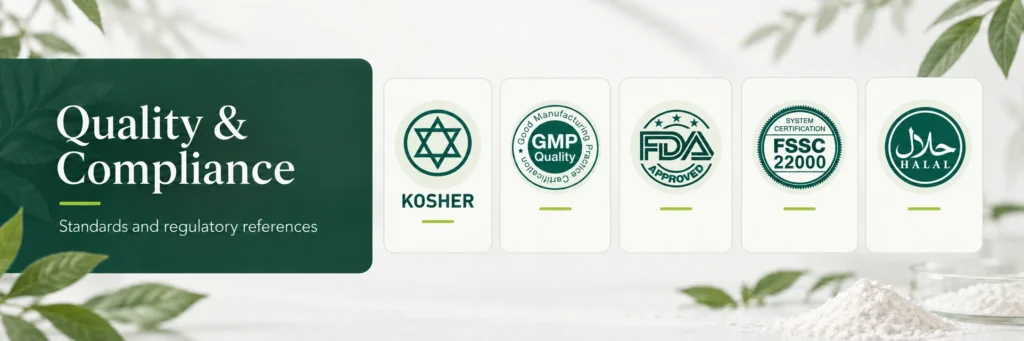
Quality documentation includes the product specification, COA, TDS and SDS. Applicable GMP, FSSC 22000, ISO 9001, HACCP, Halal and Kosher documentation is available for buyer review, as applicable.
No. Protein content measures the protein level on a dry basis; it does not show how peptide sizes are distributed. For supplier comparison, review protein content alongside the average molecular-weight definition and, where size distribution matters to the application, comparable distribution data obtained using aligned methods.
No. The value refers to a 1% aqueous solution of the ingredient. The finished product’s pH is determined by the complete formulation and its processing conditions, so measure pH in the actual formula after all ingredients have been added.
Starting with a separate aqueous solution can make the first dissolution step easier to assess. Then add the remaining ingredients in the intended production order and check appearance after each major addition. This helps distinguish an issue during initial dissolution from a change that occurs later in the full beverage system; confirm the sequence in the actual formulation.
Do not assume a one-to-one substitution. Hydrolyzed collagen peptides and gelatin have different molecular structures and functional behavior; gelatin is used for its gel-forming properties, while hydrolyzed peptides are not a direct equivalent. Test the finished product’s texture and stability if considering a reformulation.
Choose based on how each form feeds, disperses and blends on your production line. Compare weighing consistency, dusting, segregation and blend uniformity under the same process conditions before selecting a format for scale-up.
INGREDIENT PARTNER
Tell us your intended application, approximate quantity and target market. Ureda Naturals will confirm the closest grade, packaging configuration and available documentation for your project.

