
 Spanish
Spanish
Spanish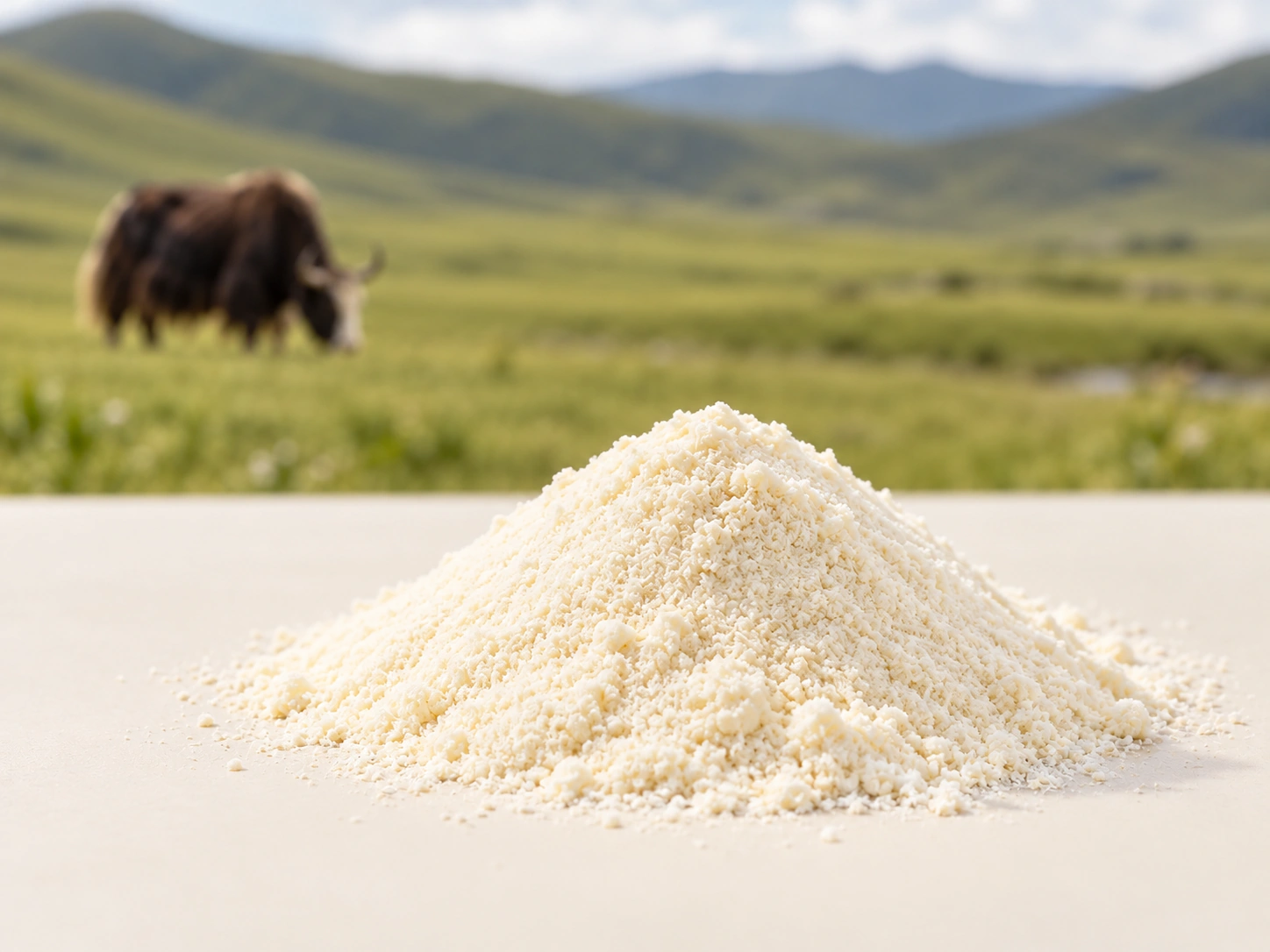
For formulators comparing animal-source peptide ingredients, source identity is only one part of specification selection. This yak-bone powder combines an enzymatically hydrolyzed peptide profile with defined protein, hydroxyproline, pH and average-molecular-weight criteria for food, health-food and cosmetic formulation review.
Selected yak bone is processed by enzymatic hydrolysis, followed by decolorization, concentration and spray drying. The product is water-soluble and forms a clear solution in water. Its sensory profile is a characteristic odor, with fishy notes reduced through processing.
The average molecular weight specification is ≤1,000 Da. This is an average-value specification, not a statement that every peptide molecule is below 1,000 Da. Supplier comparisons should use the same molecular-weight definition and measurement method.
The quality profile specifies protein at ≥90.0 g/100 g on a dry basis and hydroxyproline at ≥3.0 g/100 g on a dry basis. The listed results are 93.7 g/100 g and 8.2 g/100 g, respectively. These values describe different aspects of the material: protein content is not a peptide-size measurement, while hydroxyproline is a collagen-associated amino-acid indicator. Neither value should be converted directly into a collagen-peptide percentage without a defined analytical basis.
The pH result of 6.0 is measured in a 1% aqueous solution. It describes that test solution, not the pH of a finished beverage, supplement or cosmetic formula.
| Test item | Specification | Result |
|---|---|---|
| Color | White or light yellow | Pass |
| Odor | Characteristic odor | Pass |
| Product condition | Powder; no visible extraneous matter | Pass |
| Protein, dry basis | ≥90.0 g/100 g | 93.7 g/100 g |
| Average molecular weight | ≤1,000 Da | Pass |
| pH, 1% aqueous solution | 5.0–7.0 | 6.0 |
| Hydroxyproline, dry basis | ≥3.0 g/100 g | 8.2 g/100 g |
| Loss on drying | ≤5.0 g/100 g | 4.3 g/100 g |
| Ash | ≤3.0 g/100 g | 1.9 g/100 g |
| Lead (Pb) | ≤0.5 mg/kg | <0.5 mg/kg |
| Cadmium (Cd) | ≤0.1 mg/kg | <0.1 mg/kg |
| Chromium (Cr) | ≤2.0 mg/kg | <2.0 mg/kg |
| Total arsenic (As) | ≤0.1 mg/kg | <0.1 mg/kg |
| Total mercury (Hg) | ≤0.1 mg/kg | <0.1 mg/kg |
| Total bacteria count | ≤1,000 CFU/g | 100 CFU/g |
| Yeast and mold | ≤100 CFU/g | <100 CFU/g |
| Coliform bacteria | ≤0.3 MPN/g | <0.3 MPN/g |
| Staphylococcus aureus, 25 g | Negative | Negative |
| Salmonella, 25 g | Negative | Negative |
Water solubility makes the powder a candidate for aqueous as well as dry-form products. For a beverage prototype, assess it first in water at the intended use concentration, then test it in the complete formula under the actual mixing and processing conditions. Clarity in water alone does not establish the appearance of a finished beverage.
The product is suitable for evaluation in cosmetic formulations. For a serum, gel or cream, assess how the powder’s solubility, white-to-light-yellow color and characteristic odor carry into the finished base before scale-up.
Product documents: COA, TDS and SDS.
Quality and compliance documents: GMP, FSSC 22000, ISO 9001, HACCP, Halal, Kosher and FDA-related regulatory documentation.
Not automatically. Source, molecular-weight specification, protein and hydroxyproline values, solubility and sensory profile can differ. Compare the relevant quality criteria and evaluate the yak-bone powder in the target formula before setting a one-to-one replacement rate.
First confirm that both suppliers use the same molecular-weight definition and measurement method. An average value does not show the full peptide-size distribution or the percentage below a specific cutoff. If peptide distribution matters to the formulation, compare distribution data rather than average values alone.
No. Solubility and clarity in water are useful starting properties, but the complete beverage matrix and processing conditions affect the final appearance. Test the ingredient at the intended concentration in the full formula and inspect it after the planned mixing and processing steps.
INGREDIENT PARTNER
Tell us your intended application, approximate quantity and target market. Ureda Naturals will confirm the closest grade, packaging configuration and available documentation for your project.

