


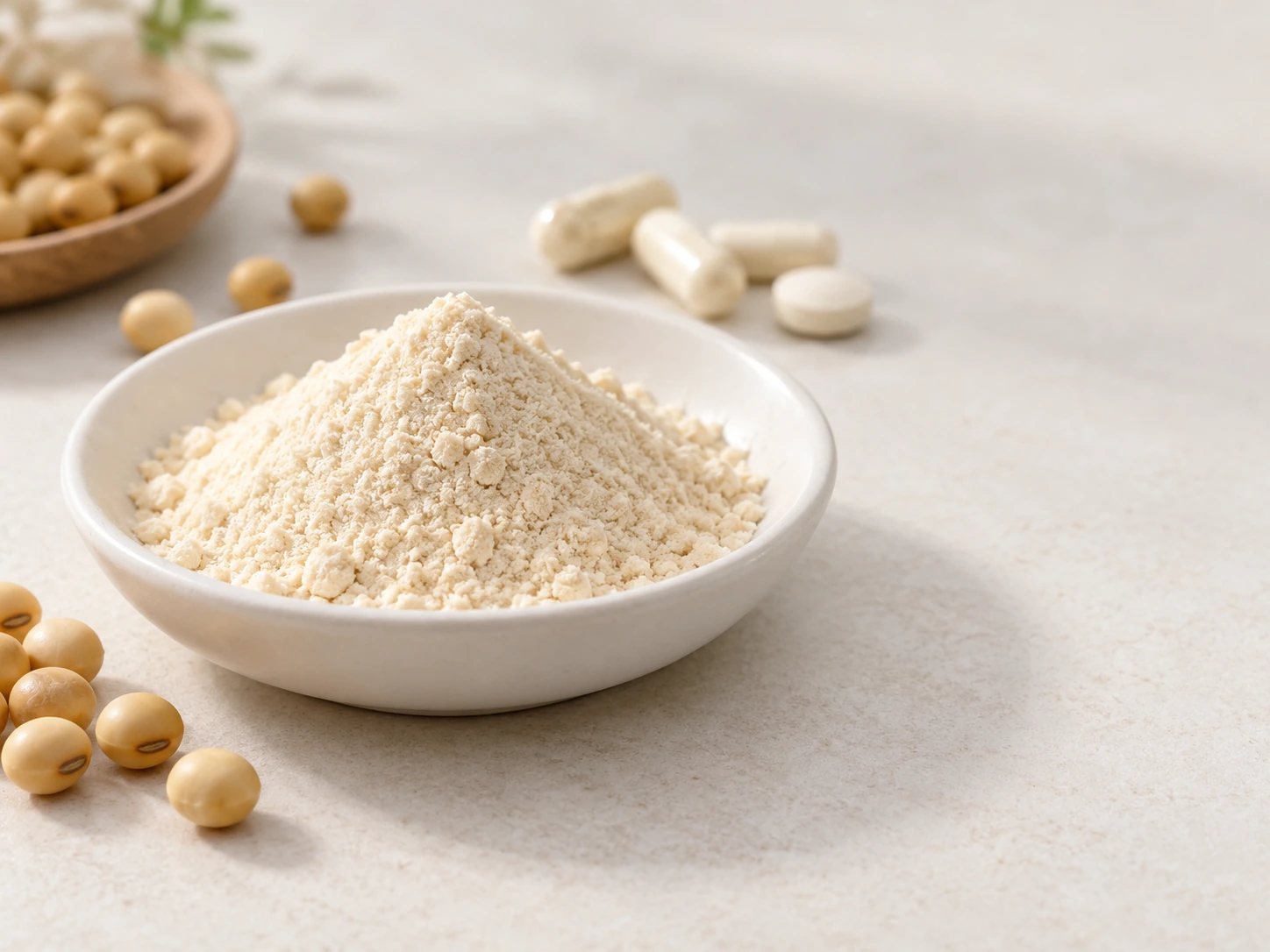
Ureda Naturals supplies Nattokinase Powder standardized by fibrinolytic enzyme activity for capsule, tablet, nutritional powder and solid-beverage development. The standard grade provides not less than 20,000 FU/g, while custom activity grades can be selected according to the target activity per serving, available dosage-form space, blending requirements and expected process retention.
Unlike a small-molecule ingredient commonly evaluated by percentage purity, Nattokinase Powder is primarily specified by the fibrin-degrading activity measured under defined assay conditions. Product qualification should therefore consider more than the declared FU/g value. The activity method, carrier composition, moisture, particle properties, microbiological quality, vitamin K2 requirements and activity retained after processing can all affect the suitability of a material for a finished formulation.
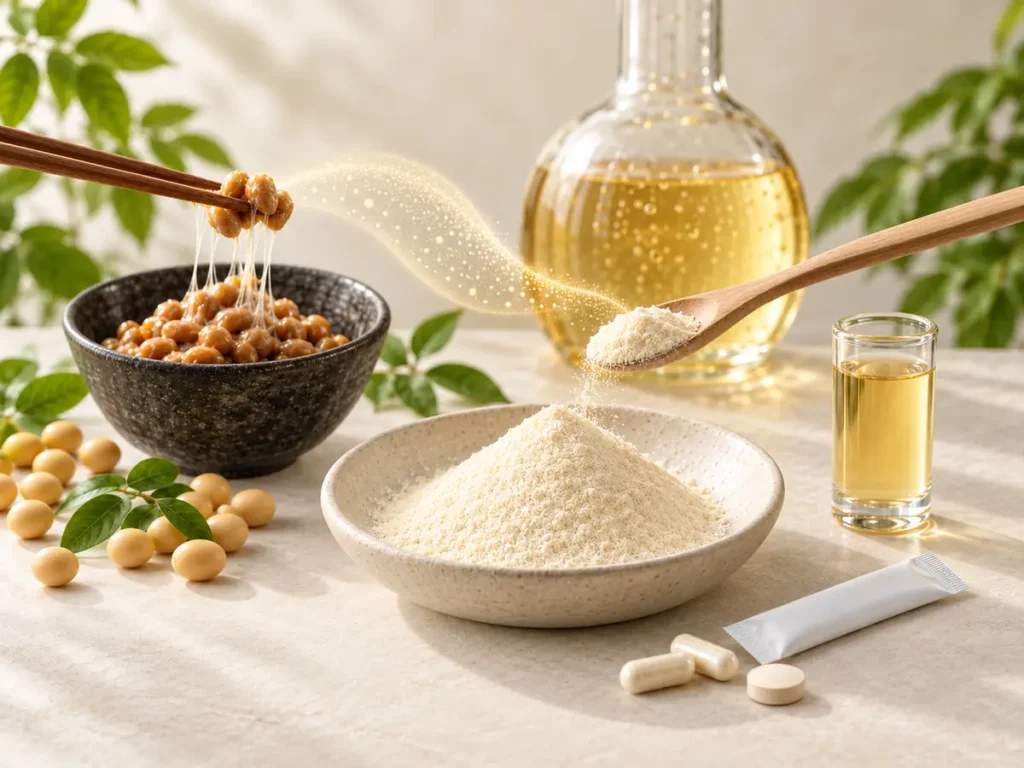
Nattokinase Powder Advantages and Technical Features
Patented Strain and Liquid Fermentation
The product is manufactured using a patented Bacillus subtilis natto strain and a controlled liquid-fermentation process. Fermentation conditions influence enzyme production, the composition of the fermentation broth and the consistency of subsequent activity standardization.
For ingredient qualification, fermentation origin is only the starting point. Strain control, fermentation substrate, culture conditions, separation and final activity standardization must work together to maintain the agreed FU/g specification between production batches.
Standard Activity of at Least 20,000 FU/g
The standard Nattokinase Powder specification provides enzyme activity of at least 20,000 FU/g. This activity level can deliver the intended fibrinolytic units with a relatively low raw-material mass, leaving additional formulation space for fillers, flow aids and other active ingredients.
FU/g expresses fibrinolytic enzyme activity per gram of powder. It does not describe the percentage by weight of nattokinase in the material. Product specifications, labels and Certificates of Analysis should therefore distinguish enzyme activity from chemical purity.
Non-GMO Soybean Fermentation Substrate
Non-GMO soybean is used as the fermentation substrate. Non-GMO status describes the origin of the substrate; it does not automatically establish that the finished material is free from residual soy protein.
Projects requiring a soy-free or allergen-free position should separately review the manufacturing process, residual soy-protein testing and the applicable allergen documentation.
Customizable Activity Grades
Different activity grades change the raw-material mass needed to deliver the same target FU. This affects capsule capacity, tablet weight, room for complementary ingredients, blending uniformity and cost per finished serving.
A higher FU/g value is not automatically the best option for every formulation. A more concentrated grade reduces ingredient mass but may make a low-dose enzyme more difficult to distribute uniformly through a large blend. The appropriate grade should be selected according to target activity, dosage-form capacity, batch size, powder behavior and verified process retention.
Available Nattokinase Activity Grades
| Activity Grade | Product Positioning | Theoretical Mass for 2,000 FU | Main Selection Consideration |
|---|---|---|---|
| 5,000 FU/g | Custom standardized grade | 400 mg | A larger material input can support weighing and premixing but occupies more dosage-form space. |
| 10,000 FU/g | Custom standardized grade | 200 mg | Balances dosage-form space, weighing accuracy and blend-uniformity requirements. |
| 20,000 FU/g | Standard high-activity grade | 100 mg | Suitable for many capsule, tablet and nutritional-powder projects. |
| 40,000 FU/g | Custom concentrated grade | 50 mg | Reduces raw-material mass and releases space for other active ingredients and excipients. |
The theoretical raw-material mass can be calculated as:
Raw material per serving (mg) = target activity (FU) ÷ raw-material activity (FU/g) × 1,000
For example, a serving target of 2,000 FU theoretically requires 100 mg of a 20,000 FU/g Nattokinase Powder. This calculation does not yet account for the actual batch result, weighing variation, blend uniformity or activity lost during manufacturing.
Standard Quality Specification
| Test Item | Specification |
|---|---|
| Product Name | Nattokinase Powder |
| Source | Bacillus subtilis natto fermentation |
| Fermentation Substrate | Non-GMO soybean |
| Appearance | Off-white to light yellow powder |
| Nattokinase Activity | ≥20,000 FU/g |
| Loss on Drying | ≤5.0% |
| Residue on Ignition | ≤5.0% |
| Particle Size | ≥95% through 80 mesh |
| Lead | ≤1.0 mg/kg |
| Arsenic | ≤1.0 mg/kg |
| Cadmium | ≤0.5 mg/kg |
| Mercury | ≤0.1 mg/kg |
| Total Plate Count | ≤1,000 CFU/g |
| Yeast and Mold | ≤100 CFU/g |
| Escherichia coli | Not detected |
| Salmonella | Not detected in 25 g |
Enzyme activity is the central specification, but it should not be reviewed in isolation. Moisture affects storage behavior, powder flow and caking risk. Particle size affects premixing and sample representativeness. Microbiological and elemental limits support raw-material release for the intended dosage form and destination market.
If a project requires low vitamin K2, the maximum vitamin K2 content and corresponding analytical method should be added as a separate specification. Vitamin K2 content cannot be inferred from the declared nattokinase activity.
How to Compare Nattokinase Activity Correctly
FU/g Is an Activity Unit, Not a Purity Percentage
FU/g describes the ability of a defined mass of Nattokinase Powder to degrade a fibrin substrate under specified test conditions. The result can be influenced by the unit definition, substrate system, sample extraction, dilution procedure, reaction temperature, pH, reaction time, endpoint measurement and calculation basis.
Two materials labelled 20,000 FU/g are not necessarily interchangeable when they are tested using different procedures. Before comparing price or potency, the buyer should establish whether the activity definitions and analytical conditions are aligned.
Minimum Specification, Typical Value and Batch Result Are Different
A specification of ≥20,000 FU/g normally represents the minimum release requirement. A typical value describes the level commonly observed in routine production, while a batch result reports the measured activity of one particular lot.
A valid supplier comparison should compare the same type of data. A minimum specification from one supplier should not be compared directly with the highest single-batch result reported by another.
Equal Activity Does Not Guarantee Equal Manufacturing Behavior
Even when two materials use comparable activity methods and both meet 20,000 FU/g, their performance can differ because of:
- Carrier type and carrier proportion;
- Moisture content;
- Particle-size distribution;
- Bulk density and tapped density;
- Powder flow and hygroscopicity;
- Electrostatic behavior and agglomeration;
- Vitamin K2 content;
- Residual soy protein;
- Microbiological and impurity controls.
Changing supplier or activity grade should therefore trigger a review of weighing, premixing, blend uniformity, processing conditions and finished-product activity retention.
From Raw-Material Activity to Finished-Product Release
A conforming raw-material COA does not by itself guarantee that the finished product will meet its target activity. Final activity depends on:
- The measured FU/g of the incoming batch;
- Activity lost during blending, granulation, drying, tableting or coating;
- Activity change during packaging and shelf-life storage.
A more complete formulation calculation is:
Planned raw-material input = target finished-product activity ÷ measured raw-material activity ÷ verified process retention
If the finished-product target is 2,000 FU, the raw material is 20,000 FU/g and the verified manufacturing retention is 85%, the theoretical input is approximately 117.6 mg rather than 100 mg.
The retention factor must come from the actual formulation and manufacturing process. A value reported in literature, in a supplier presentation or for another finished product should not be substituted for project-specific validation.
Building a Finished-Product Activity Verification Plan
Incoming Raw Material
Confirm the batch activity, moisture, appearance, microbiological quality and other agreed release parameters. Check that the COA refers to the selected activity grade and uses the approved analytical method.
After Premixing
Test samples from different blend locations to determine whether the low-dose enzyme is distributed uniformly. A visually uniform powder or a consistent blend weight does not demonstrate uniform FU activity.
After Critical Processing Steps
Depending on the dosage form, test activity after granulation, drying, tableting or coating. Intermediate testing helps identify the specific stage at which activity loss occurs.
Finished-Product Release
Evaluate finished-product FU activity, content uniformity, moisture and the other release parameters relevant to the selected dosage form.
During Stability Testing
Reassess FU activity at defined stability intervals. Appearance, moisture, disintegration and packaging integrity cannot independently demonstrate that the enzyme remains at its initial activity.
This staged approach separates raw-material variation, sampling error, blend non-uniformity, process loss and shelf-life decline instead of treating every finished-product activity deviation as an incoming-material problem.
Nattokinase Powder in Capsule Formulations
The 20,000 FU/g grade provides target activity with a relatively low ingredient mass, making it suitable for hard capsules and multi-ingredient capsule formulations. However, a lower inclusion level increases the importance of blend uniformity.
A small amount of Nattokinase Powder should not normally be added directly to a large quantity of excipient. A geometric premix with a compatible carrier can first be prepared and then expanded in controlled stages.
Capsule development should review:
- Particle-size and density differences between nattokinase and the major excipients;
- Premix ratio and order of addition;
- Blending time and equipment loading;
- FU distribution across samples taken from different blend locations;
- Segregation between blending and capsule filling;
- Finished-capsule activity and fill-weight consistency.
When changing from 20,000 FU/g to 40,000 FU/g, the theoretical ingredient mass is halved. The premix procedure should still be revalidated because the lower inclusion rate can increase sensitivity to weighing error, electrostatic adhesion and density-driven segregation.
Nattokinase Powder in Tablet Formulations
Tablet manufacturing can expose nattokinase to moisture, heat, shear and compression. A raw-material result of 20,000 FU/g does not demonstrate that the compressed tablet will retain the same activity.
Low-moisture and low-thermal-load processing routes should be evaluated first. For direct compression, the development team should examine powder flow, premix uniformity, frictional heating and activity after compression.
If wet granulation is required, the evaluation should record:
- Granulating-liquid type and quantity;
- Enzyme contact time with the liquid phase;
- Wet-mass holding time;
- Drying temperature and duration;
- Endpoint moisture;
- Milling or sizing conditions;
- Residual activity after granulation and tableting.
The suitability of the process should be determined by FU retention before and after manufacturing, rather than by granule appearance, tablet hardness or tablet weight alone.
Nattokinase Powder in Nutritional Powders and Solid Beverages
Dispersibility in water does not prove that nattokinase will retain its target activity in a complete beverage matrix or throughout the intended shelf life.
The local environment around the enzyme can be changed by:
- Organic acids and acidic fruit powders;
- Minerals;
- Proteins and peptides;
- Hygroscopic sugar alcohols;
- Hydrocolloids;
- Flavor systems;
- Other enzymes;
- High-water-activity ingredients.
A useful development study compares a control matrix with the complete formulation. Evaluate activity immediately after blending, dispersion time, agglomeration, sedimentation, moisture pickup, powder flow and activity after storage.
If the product is intended for hot-water preparation, the test should reproduce the actual water temperature and expected delay before consumption. Good dispersion in room-temperature water should not be used as evidence of activity retention after hot-water preparation.
Plain Powder, Microencapsulated Powder and Enteric Delivery
Plain Nattokinase Powder, microencapsulated nattokinase and an enteric finished product describe different product levels.
Plain Nattokinase Powder
Plain powder is the base ingredient standardized by FU/g. Qualification focuses on activity, carrier, moisture, microbiological quality, impurities, physical properties and activity retained through the intended manufacturing process.
Microencapsulated Nattokinase
A microencapsulated material contains nattokinase within a defined wall-material system. In addition to FU/g, qualification should address active loading, wall-material identity, encapsulation efficiency, particle size, release behavior, storage stability and activity retained after processing.
Heat-resistance, acid-resistance or storage-retention data generated for a specific microencapsulated system cannot automatically be assigned to a plain powder.
Enteric Finished Products
Acid protection may be supplied by an enteric capsule, an enteric-coated tablet or a protected raw-material system. Plain Nattokinase Powder can be used as the active ingredient in an enteric dosage form, but the powder itself should not automatically be described as enteric.
The development team should first decide whether protection will be provided at the ingredient level or by the finished dosage form, then define the corresponding release and activity-retention criteria.
Vitamin K2 Control
Nattokinase activity and vitamin K2 content are separate quality attributes. A specification of 20,000 FU/g describes enzyme activity; it does not establish the vitamin K2 content.
A high-activity material is not automatically a low-K2 material, and a low-K2 material does not necessarily provide a higher nattokinase activity.
Projects requiring vitamin K2 control should separately define:
- Maximum vitamin K2 content;
- Analytical method;
- Reporting unit;
- Limit of detection or quantification;
- Batch-specific reporting requirement.
Vitamin K2 content should not be inferred from fermentation origin, powder color or the declared FU/g.
Soybean Source and Allergen Review
Non-GMO soybean is used as the fermentation substrate. Non-GMO status and soy-allergen status answer different qualification questions.
A project requiring a soy-free or allergen-free claim should separately review:
- Fermentation-substrate information;
- Separation and purification process;
- Residual soy-protein testing;
- Analytical method and detection limit;
- Allergen statement;
- Labelling requirements in the destination market.
The activity COA, Non-GMO documentation and allergen documentation serve different purposes and should not be used as substitutes for one another.
Packaging, Storage and Quality Documentation
| Supply Item | Available Information |
|---|---|
| Minimum Order Quantity | 1 kg |
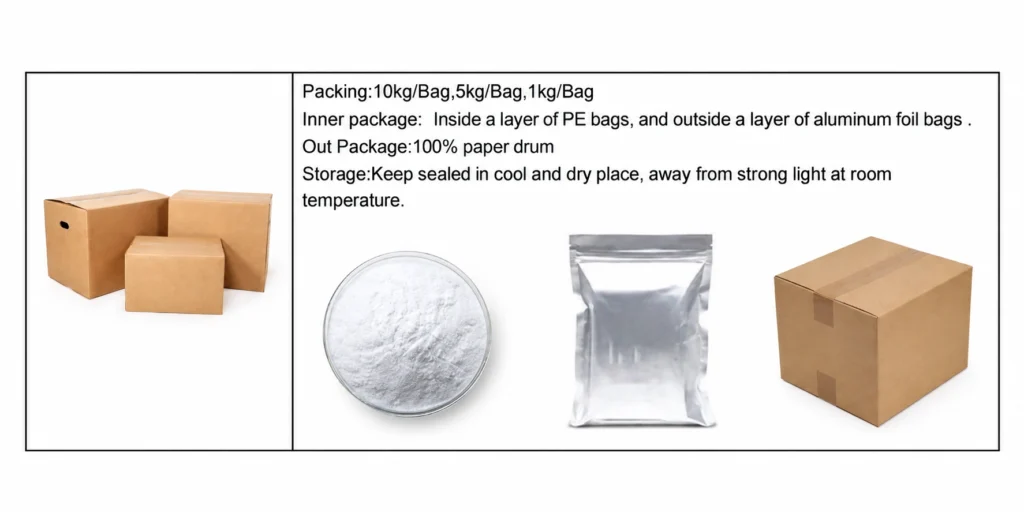
| Bag Packaging | 1 kg, 5 kg and 10 kg |
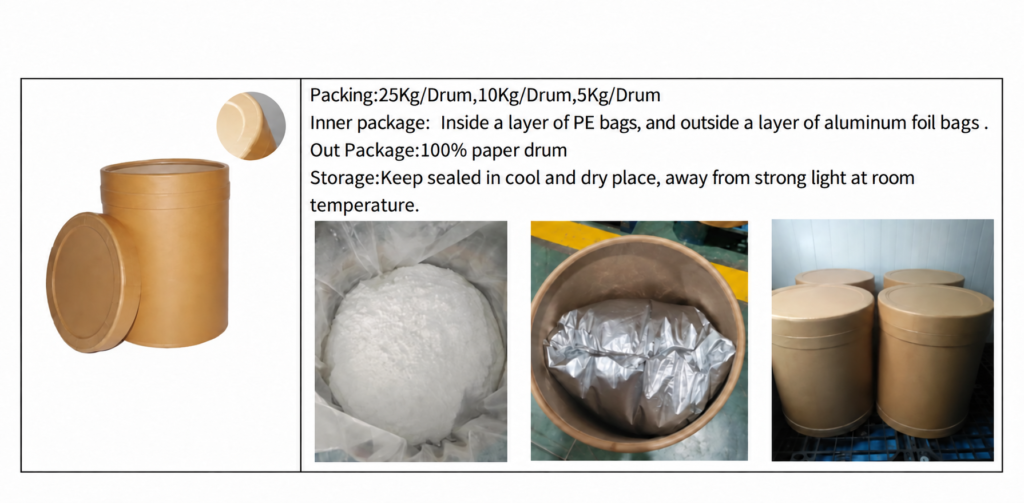
| Drum Packaging | 5 kg, 10 kg and 25 kg |
| Inner Packaging | Food-grade PE inner bag with an outer aluminium-foil barrier bag |
| Outer Packaging | Carton or fibre drum, selected according to pack weight |
| Storage | Keep sealed in a cool, dry place away from strong light, heat and high humidity |
| Product Documents | Specification, COA, TDS, SDS, Non-GMO, source and allergen documentation |
| Quality Systems and Certifications | GMP, FSSC 22000, ISO 9001, HACCP, Halal and Kosher |
| Additional Support | Applicable FDA-related registration or compliance documentation |
Aluminium-foil bags are suitable for samples and smaller development quantities, while commercial volumes can be packed in fibre drums with barrier inner packaging. After opening, exposure time should be minimized and the package should be resealed promptly to reduce moisture pickup, caking and storage-related activity change.

Frequently Asked Questions
Why should two Nattokinase Powders labelled 20,000 FU/g not be compared by price alone?
FU/g values are directly comparable only when the activity definition, substrate, sample preparation, reaction conditions and calculation method are aligned. Buyers should also determine whether 20,000 FU/g is a minimum release specification, a typical value or a batch result. Carrier composition, moisture, particle properties, vitamin K2 control and residual soy-protein requirements can create additional differences between two nominally equal grades.
Why is 20,000 FU/g not the purity of Nattokinase Powder?
FU/g is an enzyme-activity unit, not a percentage by weight. A standardized Nattokinase Powder may also contain a carrier, permitted moisture and other acceptable fermentation-derived components. Identity, activity, composition and impurities should be reviewed separately rather than being replaced by a single purity statement.
Why may the existing blending process fail after changing the activity grade?
Increasing the activity grade reduces the raw-material mass required to deliver the same FU. The smaller inclusion rate can make weighing error, electrostatic adhesion, density segregation and sampling variation more significant. Changing from 20,000 FU/g to 40,000 FU/g therefore requires more than halving the input: the premix ratio, order of addition, blending time and activity distribution across the batch should be revalidated.
What should be investigated first when the raw-material COA passes but finished-product activity is low?
First confirm that the formulation used the measured activity of the current batch and that all unit conversions were correct. Then review weighing, premixing, sampling and blend uniformity. If those controls are acceptable, examine contact with granulating liquid, acidic ingredients, drying heat, compression or coating conditions, waiting time before packaging and storage humidity. The raw-material and finished-product activity methods should also be checked for comparability.
Can plain Nattokinase Powder be used in an enteric product?
It can be used as the active ingredient in an enteric dosage form, but plain powder is not itself an enteric material. Acid protection may be provided by an enteric capsule, a coated tablet or a microencapsulated raw-material system. The development team should define where the protective function is provided and validate the corresponding release and FU-retention criteria.
Is low-vitamin-K2 nattokinase the same as high-activity nattokinase?
No. Vitamin K2 content and nattokinase activity are independent specifications. A high FU/g result does not establish low vitamin K2, and low vitamin K2 does not establish higher enzyme activity. When K2 control is required, the maximum K2 limit and method should be specified separately from the minimum nattokinase activity.
Does fermentation with non-GMO soybean mean that the product is soy-allergen-free?
Not automatically. Non-GMO status describes the origin of the fermentation substrate. A soy-allergen-free position requires separate review of the process, residual soy-protein testing, analytical detection limit and allergen documentation. Non-GMO and allergen documents should therefore be qualified independently.
How should finished-product Nattokinase activity be monitored during stability testing?
At minimum, activity should be measured for the incoming raw material, after manufacturing and at defined shelf-life intervals. Formulations involving granulation, tableting or coating should include additional measurements after the relevant high-risk steps. Appearance, moisture, disintegration and packaging integrity do not replace direct FU testing.
