
 Spanish
Spanish
Spanish
Ureda Naturals is a Trans-Resveratrol manufacturer supplying fermentation-derived Trans-Resveratrol for nutraceutical, functional food, beverage, cosmetic and specialized delivery-system applications.
Available formats include 99% high-purity powder, 50% and 20% standardized grades, 10% water-soluble Trans-Resveratrol, granular Trans-Resveratrol and liposomal Trans-Resveratrol.
The correct specification depends on the finished-product dosage, processing method, powder-handling requirements, dispersion behavior and stability profile. Trans-Resveratrol should therefore be selected according to the final application rather than assay alone.
Ureda Naturals combines a fermentation-derived production route with controls for chemical purity, visual appearance, powder performance and application flexibility.
| Test Item | Fermentation-Derived Trans-Resveratrol | Chemically Synthesized Trans-Resveratrol | Plant-Extracted Trans-Resveratrol |
|---|---|---|---|
| Appearance | White or off-white powder | Off-white or grayish-white powder | Light yellow to brown powder |
| Odor | Slight odor | Pungent odor | Pungent odor |
| Assay | ≥99% | ≥99% | 50–98% |
| Maximum single impurity | ≤0.10% | ≤0.10% | Multiple impurities at or above 0.10% |
| Total impurities | ≤0.5% | ≤0.5% | Multiple impurity components may be present |
| Solvent residues | Ethanol ≤1,000 ppm; no other solvent residues | Ethanol ≤1,500 ppm; methanol ≤20 ppm | Methanol ≤1,000 ppm; ethanol ≤1,500 ppm; other solvent residues may be present |
| Pesticide residues | Not detected | Pesticide residues not detected | Pesticide residues such as BHC may be present |
| Plasticizer residues | Not detected | Plasticizer residues cannot be guaranteed absent | Plasticizer residues may be present |
| Other potential impurities | None identified in the stated comparison | Process-related high-risk impurities may be present | Emodin-related impurities, aflatoxins, polycyclic aromatic hydrocarbons and other undesirable substances may be present |
The 99% Trans-Resveratrol powder is suitable for concentrated solid-dose products requiring a high active concentration with a relatively low raw-material input.
The main process controls are assay, powder flow, bulk density, tapped density, particle-size distribution, blend uniformity and filling behavior.
The 50% and 20% grades are useful when the finished formula requires a larger standardized input or a larger carrier matrix.
The lower assay changes the total raw-material mass, carrier proportion, fill volume and mixing behavior.
The 10% water-soluble Trans-Resveratrol form is designed for functional beverages, oral liquids, powdered drink mixes, liquid nutritional products and water-based cosmetic systems.
High-purity Trans-Resveratrol powder has limited native water solubility. Short-term dispersion in water does not confirm suitability for a commercial beverage.
Aqueous development should evaluate initial dispersion, clarity or permitted turbidity, sedimentation, recrystallization, pH, ionic strength, mineral and protein interactions, homogenization, thermal treatment, holding time, light exposure, oxygen exposure, storage stability and final container compatibility.
Granular Trans-Resveratrol is suitable when fine-powder dust, feeding consistency or material transfer creates production challenges.
Evaluation should include granule strength, moisture pickup, density, abrasion, breakage during blending and final dosage uniformity.
Liposomal Trans-Resveratrol is intended for lipid-based delivery systems rather than conventional crystalline powder formulations.
Its quality review should include active loading, particle-size distribution, encapsulation efficiency, leakage during storage, oxidative stability, homogenization conditions, filling temperature, light and oxygen protection and compatibility with the final container.
Liposomal Trans-Resveratrol should be evaluated as a complete delivery system rather than by assay alone.
For a nominal target of 100 mg Trans-Resveratrol:
The final addition rate should be calculated using the assay shown on the current batch Trans-Resveratrol COA.
Assay affects capsule fill volume, tablet weight, sachet mass, carrier proportion, powder volume, beverage solids, cost per serving and finished-product content uniformity.
The following specification describes the high-purity powder format. Water-soluble, granular and liposomal formats are evaluated according to their corresponding product specifications.
| Test Item | Standard Grade | Ultra-White Grade | Test Method |
|---|---|---|---|
| Appearance | Off-white powder | White powder | Visual |
| Moisture | ≤0.5% | ≤0.5% | CP2020 |
| Ash | ≤0.5% | ≤0.5% | CP2020 |
| Identification | HPLC | HPLC | HPLC |
| Identification | IR | IR | IR |
| Assay, on a dry basis | 99.0–101.0% | 99.0–101.0% | HPLC |
| Bulk density | ≥0.35 g/mL | ≥0.40 g/mL | USP <616> |
| Tapped density | ≥0.70 g/mL | ≥0.80 g/mL | USP <616> |
| Cis-resveratrol | Not detected | Not detected | HPLC |
| Emodin | Not detected | Not detected | HPLC |
| Maximum single impurity | ≤0.1% | ≤0.1% | HPLC |
| Total impurities | ≤0.5% | ≤0.5% | HPLC |
| Purity | ≥99.0% | ≥99.0% | HPLC |
| Residual ethanol | ≤1,000 ppm | ≤1,000 ppm | GC |
| Total heavy metals | ≤10 ppm | ≤10 ppm | CP2020 |
| Lead | ≤0.5 ppm | ≤0.5 ppm | ICP-MS |
| Cadmium | ≤1.0 ppm | ≤1.0 ppm | ICP-MS |
| Arsenic | ≤1.0 ppm | ≤1.0 ppm | ICP-MS |
| Mercury | ≤0.1 ppm | ≤0.1 ppm | ICP-MS |
| Particle size | 95% passing through 80 mesh | 95% passing through 80 mesh | Internal control |
| Total plate count | ≤1,000 CFU/g | ≤1,000 CFU/g | CP2020 |
| Total yeast and mold | ≤1,000 CFU/g | ≤1,000 CFU/g | CP2020 |
| Escherichia coli, coliforms and Pseudomonas aeruginosa | Not detected | Not detected | CP2020 |
| Salmonella | Not detected | Not detected | CP2020 |
| Storage | Store sealed at room temperature and protect from light | Store sealed at room temperature and protect from light | — |
Bulk density and tapped density affect capsule filling, hopper feeding, transport efficiency and the powder volume required for a defined dosage.
Particle size supports handling and dispersion control, but 80 mesh alone does not guarantee blend uniformity. Particle shape, density, electrostatic behavior, agglomeration and mixing conditions also affect the final blend.
The product quality profile includes controls for residual ethanol, heavy metals, pesticide residues, plasticizer residues, total plate count, yeast and mold, Escherichia coli, coliforms, Pseudomonas aeruginosa and Salmonella.
Supporting third-party reports can be provided for heavy metals, pesticide residues and microbiological quality.
The technical material reports an acute oral LD50 above 5,000 mg/kg in ICR mice and classifies the tested material as practically non-toxic under the stated acute-toxicity classification.
For solid dosage forms, the key development factors are assay, powder flow, density, blend uniformity, segregation, compression and fill volume.
The 99% grade reduces the raw-material mass required for a given active dose. The 50% and 20% grades provide a larger standardized input. Granules may be selected when dust control and feeding consistency are important.
For water-based products, the 10% water-soluble Trans-Resveratrol form is the preferred starting point.
Evaluation should include appearance immediately after mixing, sedimentation during storage, recrystallization, pH stability, mineral and protein interactions, homogenization, heat treatment, holding time, light and oxygen exposure and storage stability.
High-purity powder should not be substituted into a beverage formula without reviewing its dispersion and storage behavior.
Cosmetic formulations should control final pH, heat exposure, oxygen exposure, light exposure, addition sequence, vehicle compatibility, dispersion, color change, precipitation, container opacity and storage stability.
Light-protective packaging may be selected when the finished product is sensitive to light exposure.
Granular Trans-Resveratrol should be evaluated for particle strength, feeding behavior, dust generation, breakage, moisture pickup and dosage uniformity.
Liposomal Trans-Resveratrol should be evaluated for active loading, particle size, encapsulation efficiency, leakage, oxidation, homogenization and storage stability.
Fermentation-derived Trans-Resveratrol provides a defined production route for customers who require a biobased origin profile.
A C-14 report supports origin assessment and should be reviewed together with HPLC identity and assay, IR identification, related-substance profile, residual solvent testing, heavy-metal testing and microbiological testing.
C-14 documentation supports origin assessment and complements the identity, assay and impurity information shown in the product specification and batch COA.
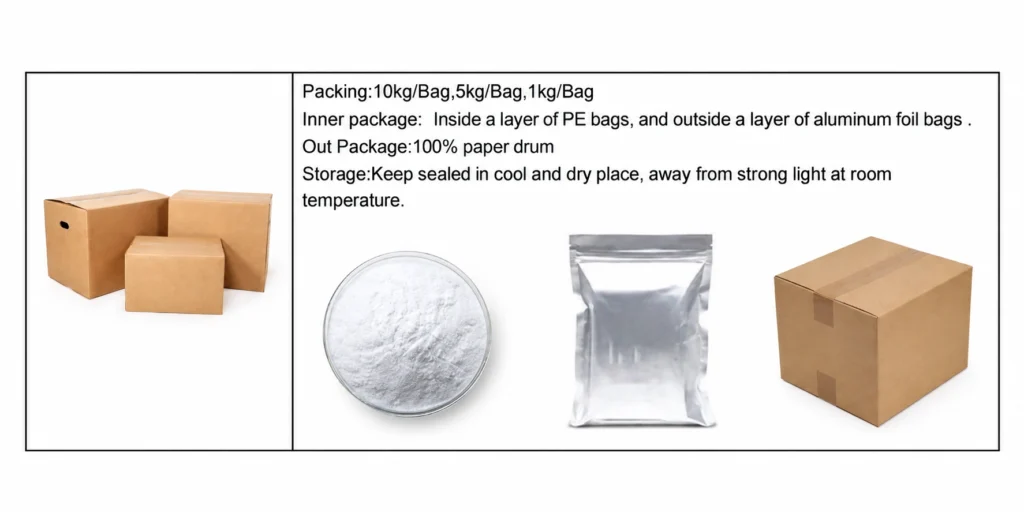
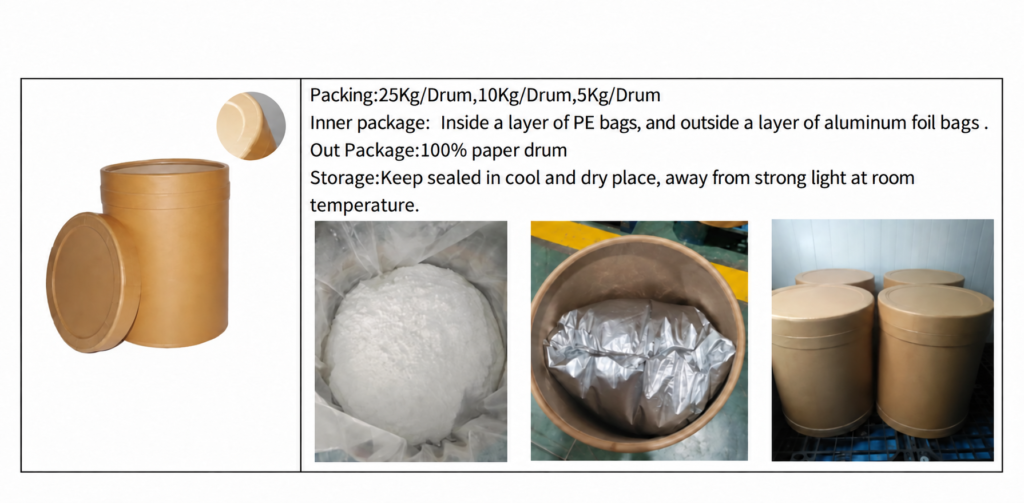
Available packaging options include:
Bag packaging uses an inner PE bag with an outer aluminum foil layer. Drum packaging uses a sealed inner liner with an outer paper drum.
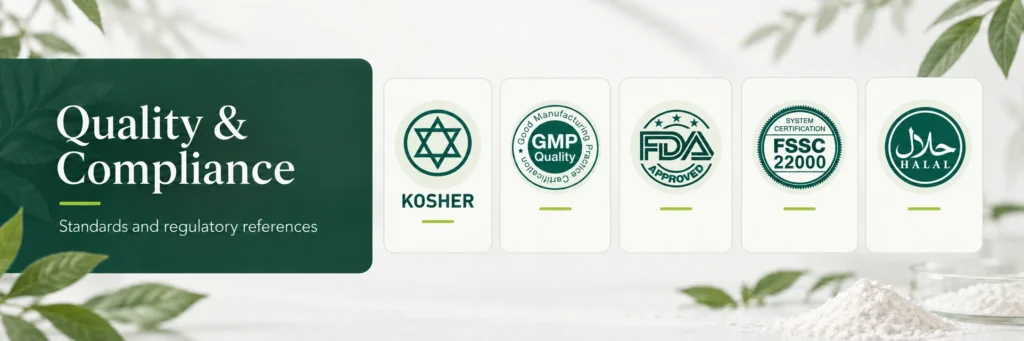
Available documentation and quality references for the selected Trans-Resveratrol specification include:
Assay determines active concentration, but the physical form determines dispersion, flow, filling, mixing and stability behavior. A 99% powder, a 10% water-soluble grade, a granule and a liposomal system require different process controls.
They change the raw-material quantity required to deliver the same active dose. This affects fill weight, carrier level, capsule capacity, powder volume, beverage solids and finished-product uniformity.
High-purity powder has limited native water solubility. It may initially disperse but later produce haze, sediment or recrystallization. The 10% water-soluble form is a more suitable starting point for beverage development.
Mesh size only describes sieve passage. Particle shape, density, electrostatic behavior, agglomeration, transfer distance and mixing conditions also affect uniformity.
Assay confirms the amount of Trans-Resveratrol, while related-substance testing describes the composition of the remaining material. Reviewing both provides a more complete assessment of chemical consistency.
No. Ultra-white appearance is valuable when the finished product requires a lighter color, but appearance does not replace HPLC assay, identity testing or impurity testing.
The quality review expands beyond assay and purity. Active loading, particle size, encapsulation efficiency, leakage, oxidation and storage stability become important performance parameters.
Control pH, heat, oxygen, light and addition sequence. The final container should also reduce exposure to conditions that may cause color change, precipitation or active degradation.
INGREDIENT PARTNER
Tell us your intended application, approximate quantity and target market. Ureda Naturals will confirm the closest grade, packaging configuration and available documentation for your project.

