


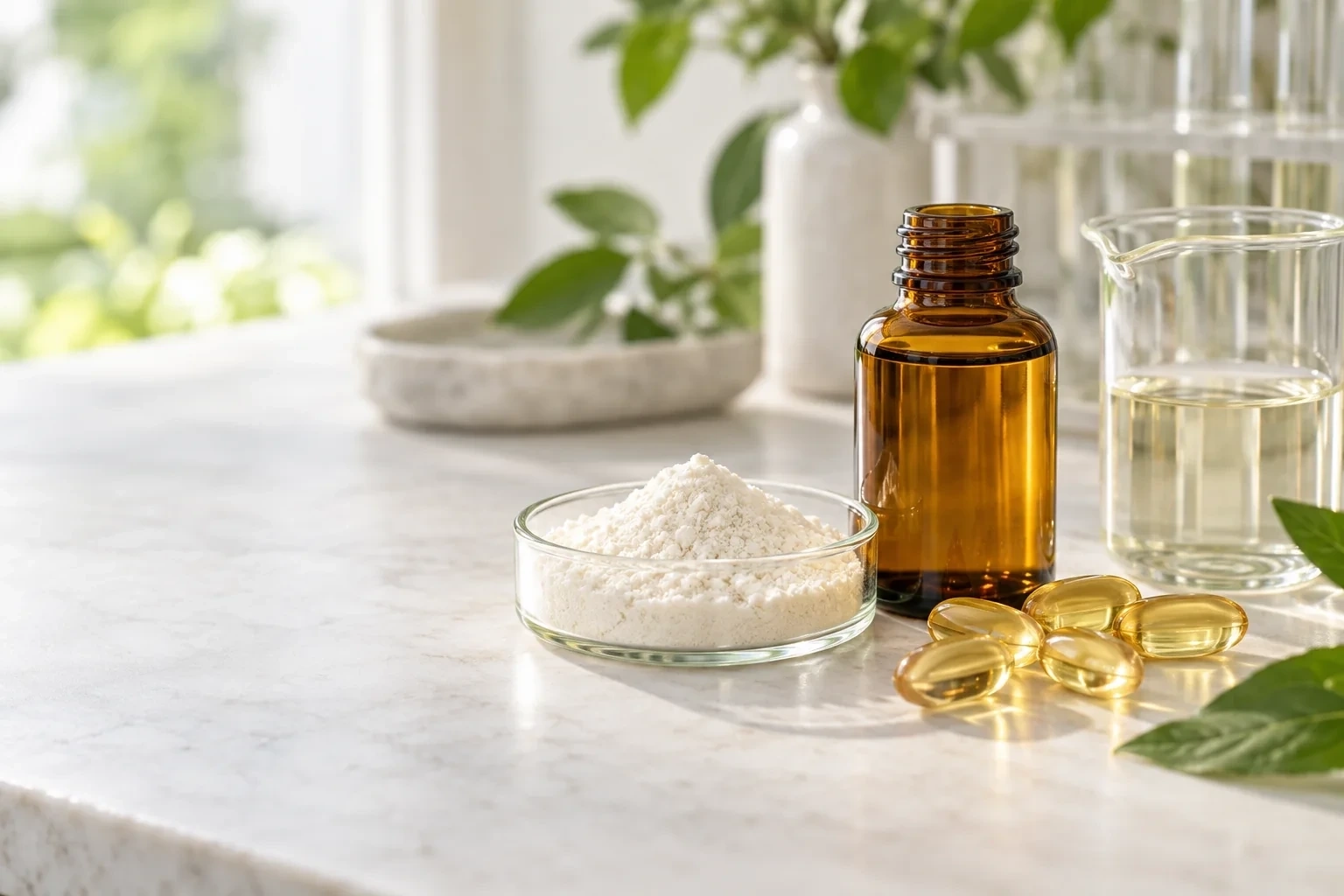
Vitamin K2 MK-7 is not one universal raw-material format. Oil concentrates, powder premixes and encapsulated powders can contain the same named vitamin but behave differently during weighing, blending, filling, storage and finished-product testing. The right choice depends on the dose, the carrier system, the process and the stability target.
Start with delivered MK-7, not the gross powder weight
Many MK-7 materials are supplied at a low concentration relative to the total ingredient weight. A powder premix may be easier to dose into a tablet or capsule blend, while an oil concentrate may be more suitable for a softgel or oil drop. The raw-material addition must be calculated from the declared MK-7 potency and the analytical basis used by the supplier.
If the specification is expressed in micrograms per gram, document the conversion to the finished serving and the overage policy separately. Do not compare an oil concentration and a powder concentration as though the numbers describe the same physical material.
Why format changes stability behavior
MK-7 is sensitive to its surrounding environment. Published formulation and regulatory documents describe the importance of the carrier, light, oxygen, storage and the chemical profile of the material. The powder matrix can reduce handling problems in a dry blend, but it does not make the active immune to heat, moisture or incompatible excipients. An oil form may fit a softgel process, but its stability must be evaluated in the selected oil and package.
An encapsulated format may protect the active during some processing steps, but the protection is formulation-specific. The developer should request evidence for the relevant matrix rather than treating encapsulation as a universal stability guarantee.
Choosing between oil, premix and encapsulated powder
- Format — Often considered for — Main development questions
- Oil concentrate — Softgels, oil drops and lipid systems — Oil compatibility, oxygen, light, viscosity, filling temperature and package
- Dry premix — Capsules, tablets and dry blends — Carrier identity, blend uniformity, flow, dose calculation and moisture
- Encapsulated powder — Dry products requiring additional protection — Release behavior, carrier system, process shear and stability evidence
The table is a starting point. The same format can work differently at different concentrations or with different carriers.
Process fit is as important as shelf-life data
For tablets and capsules, evaluate flow, segregation, carrier density, blending time and the impact of mineral excipients. For softgels, evaluate the oil vehicle, fill temperature, oxygen exposure and shell compatibility. For beverages, the challenge is not only the vitamin’s chemical stability but also whether the format can disperse, remain uniform and support accurate dosing in the finished liquid.
The current Ureda Vitamin K2 MK-7 product page lists several commercial formats and concentration options. Use that page for the current product range; use this article to decide which format should enter the next formulation trial.
What should be tested before approval
At minimum, compare identity and potency at release and during storage using the agreed analytical method. Add physical and process tests that match the format:
- powder appearance, flow and blend uniformity;
- oil appearance, viscosity and homogeneity;
- assay recovery from the finished matrix;
- light and oxygen exposure where relevant;
- moisture and water activity for dry systems;
- thermal hold or filling conditions;
- package closure and headspace;
- cis/trans profile when required by the specification or market.
Do not infer stability from color alone. A pale or darker material may reflect a carrier or process difference, while potency requires a validated analytical method.
How to compare supplier documentation
Request the exact MK-7 form, carrier composition, potency basis, analytical method, storage conditions, packaging, current COA, TDS, SDS and available stability data. If a supplier uses a branded format, ask for the underlying active identity and the non-active components relevant to label review and allergen assessment.
The supplier should also explain whether the material is intended for dry blending, oil filling, beverage dispersion or another process. A generic statement that the ingredient is suitable for supplements does not replace process-specific qualification.
Final decision rule
Choose MK-7 format by the finished product’s process and dose architecture. Oil is not automatically better for oil products, and powder is not automatically more stable for dry products. The correct choice is the format whose carrier, potency, handling and stability data fit the actual manufacturing route.
Technical references
- Menaquinone-7 stability and purity profile study
- Food Standards Australia New Zealand assessment of MK-7 incorporation and stability
- Ureda MK-7 product formats and specifications
Need help selecting a Vitamin K2 MK-7 format for a finished-product process? Contact Ureda Naturals.
