


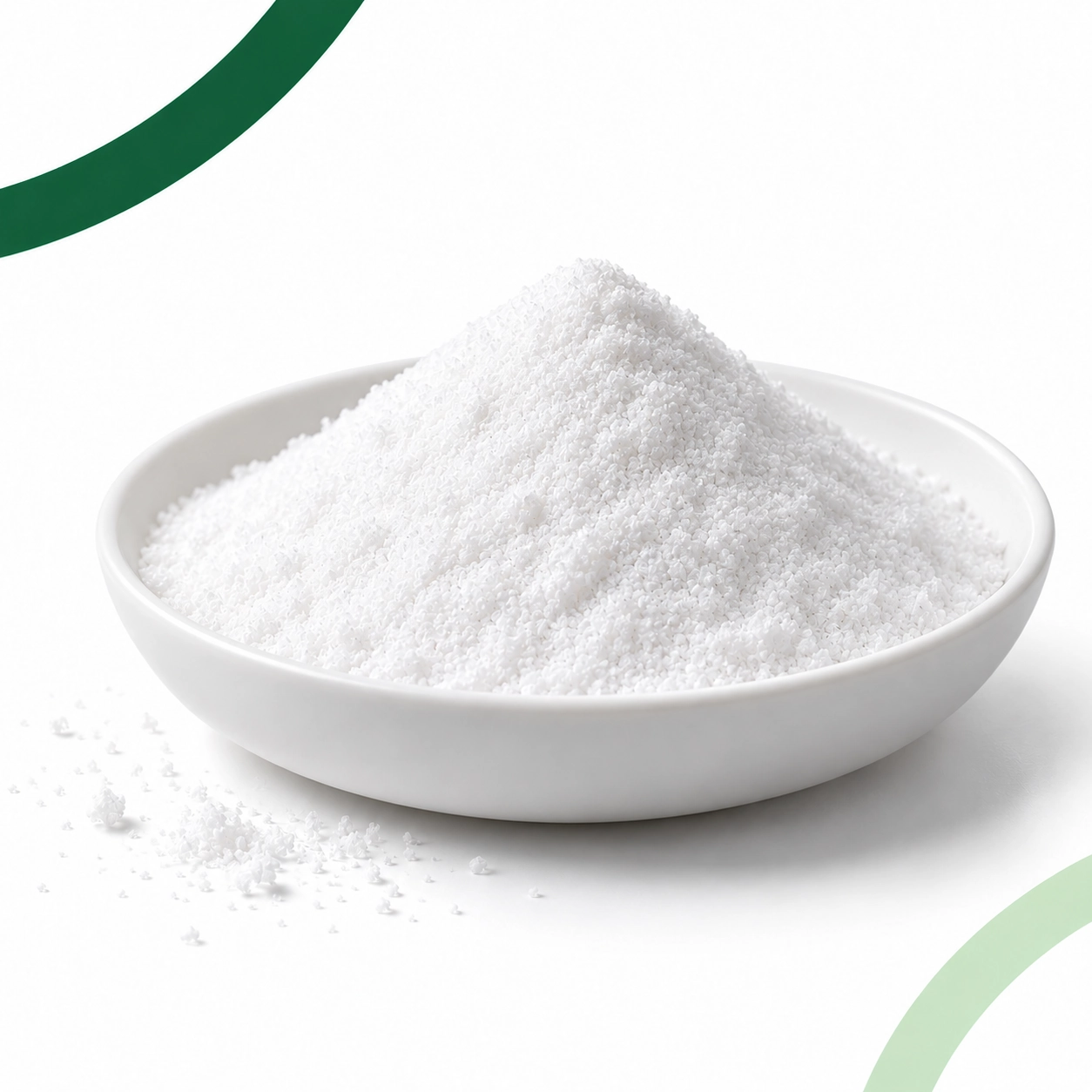
Calcium HMB Monohydrate for Dry-Dose and Qualified Nutrition Formulations
Calcium Beta-Hydroxy-Beta-Methylbutyrate Monohydrate is the crystalline calcium salt of beta-hydroxy-beta-methylbutyrate. Ureda Naturals manufactures this defined monohydrate grade with HMB purity of not less than 84.0%, calcium content of 13.6–14.8%, total content of not less than 99.0% and controlled loss on drying of 5.0–7.5%.
The material is primarily suited to dry powders, capsules and tablets. Sachets, nutrition bars and powdered protein blends require physical-property qualification, while clear beverages and heat-processed protein liquids require formulation-specific mineral, protein and stability studies.
Product Identity and Specification
| Parameter | Specification |
|---|---|
| Product name | Calcium Beta-Hydroxy-Beta-Methylbutyrate Monohydrate |
| Abbreviation | HMB-Ca / CaHMB |
| Chemical name | Calcium bis(3-hydroxy-3-methylbutyrate) monohydrate |
| CAS number | 135236-72-5 |
| Molecular formula | C10H20CaO7 |
| Molecular weight | 292.34 g/mol |
| Appearance | White crystalline powder |
| HMB purity | ≥84.0% |
| Calcium assay | 13.6–14.8% |
| Total content | ≥99.0% |
| Loss on drying | 5.0–7.5% |
| Pile-up density | 0.3–0.6 g/mL |
Application Fit
| Application Level | Product Formats | Principal Consideration |
|---|---|---|
| Primary fit | Dry nutritional powders, capsules and tablets | Powder density, flow and unit-dose capacity |
| Development fit | Sachets, stick packs, nutrition bars and powdered protein blends | Segregation, filling variation, texture and reconstitution |
| Formulation-dependent | Clear beverages, high-protein RTD products and thermally processed liquid nutrition | Protein–mineral interaction, pH, heat stability and sedimentation |
This classification reflects manufacturing complexity rather than regulatory suitability. Permitted use and declaration requirements depend on the destination market and finished-product category.
How to Read the HMB-Ca Monohydrate Specification
HMB purity, calcium assay, total content and loss on drying describe different properties of the material. They must not be merged into a single purity claim or used interchangeably in formulation calculations.
Calcium Assay and Salt Composition
HMB-Ca monohydrate contains one calcium ion associated with two HMB anions. Based on its molecular formula and molecular weight, the theoretical elemental calcium proportion is approximately 13.7%. The specified range of 13.6–14.8% therefore controls an important aspect of the calcium salt composition.
Calcium supplied by HMB-Ca must be included in the complete mineral calculation when the formulation also contains calcium citrate, calcium carbonate, dairy minerals, phosphate buffers, electrolyte premixes or vitamin-mineral blends.
HMB Purity
HMB purity controls the HMB component of the ingredient. The reporting basis used in the approved raw-material specification must remain consistent with the formulation calculation, finished-product analytical method and final declaration.
Dry-basis and as-is values must not be interchanged without applying the corresponding loss-on-drying convention.
Total Content
Total content is controlled at not less than 99.0% as a separate compositional release parameter. It is not equivalent to HMB purity and must not be presented as “99% HMB.”
Hydration State and Loss on Drying
One mole of bound water in the monohydrate represents approximately 6.16% of its molecular weight:
18.015 ÷ 292.34 × 100 ≈ 6.16%
This theoretical value falls within the specified loss-on-drying range of 5.0–7.5%. The two-sided range therefore supports control of the hydrated material rather than serving only as a conventional maximum-moisture limit.
Loss on drying is also different from water activity. LOD measures mass loss under defined test conditions, while water activity reflects the availability of water for physical, chemical and microbiological processes.
Quality Specification
| Test Item | Specification |
|---|---|
| Appearance | White crystalline powder |
| Calcium assay | 13.6–14.8% |
| HMB purity | ≥84.0% |
| Total content | ≥99.0% |
| Loss on drying | 5.0–7.5% |
| Heavy metals | ≤10 ppm |
| Lead | ≤3 ppm |
| Arsenic, as As2O3 | ≤1 ppm |
| Mercury | ≤0.1 ppm |
| Cadmium | ≤1 ppm |
| Total plate count | ≤1,000 CFU/g |
| Yeasts and moulds | ≤50 CFU/g |
| Escherichia coli | Negative |
| Salmonella | Negative |
| Staphylococcus | Negative |
| Pile-up density | 0.3–0.6 g/mL |
These values are product release limits. Lot-specific results are reported on the Certificate of Analysis supplied with the corresponding shipment.
How Production-Dependent Attributes Affect Customer Processing
Chemical composition establishes product identity, but downstream manufacturing performance is also influenced by the physical attributes created during salt formation, crystallisation, drying, particle-size adjustment and final material handling.
| Production-Dependent Attribute | Raw-Material Effect | Customer Manufacturing Effect | Finished-Product Risk |
|---|---|---|---|
| Calcium-to-HMB composition | Salt consistency and calcium contribution | Formula calculation and mineral balance | Incorrect HMB or calcium declaration |
| Hydration state | LOD and crystal condition | Weighing consistency, flow and storage behavior | Caking or mass-balance variation |
| Crystal habit | Surface area and packing behavior | Dissolution, blending and filtration | Slow dispersion or sediment |
| Particle-size distribution | Dusting, flow and segregation tendency | Transfer, mixing, filling and reconstitution | Blend non-uniformity or unit-weight variation |
| Bulk and tapped density | Powder volume and compressibility | Hopper flow, capsule filling and package sizing | Variable fill weights or excess capsule count |
| Surface moisture | Cohesion and agglomeration | Reduced flow and screen blockage | Caking and poor reconstitution |
| Packaging barrier | Protection from environmental moisture | Storage and dispensing behavior | Physical deterioration before expiry |
Raw-Material Controls and Finished-Product Validation
| Controlled by the Raw-Material Specification | Verified in the Customer’s Finished Product |
|---|---|
| Product identity and appearance | Particle compatibility with the complete formulation |
| HMB purity | Finished-product HMB recovery |
| Calcium assay | Total mineral balance and label calculation |
| Total content | Finished-product analytical method performance |
| Loss-on-drying range | Caking, flow and stability in the selected package |
| Pile-up density | Final blend density and filling performance |
| Heavy-metal limits | Market-specific finished-product contaminant limits |
| Microbiological limits | Finished-product microbiological quality |
HMB-Ca Monohydrate Versus Other HMB Forms
| Decision Factor | HMB-Ca Monohydrate | Anhydrous Calcium HMB | HMB Free Acid |
|---|---|---|---|
| Physical form | Crystalline solid | Solid calcium salt | Commonly supplied as a liquid or low-melting form |
| Calcium contribution | Yes | Yes | No |
| Bound water | Defined monohydrate | No monohydrate water | Not applicable |
| Dry blending | Suitable after physical-property qualification | Requires its own density and assay basis | Requires a different handling approach |
| Capsules and tablets | Suitable after fill or compression trials | Not weight-equivalent to the monohydrate | Less convenient for conventional dry-dose processing |
| Liquid systems | Requires protein, mineral and pH compatibility assessment | Requires separate dissolution and stability assessment | Avoids direct calcium contribution but introduces different handling considerations |
Changing between HMB forms affects ingredient mass, calcium contribution, water balance, physical handling and finished-product testing. A form change should therefore be managed as a formulation change.
Dry-Dose Manufacturing
Blend Uniformity and Segregation
High ingredient inclusion does not eliminate segregation. Separation can occur when HMB-Ca differs from proteins, amino acids, flavours or micronutrient premixes in particle size, density, particle shape, surface texture or moisture condition.
Extending mixing time cannot reliably correct a blend that separates during discharge, hopper residence or transport. Representative sampling should cover the blender and the beginning, middle and end of the filling operation.
Sachets and Stick Packs
The pile-up-density range of 0.3–0.6 g/mL represents a twofold difference in loose powder volume. Final package capacity should therefore be based on the completed blend rather than HMB-Ca alone.
Qualification should cover loose and tapped density, hopper flow, filler repeatability, seal-area dust, fill-weight variation and volume change after transport vibration.
Capsules
Capsule feasibility is frequently limited by volumetric capacity. Development should establish practical fill weight, shell size, capsule count per serving, weight variation, flow-aid requirement, shell compatibility and disintegration after storage.
Tablets
Pile-up density does not predict compactability. Tablet development should evaluate die filling, compression force, hardness, elastic recovery, capping, sticking, ejection force, friability, disintegration and content uniformity.
Dry granulation may improve feed consistency, but the resulting granules require separate dissolution and disintegration assessment.
Powdered Beverage Reconstitution
Laboratory solubility does not define consumer reconstitution. The observed result depends on serving concentration, water temperature, mixing device, mixing time, addition sequence, beverage pH and the presence of proteins, minerals, acids or hydrocolloids.
Testing should reproduce the intended preparation instructions and record initial wetting, agglomerates, dispersion time, foam, turbidity, sediment and sensory impact.
Protein and Liquid Nutrition Systems
CaHMB introduces divalent calcium into the liquid phase. In protein-containing products, calcium, phosphate, protein concentration, pH and heat treatment can interact to affect turbidity, flocculation, sedimentation, coagulation and viscosity.
Recommended Evaluation Sequence
- Characterise the base protein, pH and mineral system.
- Evaluate HMB-Ca in the water phase before protein addition.
- Compare direct addition with controlled pre-dissolution.
- Compare addition before and after protein hydration.
- Avoid local mineral overconcentration during addition.
- Apply the complete homogenisation and heat process.
- Measure pH, viscosity, turbidity, particle size and sediment.
- Repeat physical and analytical testing through packaged shelf life.
A solution that appears stable before heating cannot be assumed to remain stable after pasteurisation, retort, UHT processing or storage.
Finished-Product Analytical Recovery
Raw-material release testing does not automatically demonstrate that the same procedure will accurately measure HMB in a finished matrix. Proteins, fats, carbohydrates, organic acids, minerals, flavours and hydrocolloids can affect extraction efficiency and analytical selectivity.
Finished-product method qualification should address the reported chemical equivalent, dry-basis or as-is convention, sample homogenisation, extraction recovery, selectivity, calibration standard, repeatability, intermediate precision and prepared-sample stability.
For dairy and high-protein products, matrix cleanup may be required before chromatographic measurement. Calcium analysis cannot substitute for HMB analysis when other calcium sources are present.
Packaging and Storage
Standard Packaging
- 1 kg, 5 kg and 10 kg aluminium-foil barrier bags with PE inner liners and outer cartons.
- 5 kg, 10 kg and 25 kg fibre drums with PE inner liners and aluminium-foil barrier protection.
Minimum order quantity: 1 kg.
Storage
Store in the sealed original package in a cool, dry environment protected from moisture, heat and prolonged light exposure. Use clean, dry dispensing equipment and reseal partially used packages immediately.
Shelf life: 24 months from the manufacturing date when stored unopened under the recommended conditions.
Technical FAQ
How should the raw-material specification, formulation input and finished-product HMB result be aligned?
All three must use the same defined reporting basis. The approved specification should establish whether the HMB value is reported as-is or on a dry basis and what chemical equivalent the result represents.
Total content should not replace HMB purity, and calcium contribution should be calculated separately from the calcium assay.
Why can’t calcium analysis be used to calculate finished-product HMB content?
Calcium measurement is not specific to HMB-Ca. A finished formula may contain calcium carbonate, calcium citrate, dairy minerals or calcium supplied by other ingredients.
Direct HMB analysis is required when verifying the finished-product HMB declaration.
How can incomplete HMB-Ca dissolution be distinguished from protein–mineral aggregation?
Evaluate HMB-Ca first in the water phase, then after protein addition, after pH adjustment and after the complete heat process. Compare turbidity, particle size and centrifugable sediment at each stage.
Material present before protein addition indicates a dissolution or recrystallisation issue. Particles that develop after protein, mineral or heat exposure indicate a broader formulation interaction.
What should be tested when pile-up density complies but high-speed filling remains unstable?
Additional evaluation may include tapped density, particle-size distribution, fine-particle fraction, compressibility index, hopper flow, aeration behavior, wall friction, electrostatic tendency and machine-speed fill-weight variation.
The complete blend must be tested because proteins, flavours, lubricants and micronutrients can change flow behavior.
Which changes should trigger formulation requalification?
Relevant changes include switching the HMB form, changing the assay basis, LOD range, particle size or granulation status, adding another calcium or phosphate source, changing the protein system, changing pH or heat processing, or changing the package moisture barrier.
The requalification scope should correspond to the physical, chemical or analytical property affected by the change.
