
 English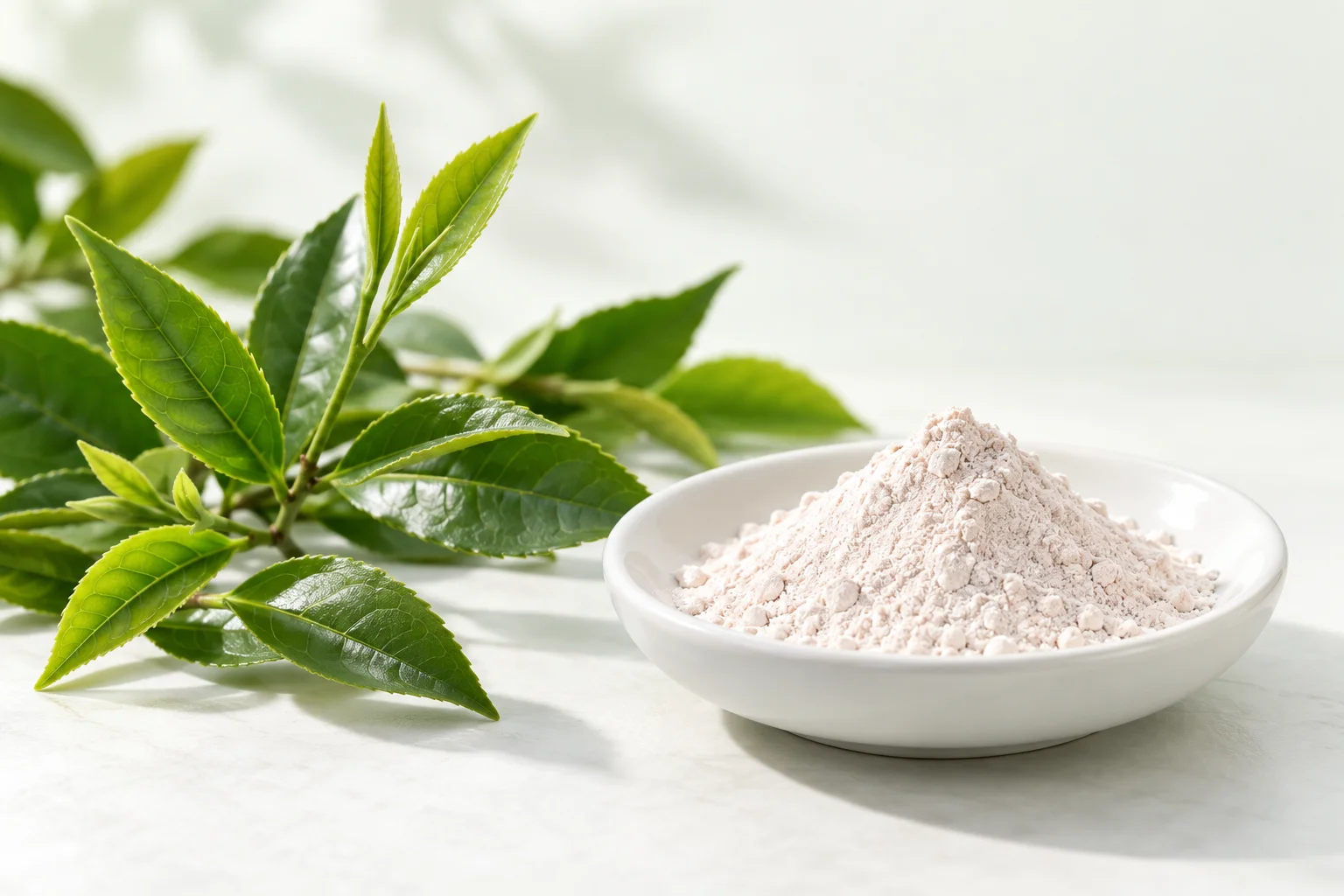
Ureda Naturals manufactures green tea–derived Epigallocatechin (EGC), CAS No. 970-74-1, in EGC90 and EGC98 grades with caffeine controlled at ≤0.1%.
| Source | Green tea |
|---|---|
| CAS No | 970-74-1 |
| EGC90 | EGC ≥90% |
| EGC98 | EGC ≥98% |
| Caffeine | ≤0.1% |
Ureda Naturals manufactures green tea–derived Epigallocatechin (EGC), CAS No. 970-74-1, in two standardized grades: EGC90 and EGC98.
Both grades are supplied as an off-white to light pink powder with caffeine controlled at ≤0.1%. Grade selection should be based on the target EGC dose, dosage format, caffeine limit and finished-product recovery—not assay percentage alone.
| Item | EGC90 | EGC98 |
|---|---|---|
| Product name | Epigallocatechin (EGC) | Epigallocatechin (EGC) |
| Botanical source | Green tea | Green tea |
| CAS No. | 970-74-1 | 970-74-1 |
| Appearance | Off-white to light pink powder | Off-white to light pink powder |
| EGC content | ≥90% | ≥98% |
| Caffeine | ≤0.1% | ≤0.1% |
| Customer requirement | Recommended starting point | Reason |
|---|---|---|
| Low-dose capsule or tablet | EGC98 | Lower material mass for the same EGC target |
| Formula with a wider dosage window | EGC90 | More flexibility in total addition mass |
| Strict EGC standardization | EGC98 | Smaller correction between target dose and weighed material |
| Heated or long-hold beverage | Compare both grades | Select by post-process recovery and appearance stability |
| Formula containing several tea ingredients | Either grade | Select after total caffeine mass-balance review |
| Pilot blend with uncertain filling behavior | Compare both grades | Select by blend uniformity and transfer recovery |
EGC90 and EGC98 should not be treated as automatically interchangeable. A higher assay reduces the amount of material required, but it does not by itself prove better dispersion, flow, compression or stability in the finished formula.
The grade assay changes the quantity of raw material required to deliver a defined EGC amount.
Required material = Target EGC amount ÷ Assay fraction
| Target EGC in finished product | EGC90 addition | EGC98 addition |
|---|---|---|
| 100 mg | 111.1 mg | 102.0 mg |
| 500 mg | 555.6 mg | 510.2 mg |
| 1 g | 1.111 g | 1.020 g |
For low-dose products, EGC98 can reduce the material burden in a capsule, tablet or sachet. For pilot blends or formulas with a wider active-loading range, EGC90 may provide more flexibility.
The calculation should be based on the agreed minimum assay during formulation locking. This prevents under-dosing when the assay is close to the grade limit.
Caffeine is controlled separately from EGC content.
When other green tea ingredients are present, their caffeine contributions must be calculated separately and then combined. The finished-product caffeine level should not be calculated from the EGC target alone.
A general green tea extract or total tea-polyphenol ingredient does not define the actual EGC input.
| Ingredient | Abbreviation | Quality distinction |
|---|---|---|
| Epigallocatechin | EGC | Target compound in this product |
| Epigallocatechin gallate | EGCG | Different gallated catechin |
| Epicatechin gallate | ECG | Different gallated catechin |
| Epicatechin | EC | Different non-gallated catechin |
| Total tea polyphenols | — | Composite value, not an EGC-specific assay |
A formula can meet a total tea-polyphenol target while containing a different ratio of EGC, EGCG, ECG and EC. For an EGC-specific product claim or release specification, the analytical method must identify and quantify EGC separately.
| Manufacturing step | EGC-specific issue | Observable risk | Verification action |
|---|---|---|---|
| Incoming release | Wrong grade or incorrect assay basis | Incorrect active calculation | Confirm EGC grade, assay and caffeine |
| Weighing | Addition based on nominal mass instead of assay | Under-dosing | Apply assay correction before batching |
| Pre-blending | Low-dose distribution | Blend non-uniformity | Compare samples from different blender locations |
| Transfer and filling | Segregation or equipment hold-up | First, middle and last units differ | Test staged filling samples |
| Beverage dispersion | Matrix-dependent physical behavior | Haze, sediment or incomplete dispersion | Test the actual formula, not water alone |
| Heating and holding | EGC recovery and catechin stability | Assay decrease or color change | Compare pre-process and post-process samples |
| Storage | Assay or appearance drift | Finished product moves outside target | Test the final package at defined time points |
EGC assay and powder appearance do not determine final beverage clarity, dispersion time or storage performance.
A meaningful trial should use the actual formulation and control EGC concentration, formula pH, water composition, ionic strength, acidulants, sweeteners, flavors, addition order, mixing energy, heating profile, holding time, dissolved oxygen and packaging headspace.
The trial should measure dispersion behavior, visible haze or sediment, color before and after processing, EGC assay before and after processing, caffeine contribution and EGC recovery after holding and storage.
A water-only test cannot reproduce the effects of the customer’s acidulants, salts, flavors, oxygen exposure or thermal history.
For solid dosage products, the EGC assay controls active input but does not predict powder-flow behavior or finished-dose uniformity.
The customer should qualify pre-blend uniformity, main-blend distribution, transfer loss, hopper discharge, first/middle/last filled units, finished-product EGC content, caffeine contribution and moisture exposure during storage.
If raw-material assay passes but finished-unit results vary, the likely control point may be segregation, transfer hold-up or insufficient pre-blending rather than a failure of the EGC grade.
For heated or oxygen-exposed products, EGC should be measured across the process instead of only at incoming inspection.
| Sampling point | Purpose |
|---|---|
| Incoming material | Confirm starting EGC and caffeine |
| Pre-process bulk | Confirm actual formula input |
| Immediately after heating | Detect early recovery loss |
| After cooling | Identify precipitation or physical loss |
| After holding | Measure process-related change |
| After storage | Confirm retained EGC level and appearance |
EGC recovery (%) = Measured EGC after processing ÷ Theoretical EGC input × 100
A lower recovery should be investigated through incorrect dosing, incomplete dispersion, sedimentation, filtration loss, equipment hold-up, thermal or oxidative change and analytical recovery bias before changing the raw-material grade.
The analytical procedure should distinguish EGC from EGCG, ECG and EC. Total tea-polyphenol testing cannot replace EGC-specific quantification.
The method should establish EGC identity, separation from related catechins, matrix recovery, repeatability, reporting basis and finished-product applicability.
The release method must identify and quantify EGC while resolving it from EGCG, ECG and EC. Total tea polyphenols or a non-selective colorimetric result cannot establish EGC content.
The method should demonstrate peak identity, separation from related catechins, matrix recovery, repeatability and a defined reporting basis.
Assay equivalence alone is insufficient. Both grades should be tested in the same formula and process, comparing EGC recovery, caffeine contribution, blend uniformity, color, turbidity, heat-hold performance, finished-product assay and storage trend.
The grades should only be treated as interchangeable when the finished-product results meet the same predefined acceptance criteria.
Caffeine must be calculated as a separate mass-balance component:
Maximum caffeine contribution = Ingredient addition × Caffeine limit
The caffeine contribution from EGC must be added to the caffeine contribution of every other tea-derived ingredient. Calculating caffeine only from the EGC target can underestimate the total caffeine level of the finished product.
A lower post-process result does not automatically prove chemical degradation. Compare the incoming material, pre-process bulk, post-process bulk, sediment or filter residue and a matrix-spiked recovery sample using the same validated chromatographic method.
This separates chemical degradation, physical process loss and analytical interference before changing the raw-material grade or manufacturing process.
Requalification should be considered when the selected grade, target EGC dose, formula pH, acidulant system, heating profile, mixing equipment, filtration step, packaging or analytical method changes.
These changes can alter EGC recovery, color, caffeine contribution, finished-product uniformity or stability even when the incoming raw material still meets its original specification.
INGREDIENT PARTNER
Tell us your intended application, approximate quantity and target market. Ureda Naturals will confirm the closest grade, packaging configuration and available documentation for your project.

Scan the QR code or
search WeChat ID: 18270717590
From Natural Origin to Formulation Intent
Tell us what you’re sourcing.
