
 English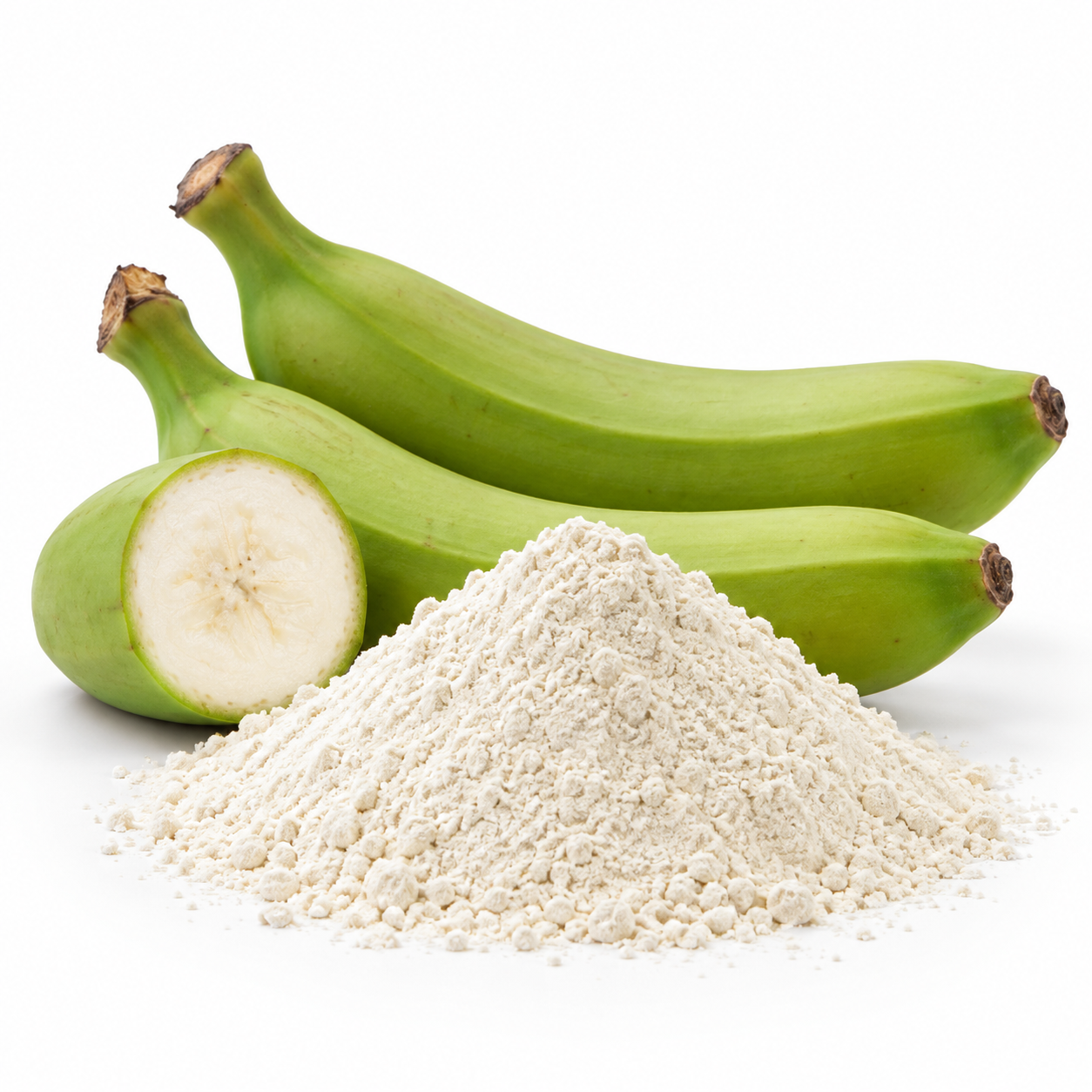
Ureda Naturals manufactures Green Banana Powder from unripe green bananas for resistant-starch-focused food and beverage formulations. Choose a standard grade at ≥40% resistant starch or a high-RS grade at ≥50%, with 80-mesh and custom particle-size options.
| Source | green banana |
|---|---|
| Appearance | Off-white powder |
| Resistant starch | ≥40% standard grade; ≥50% high-RS grade |
| Particle size | 95% through 80 mesh; custom 60–120 mesh |
| Moisture | <8% |
Ureda Naturals manufactures Green Banana Powder from unripe green bananas for food and beverage developers seeking a plant-based, resistant-starch-rich ingredient. Unlike ripe banana powder, which is commonly selected for sweetness and banana flavor, green banana powder is selected for its starch profile and its role in formulation.
The standard grade targets resistant starch at ≥40%; a high-RS grade targets ≥50%. These figures describe the raw ingredient—not the amount that will necessarily remain in a baked, cooked or extruded finished product.
| Parameter | Standard Grade | High-RS Grade |
|---|---|---|
| Resistant starch | ≥40% | ≥50% |
| Test method | AOAC 2002.02 | AOAC 2002.02 |
| Moisture | <8% | <8% |
| Appearance | Off-white powder | Off-white powder |
| Particle size | 95% through 80 mesh | 95% through 80 mesh |
| Custom particle-size range | 60–120 mesh | 60–120 mesh |
AOAC 2002.02 quantifies resistant starch. The RS2 description refers to the ingredient’s native-starch profile; it should not be read as a separate RS2-specific result produced by that assay. When comparing suppliers or grades, compare the same analytical method and reporting basis. A mesh value alone also does not describe the entire particle-size distribution, so the sieve-pass requirement matters when powder flow, dispersion or mouthfeel is important.
When measured on the same basis, the ≥50% grade supplies a higher resistant-starch contribution per unit of raw ingredient than the ≥40% grade. For example, a 10% inclusion of a ≥40% grade represents a theoretical raw-material contribution of at least 4% resistant starch to a dry blend on a matching mass basis. This calculation is not a finished-product guarantee: processing, added water, other ingredients and product yield change the final composition.
Green Banana Powder also suits plant-based and vegan formulation concepts. Its product profile identifies it as gluten-free and notes naturally occurring minerals such as magnesium and potassium. It is also positioned for prebiotic, low-fat and lower-sugar product concepts; finished-formula claims depend on the complete recipe and its measured composition.
RS2 is associated with the structure of native, ungelatinized starch granules. When green banana powder is heated in the presence of sufficient water, starch gelatinization can alter that structure and reduce the RS2 remaining in the processed food. Cooling may produce retrograded starch, but that is not a reason to assume the original RS2 value carries through unchanged.
For a heated application, measure the ingredient against the incoming-material target, then test the finished product after its actual cooking, cooling and storage sequence. If the finished-food target is not met, consider adjusting the ingredient level, changing the point of addition or selecting a less heat-intensive application. Do not assume that a higher raw-material grade alone will resolve the issue.
| Application | Formulation Consideration | Useful Development Check |
|---|---|---|
| Bakery | Replacing wheat flour changes the balance of gluten-forming flour and starch-rich solids. Water demand and dough handling can shift, and baking changes the raw RS2 profile. | For an initial wheat-bread screen, compare a control with 5%, 10% and 15% flour replacement by weight. Keep the initial process and water addition consistent; record dough handling, mixing stability, proofing, loaf volume and crumb. In a separate follow-up, adjust water one factor at a time. Test resistant starch in the baked and cooled bread if that is the finished-product target. |
| Noodles | In wheat noodles, replacing wheat flour dilutes the gluten network. In gluten-free noodles, structure must come from the rest of the formulation and process. | Compare dough handling or sheeting/extrusion, cooking loss, cooked firmness and breakage. If a resistant-starch target applies to the finished product, test the cooked noodle rather than calculating it from the raw powder alone. |
| Milkshakes and solid beverages | Starch-rich powder should not be treated as a sugar-like, fully soluble ingredient. Particle size and mixing order can affect wetting, dispersion, viscosity, sediment and mouthfeel. | Test the powder in the complete beverage system. Compare dispersion, lumps, viscosity and settling over the intended preparation and holding period. |
| Tableting candy | Powder characteristics interact with the binder and sweetener system and may affect die filling, compaction and finished texture. | Test flow and fill consistency, then evaluate tablet weight variation, hardness, friability and the intended texture. Do not assume the powder acts as a binder without formulation data. |
For bakery screening, 5%, 10% and 15% are trial points used in published green-banana-flour research—not universal recommended use levels. Final selection should be based on the customer’s reference formula and finished-product requirements.
The percentage alone does not describe the full ingredient. Banana maturity, fruit portion, drying history, carrier use, moisture basis and particle-size distribution can affect formulation behavior or complicate comparisons. Compare the product form, test method, reporting basis and sieve specification—not just the headline RS number.
No. The figure describes the raw ingredient. Heat and water can change the native starch structure during baking, so finished-product RS must be determined after the actual process. If cooling and storage are part of the product’s intended use, include those stages before sampling.
No. It is a nominal sieve size, not a complete particle-size distribution or a solubility result. For a milkshake or beverage, evaluate wetting, dispersion, viscosity, sediment and mouthfeel in the full formula and over the intended holding time.
It should not be assumed to do so. Green Banana Powder does not provide wheat flour’s gluten-forming proteins, and its starch-rich composition can change water demand and texture. Start with a controlled partial-replacement screen, then adjust hydration or structure based on dough and finished-product results.
Useful details include the application, target resistant-starch contribution, current formula or replacement material, particle-size requirement, processing heat and moisture, addition stage, finished-product texture target, and whether the target applies to the ingredient or the final food.
INGREDIENT PARTNER
Tell us your intended application, approximate quantity and target market. Ureda Naturals will confirm the closest grade, packaging configuration and available documentation for your project.

Scan the QR code or
search WeChat ID: 18270717590
From Natural Origin to Formulation Intent
Tell us what you’re sourcing.
