
 English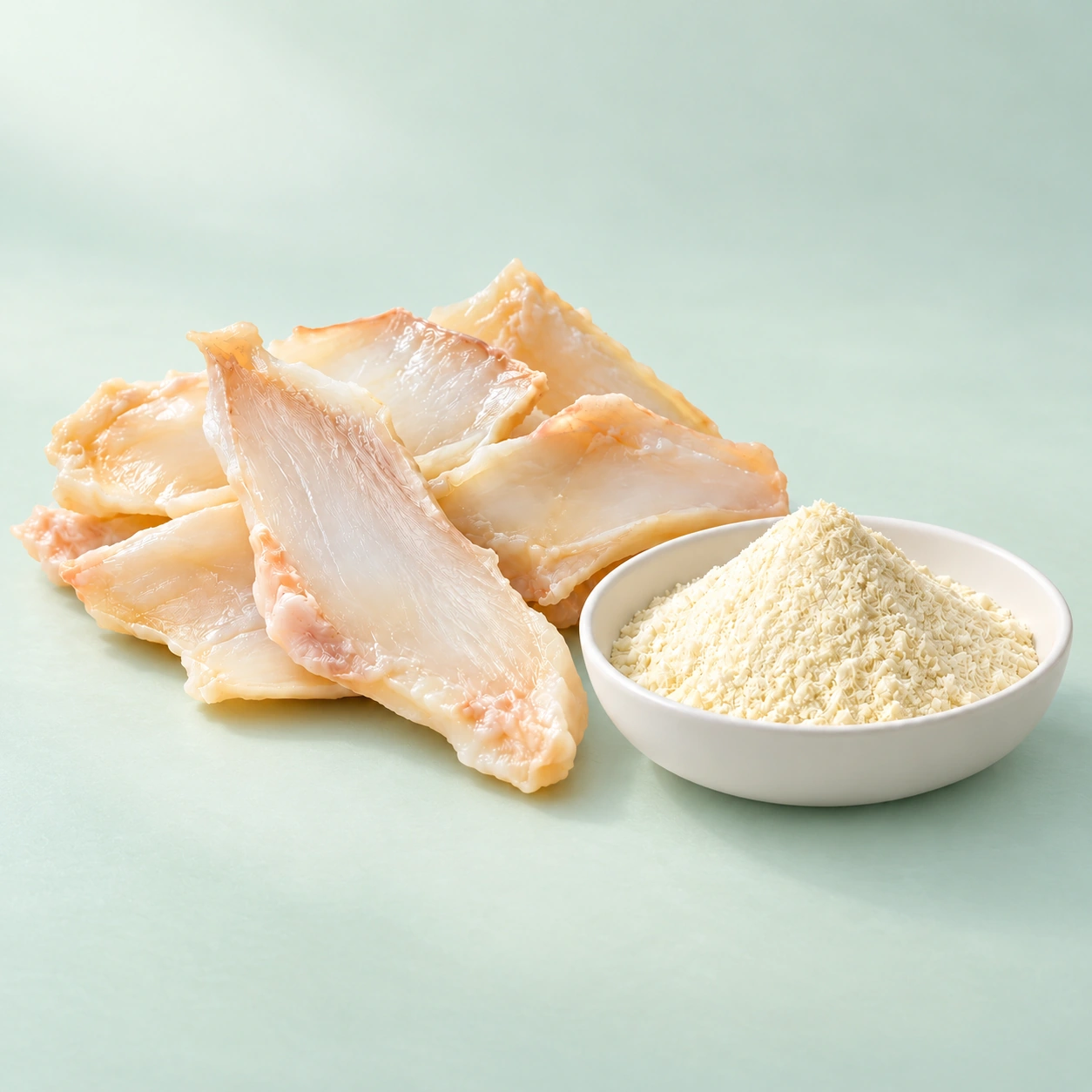
A hydrolyzed chicken sternal cartilage extract with ≥25% acid mucopolysaccharides, ≥55% protein and ≥4.5% hydroxyproline for joint nutrition formulations.
| Source | Chicken sternal cartilage |
|---|---|
| Form | White to light-yellow powder |
| Protein | ≥55% on a dry basis |
| Acid mucopolysaccharides | ≥25% |
| Particle size | 100% through 40 mesh |
| Packaging | 15 kg/drum |
Ureda Naturals Cartilage Extract (Type II Collagen) is a hydrolyzed chicken sternal cartilage ingredient standardized to ≥25% acid mucopolysaccharides, ≥55% protein and ≥4.5% hydroxyproline on a dry basis. Supplied as a white to light-yellow powder for joint nutrition and functional food formulations.
Ureda Naturals Cartilage Extract (Type II Collagen) is made from chicken sternal cartilage through hydrolysis, decolorization, nanofiltration, concentration and spray drying. The resulting powder combines cartilage-derived protein, acid mucopolysaccharides and collagen-associated components in one ingredient.
This composition makes it a practical option for joint nutrition formulas that call for a cartilage-derived matrix. Its quality profile is defined by acid mucopolysaccharides, protein and hydroxyproline, alongside physical, chemical and microbiological specifications.
Protein, acid mucopolysaccharides and hydroxyproline answer different quality questions. Reviewing them together gives formulators a more useful composition profile than relying on a product name or a single percentage.
When comparing suppliers, confirm that the analytical definitions, units and reporting basis match. A higher protein result alone does not establish a better cartilage extract if the mucopolysaccharide fraction, hydroxyproline, moisture, ash or powder-handling characteristics differ.
| Ingredient format | Main quality focus | Formulation consideration |
|---|---|---|
| Cartilage Extract (Type II Collagen) | Acid mucopolysaccharides, protein and hydroxyproline | Cartilage-derived matrix for multi-component joint nutrition formulas |
| Undenatured Type II Collagen | Preserved native structure measured with a structure-specific method | Different ingredient format and quality definition |
| Conventional collagen peptides | Protein or collagen content and peptide profile | Often selected for higher-protein applications |
| Purified chondroitin sulfate | Chondroitin-specific assay | Used when the formula requires a defined chondroitin sulfate contribution |
These formats should not be substituted kilogram for kilogram without recalculating the formula. Changing the ingredient changes the protein and mucopolysaccharide contribution, powder volume and finished-product composition.
| Test item | Specification | Result |
|---|---|---|
| Color | White or light yellow | Pass |
| Taste and odor | Characteristic | Pass |
| Condition | No visible foreign matter | Pass |
| Protein, dry basis | ≥55.0 g/100 g | 70.4 g/100 g |
| Acid mucopolysaccharides | ≥25.0 g/100 g | 26.5 g/100 g |
| Fat | ≤2.0 g/100 g | 0.2 g/100 g |
| Hydroxyproline, dry basis | ≥4.5 g/100 g | 5.6 g/100 g |
| Loss on drying | ≤5.0 g/100 g | 4.6 g/100 g |
| Ash | ≤10.0 g/100 g | 9.5 g/100 g |
| Particle size | 100% through 40 mesh | Pass |
| Bulk density | ≥0.18 g/mL | 0.35 g/mL |
| Lead | ≤0.5 mg/kg | <0.5 mg/kg |
| Cadmium | ≤0.1 mg/kg | <0.1 mg/kg |
| Chromium | ≤2.0 mg/kg | <2.0 mg/kg |
| Arsenic | ≤0.5 mg/kg | <0.5 mg/kg |
| Mercury | ≤0.3 mg/kg | <0.3 mg/kg |
| Total bacterial count | ≤1,000 CFU/g | 100 CFU/g |
| Yeast and mold | ≤25 CFU/g | <10 CFU/g |
| Coliform bacteria | ≤0.3 MPN/g | <0.3 MPN/g |
| Salmonella | Negative | Negative |
| Staphylococcus aureus | Negative | Negative |
| Attribute | Why it matters to the formulator | What to check during a trial |
|---|---|---|
| 100% through 40 mesh | Sets an upper particle-size boundary, but does not describe the full particle-size distribution or guarantee blend uniformity. | Check blend uniformity, discharge behavior and segregation against the other formula ingredients. |
| Bulk density ≥0.18 g/mL; result 0.35 g/mL | Powder volume affects capsule capacity and can differ substantially from dense minerals or crystalline ingredients. | Calculate the volume of the complete blend and check capsule fill-weight variation in a pilot run. |
| Loss on drying ≤5.0% | Moisture uptake can increase cohesion and agglomeration, affecting weighing and flow before a major visual change appears. | Observe flow after handling and reseal opened drums promptly, especially in humid production areas. |
| Ash ≤10.0% | Inorganic residue contributes to total formula solids and can matter in mineral-sensitive or clear beverage systems. | Account for the ingredient in the solids balance and assess the complete formula rather than the raw material alone. |
In formulas containing glucosamine salts, minerals or other dense ingredients, differences in bulk density can promote segregation during transfer and discharge. Prepare a geometric premix with a compatible portion of the blend before adding it to the main blender. Confirm uniformity using samples from multiple locations and discharge points.
For capsule development, calculate fill volume from the complete blend rather than from ingredient weights alone. Monitor hopper flow, capsule-weight variation and blend behavior after production stops and restarts.
Evaluate flow, compactability and disintegration together. Increasing compression force may improve hardness but delay disintegration; excessive lubricant may weaken tablet bonding. A pilot should therefore measure tablet weight variation, hardness, friability and disintegration as a combined performance profile.
The powder’s water-soluble format supports development in water-based products, while the complete formula determines final turbidity, sediment and sensory performance. Acids, minerals, proteins and hydrocolloids can change how the ingredients hydrate and disperse.
For a beverage pilot, add the powder gradually into a moving water phase, then introduce the other ingredients in the intended process order. Check dispersion time, visible agglomeration, turbidity, sediment after the planned holding period and redispersibility after heat treatment where applicable.
Evaluate the ingredient in the actual food matrix and thermal process. The pilot should confirm sensory profile, dispersion, finished-product appearance and the quality attributes that matter for the intended format.
No. Acid mucopolysaccharides are a broader analytical category. A chondroitin sulfate declaration requires a suitable chondroitin-specific test and a defined reporting basis. The acid mucopolysaccharide result should not be relabeled as chondroitin sulfate.
No. Protein measures the overall protein fraction and does not identify every protein as Type II collagen. Review the cartilage source, protein, acid mucopolysaccharides and hydroxyproline together, and use a specific collagen assay when a quantified Type II collagen claim is required.
Multiply the planned raw-material amount by the relevant specification separately. At the minimum specification, the ingredient contributes at least 25% acid mucopolysaccharides and 55% protein on a dry basis. Do not use the acid mucopolysaccharide value as a chondroitin sulfate amount or the protein value as a pure Type II collagen amount.
Not by equal weight. Cartilage Extract (Type II Collagen) is a hydrolyzed cartilage matrix standardized by its composition profile. Undenatured Type II collagen is defined by retention of native structure, while conventional collagen peptides are generally specified around protein or collagen content and peptide profile. Recalculate the formula and validate the finished format after a substitution.
Passing 40 mesh controls oversized particles but does not define the full particle-size distribution, flow or density match with other ingredients. Check the complete blend’s bulk and tapped density, premix quality, hopper flow and capsule-weight variation during a representative pilot run.
First check the addition method. Gradual addition into a moving liquid phase can reduce surface-wetted agglomerates that trap dry powder. If lumps persist, assess water temperature, mixing energy, mineral load and the order of acid, protein or hydrocolloid addition in the complete formula.
It can be evaluated in water-based products, but clarity must be confirmed in the complete formula. Proteins, acid mucopolysaccharides, minerals, acids and thermal treatment can affect turbidity or sediment. Test the actual formula after processing and the intended holding period.
Compare source tissue, hydrolyzed or undenatured format, acid mucopolysaccharides, protein, hydroxyproline, fat, moisture, ash, particle size, bulk density, heavy metals and microbiology. Confirm that the methods, units and reporting basis match before treating two specifications as equivalent.
INGREDIENT PARTNER
Tell us your intended application, approximate quantity and target market. Ureda Naturals will confirm the closest grade, packaging configuration and available documentation for your project.

Scan the QR code or
search WeChat ID: 18270717590
From Natural Origin to Formulation Intent
Tell us what you’re sourcing.
