
 English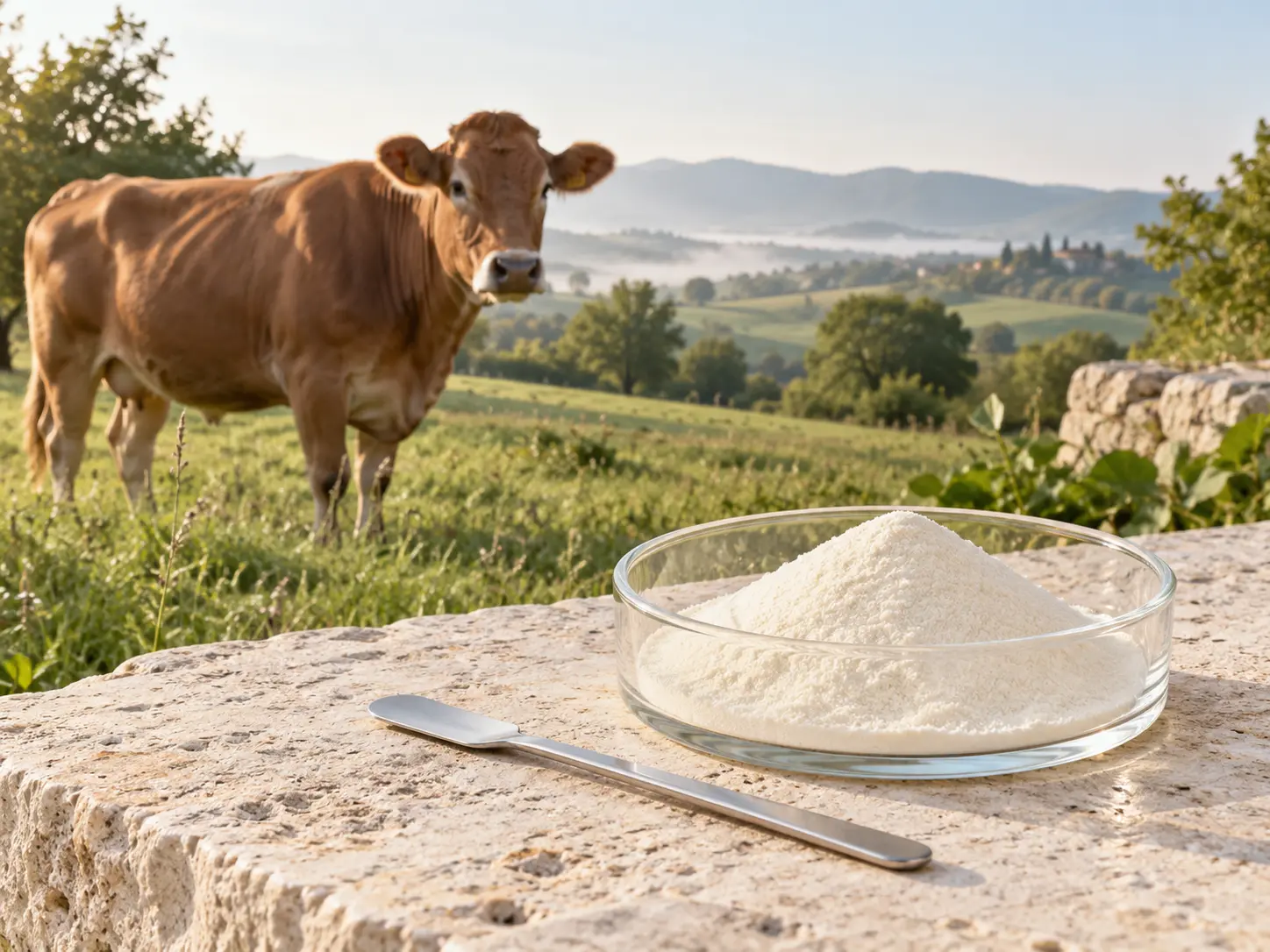
Ureda Naturals is a bovine cartilage collagen peptide manufacturer supplying powder and granules produced from fresh bovine cartilage through controlled enzymatic hydrolysis. The ingredient is specified to contain ≥90.0% protein on a dry basis, with an average molecular weight of ≤1000 Da and hydroxyproline of ≥3.0%. It is suitable for powdered beverages, nutrition blends, tablets, hard capsules, and granulated formulations.
| Product Type | Hydrolyzed Bovine Cartilage Collagen Peptide |
|---|---|
| Protein | ≥90.0% on Dry Basis |
| Average Molecular Weight | ≤1000 Da |
| Packing | 10 kg/bag; 20 kg/bag |
| Shelf Life | 24 Months |
As a bovine cartilage collagen peptide manufacturer, Ureda Naturals produces this ingredient from fresh bovine cartilage through enzymatic hydrolysis, decolorization, concentration, and spray drying. The product is available in powder or granular form and is designed for use in powdered beverages, nutritional blends, tablets, hard capsules, and granulated products.
Its quality profile is defined by three complementary parameters: protein content of not less than 90.0% on a dry basis, average molecular weight of not more than 1000 Da, and hydroxyproline content of not less than 3.0% on a dry basis. These specifications describe the product more meaningfully than protein content alone and help formulators evaluate both composition and degree of hydrolysis.
| Product Name | Bovine Cartilage Collagen Peptide |
|---|---|
| Raw Material | Fresh bovine cartilage |
| Processing | Enzymatic hydrolysis, decolorization, concentration, and spray drying |
| Appearance | White or light-yellow powder or granules |
| Protein | ≥90.0 g/100 g, dry basis |
| Average Molecular Weight | ≤1000 Da |
| Hydroxyproline | ≥3.0 g/100 g, dry basis |
| pH | 5.0–7.0 in a 1% aqueous solution |
| Available Forms | Powder or granules |
| Standard Packing | 10 kg/bag or 20 kg/bag |
| Shelf Life | 24 months |
| Storage | Store sealed in a cool, dry place |
Collagen peptides may be produced from different animal tissues, but the original tissue source, pretreatment conditions, and hydrolysis process are not interchangeable. For brands that require a clearly defined ingredient identity and traceable sourcing documentation, “bovine origin” is not always sufficiently specific. This product is identified more precisely as being derived from fresh bovine cartilage.
The value of the cartilage source should be considered together with the final peptide specifications:
This makes the product suitable for formulations that require a defined cartilage source together with a low-molecular-weight hydrolyzed collagen profile. It should not, however, be confused with native or undenatured type II collagen, which is defined by preservation of its native protein structure rather than by hydrolysis into peptides.
Producing collagen peptide is not simply a matter of drying and milling cartilage. The process changes the molecular structure of the original collagen and determines the resulting peptide profile, sensory properties, moisture level, and powder-handling characteristics.
The condition and consistency of fresh bovine cartilage affect subsequent hydrolysis and purification. Raw-material controls should address source identification, preservation, foreign-matter control, and preparation before enzymatic treatment.
Enzyme selection, enzyme dosage, temperature, pH, and hydrolysis time influence peptide-chain cleavage and molecular-weight distribution. Insufficient hydrolysis may leave a higher proportion of large molecular fragments, while excessive hydrolysis may change flavor and increase the proportion of very small peptides or free amino acids.
For this reason, average molecular weight should be evaluated together with protein content, hydroxyproline, sensory properties, and performance in the intended formulation.
Decolorization and purification help improve the color and sensory profile of the hydrolysate. The finished product is specified as white or light yellow and has its characteristic odor.
A characteristic odor is not the same as an objectionable odor. Nevertheless, its effect depends on the application and use level. It may have limited impact in capsules or tablets but should be evaluated carefully in powdered beverages and other directly consumed formulations.
Concentration raises the solids level of the hydrolysate before drying and helps establish stable spray-drying conditions. Spray-drying parameters can influence product color, moisture, particle characteristics, bulk behavior, and storage stability.
The finished-product loss-on-drying specification is no more than 5.0 g/100 g. Maintaining suitable moisture control helps reduce the risk of caking and microbial growth, although the powder must still be protected from humidity after opening.
The ingredient can be supplied as powder or granules. The two forms may meet the same principal chemical specifications, but they can behave differently during conveying, weighing, blending, capsule filling, tableting, and packaging. Form selection should therefore be based on the customer’s manufacturing process rather than appearance alone.
The following table retains the complete specification and test-result information shown in the available quality document. Numerical results represent the tested sample or batch; commercial shipments should be evaluated against the COA issued for the corresponding batch.
| Test Item | Specification | Test Result |
|---|---|---|
| Color | White or light yellow | Pass |
| Odor | Characteristic odor | Pass |
| Condition | Powder or granules, with no visible exogenous impurity | Pass |
| Protein, dry basis | ≥90.0 g/100 g | 93.7 g/100 g |
| Average molecular weight | ≤1000 Da | Pass |
| pH, 1% aqueous solution | 5.0–7.0 | 6.0 |
| Hydroxyproline, dry basis | ≥3.0 g/100 g | 8.2 g/100 g |
| Loss on drying | ≤5.0 g/100 g | 4.3 g/100 g |
| Ash | ≤3.0 g/100 g | 1.9 g/100 g |
| Lead | ≤0.5 mg/kg | <0.5 mg/kg |
| Cadmium | ≤0.1 mg/kg | <0.1 mg/kg |
| Chromium | ≤2.0 mg/kg | <2.0 mg/kg |
| Total arsenic | ≤0.1 mg/kg | <0.1 mg/kg |
| Total mercury | ≤0.1 mg/kg | <0.1 mg/kg |
| Total plate count | ≤1000 CFU/g | 100 CFU/g |
| Yeast and mold | ≤100 CFU/g | <100 CFU/g |
| Coliforms | ≤0.3 MPN/g | <0.3 MPN/g |
| Staphylococcus aureus | Negative/25 g | Negative/25 g |
| Salmonella | Negative/25 g | Negative/25 g |
Protein content describes the overall concentration of protein and peptide material. The specification is not less than 90.0 g/100 g on a dry basis, while the reported test result is 93.7 g/100 g.
A high protein level helps formulators use the available formulation space efficiently, particularly in tablets, capsules, and multi-ingredient nutrition powders. Protein content alone, however, does not describe peptide size and cannot replace molecular-weight evaluation.
The average molecular-weight specification of no more than 1000 Da describes the overall degree of hydrolysis and differentiates this product from intact collagen and some higher-molecular-weight hydrolysates.
An average molecular weight of ≤1000 Da does not mean that every peptide in the material is below 1000 Da. Projects requiring a defined percentage within specific molecular-weight ranges should evaluate a complete molecular-weight distribution rather than relying on the average value alone.
Hydroxyproline is a characteristic amino acid associated with collagen. The product specification is not less than 3.0 g/100 g on a dry basis, while the reported result is 8.2 g/100 g.
| Parameter | What It Helps Evaluate |
|---|---|
| Protein | The overall concentration of protein and peptide material |
| Average molecular weight | The overall size profile produced by enzymatic hydrolysis |
| Hydroxyproline | Collagen-related compositional characteristics |
These parameters should be interpreted together. Protein content alone does not confirm the characteristics of a collagen peptide, while hydroxyproline alone cannot identify a specific collagen type or establish a particular physiological effect.
The pH specification is 5.0–7.0 in a 1% aqueous solution, with a reported result of 6.0. This provides a relatively moderate starting point for many food and nutraceutical systems, but the final pH is determined by the complete formulation.
Products containing fruit acids, vitamin C, minerals, botanical extracts, or other proteins should be retested for final pH, clarity, precipitation, and storage stability. The pH of a 1% raw-material solution should not be treated as the pH of the finished product.
Moisture can affect caking, flowability, weighing accuracy, and storage behavior. The loss-on-drying specification is not more than 5.0 g/100 g, and the reported result is 4.3 g/100 g.
Even when the material meets its release specification, extended exposure to humid production environments may change powder handling. Open-bag time, room humidity, and resealing procedures should therefore be controlled.
Ash represents the total inorganic residue remaining after ignition. The specification is not more than 3.0 g/100 g, with a reported result of 1.9 g/100 g. Ash is useful as a general quality parameter but does not replace individual mineral or heavy-metal testing.
Because bovine cartilage collagen peptide is an animal-derived ingredient, heavy-metal and microbiological controls are important parts of supplier qualification and batch release. The specification includes limits for lead, cadmium, chromium, total arsenic, and total mercury, together with controls for total plate count, yeast and mold, coliforms, Staphylococcus aureus, and Salmonella.
These parameters also influence the customer’s finished-product risk assessment:
| Application | Relevant Ingredient Attributes | Recommended Evaluation |
|---|---|---|
| Powdered beverages | Low average molecular weight, powder or granular format, moderate pH profile | Dissolution time, clarity, flavor, foam, sediment, and storage stability |
| Nutrition blends | High protein content and compatibility with dry blending | Blend uniformity, segregation, flowability, hygroscopicity, and package stability |
| Tablets | High peptide loading within a compact dosage form | Compressibility, tablet weight, hardness, friability, and disintegration |
| Hard capsules | Defined powder or granular form | Bulk density, tapped density, flowability, capsule size, and fill-weight variation |
| Granulated products | Reduced dust and potentially improved handling | Particle-size distribution, granule disintegration, dissolution, and packaging-machine compatibility |
In powdered beverages, formulators normally evaluate dissolution, dispersion, clarity, flavor, foaming, and moisture sensitivity. Product information describes the ingredient as water-soluble and capable of forming a clear solution under suitable conditions. Actual performance, however, depends on use level, water temperature, mixing conditions, pH, mineral content, and other formulation components.
Acidic systems and formulations containing high mineral or protein levels should be tested for haze, sediment, flavor changes, and stability under the intended preparation conditions.
When collagen peptide is blended with vitamins, minerals, botanical extracts, or other proteins, differences in particle size and bulk density may lead to segregation during blending, conveying, and packing. Ingredient addition sequence, preblending, mixing time, and sampling from different blender locations should be considered during process development.
A high collagen-peptide content does not automatically provide suitable direct-compression performance. Flowability, compressibility, and elastic recovery may affect tablet weight, hardness, friability, and disintegration. Depending on the target dose and formulation, suitable fillers, binders, disintegrants, lubricants, or a granulation step may be required.
Capsule filling depends strongly on bulk density, tapped density, and flow behavior. A low-density powder may occupy the capsule volume before the target amount is reached, while insufficient flow may increase fill-weight variation. The actual batch should therefore be evaluated before selecting capsule size and filling parameters.
Granulation may reduce dust and improve material flow during automated feeding and packing. It also changes particle size, bulk density, and dispersion behavior. Products intended for rapid reconstitution should be tested under the actual water temperature and mixing conditions specified for consumer use.
| Selection Factor | Powder | Granules |
|---|---|---|
| Dry blending | Suitable for fine blending; particle-size differences should be managed | May provide improved flow, depending on granule size |
| Dust control | Requires appropriate dust management during charging | Generally more suitable where reduced dust is preferred |
| Capsule filling | Bulk density and flowability should be verified | Granule size must be compatible with the filling equipment |
| Tableting | May require excipient or granulation optimization | Direct compression should still be confirmed by testing |
| Reconstitution | May disperse quickly but can produce floating powder or lumps | May improve handling but requires granule-disintegration testing |
| Automated packing | Bridging, adhesion, and feeding consistency should be evaluated | Often easier to meter consistently, subject to equipment trials |
The standard packing options are 10 kg/bag and 20 kg/bag. The product has a shelf life of 24 months when stored sealed in a cool, dry place.
Production-site handling should also address the following points:
Compliance with the raw-material specification does not remove the need for finished-formulation testing. Before commercial production, manufacturers should evaluate the ingredient under their actual formula and process conditions, including:
No. Bovine cartilage describes the raw-material source, while this product is enzymatically hydrolyzed into smaller peptides. Undenatured type II collagen is defined by preservation of its native protein structure. The two ingredients differ in processing, structural state, specifications, and formulation rationale.
No. Average molecular weight describes the overall average of the peptide population. It does not establish an absolute upper limit for every individual peptide. A complete molecular-weight distribution is required when a project specifies percentages within defined molecular-weight ranges.
They describe different aspects of the material. Protein indicates the overall concentration of protein and peptide material, hydroxyproline supports evaluation of collagen-related composition, and average molecular weight reflects the overall degree of enzymatic hydrolysis. No single parameter provides a complete product profile.
No. Hydroxyproline is a characteristic amino acid associated with collagen, but it cannot independently distinguish type I, type II, or other collagen types. It also should not be used alone to establish a specific physiological effect.
Performance in water does not necessarily predict behavior in a complex formulation. Use level, pH, mineral ions, other proteins, botanical polyphenols, temperature, and processing sequence may all influence clarity and physical stability. Testing should therefore be conducted in the complete target formulation.
The choice should be based on the intended dosage form and manufacturing equipment. Powder may be suitable for fine blending, while granules may reduce dust and improve flow. Bulk density, particle size, dissolution, tableting, capsule filling, and packing-machine performance should be verified using the actual material.
Batch comparison should include appearance, odor, protein, average molecular weight, hydroxyproline, pH, moisture, ash, heavy metals, and microbiological results. For process-sensitive applications, customers should also establish internal tests for dissolution, sensory performance, flowability, or bulk density.
“`
INGREDIENT PARTNER
Tell us your intended application, approximate quantity and target market. Ureda Naturals will confirm the closest grade, packaging configuration and available documentation for your project.

Scan the QR code or
search WeChat ID: 18270717590
From Natural Origin to Formulation Intent
Tell us what you’re sourcing.
