
 English
English
English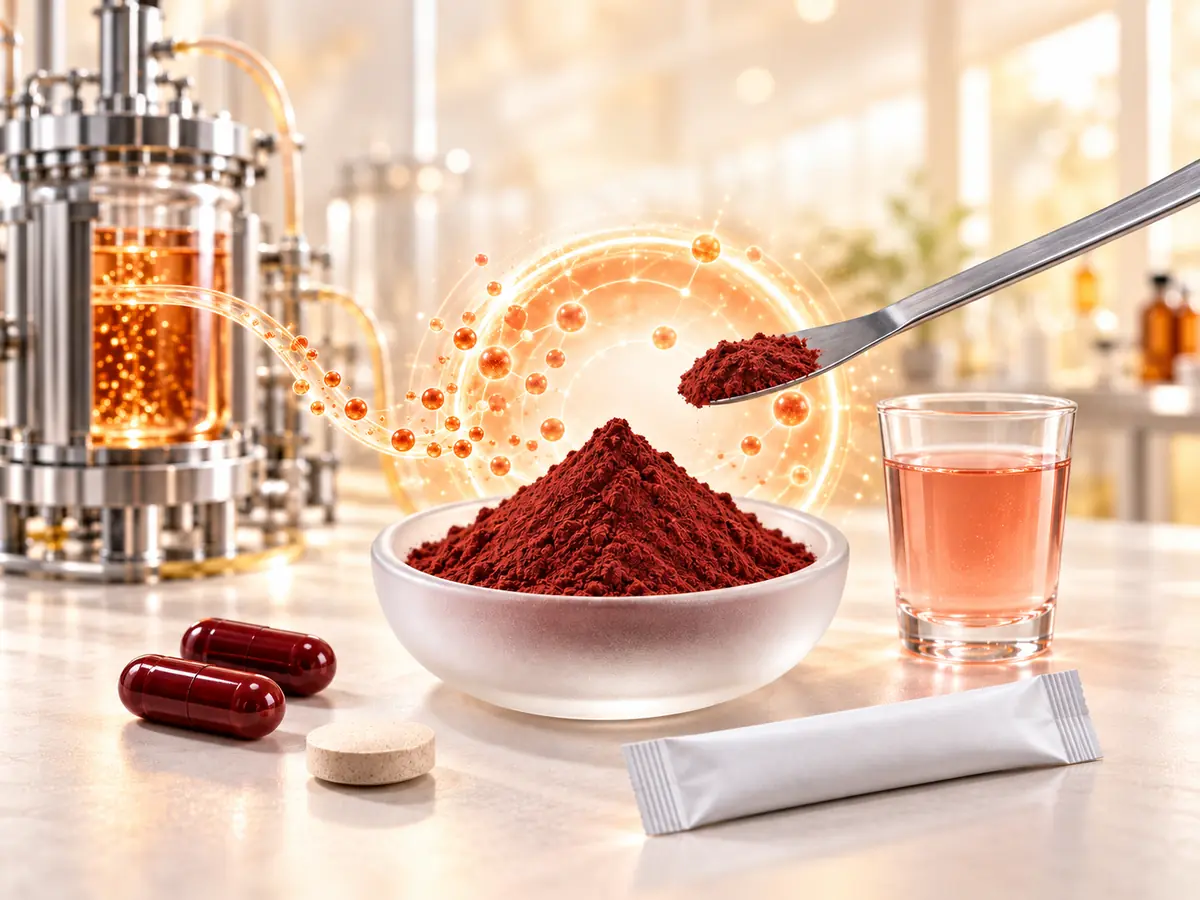
Ureda Naturals is a Pyrroloquinoline Quinone Disodium Salt manufacturer supplying fermentation-derived Pyrroloquinoline Quinone Disodium Salt powder with an assay above 98%. The product is available in three grades: PQQ I dark fine powder, PQQ II light coarse powder and PQQ III light fine powder.
These grades are designed for different powder-handling and formulation requirements. Selection should consider particle size, color, blending behavior, feeding performance, reconstitution and finished-product appearance—not assay alone.
| Item | Specification |
|---|---|
| Product name | Pyrroloquinoline Quinone Disodium Salt |
| CAS No. | 122628-50-6 |
| Molecular formula | C14H4N2Na2O8 |
| Molecular weight | 374.17 g/mol |
| Source | Fermentation-derived |
| Physical form | Powder |
| Assay | >98% |
| Available grades | PQQ I, PQQ II and PQQ III |
| Grade | Appearance | Particle form | Formulation focus |
|---|---|---|---|
| PQQ I | Dark-colored powder | Fine | Capsules, tablets and fine premixes |
| PQQ II | Light-colored powder | Coarse | Solid beverages, sachets and continuous feeding |
| PQQ III | Light-colored powder | Fine | Fine powders and formulations with lighter appearance requirements |
PQQ I is suitable when fine particle distribution and low-dose blending are important. For capsule, tablet and fine premix applications, the main development checks are agglomeration, static charge, segregation and content variation between sampling points.
PQQ II is suitable when feeding stability, dust control and continuous transfer are important. The coarse particle form can support easier handling, while particle-size compatibility with other premix ingredients should be reviewed to control segregation.
PQQ III combines a lighter appearance with a fine powder form. It is suitable for formulations that require fine dispersion while placing greater emphasis on the visual appearance of the finished product.
The color of Pyrroloquinoline Quinone Disodium Salt does not directly determine assay or purity. Dark and light grades can meet the same assay requirement, so color should be assessed separately from chemical identity and quality testing.
For capsules, tablets, solid beverages and clear or lightly colored liquid systems, the selected grade should be tested directly in the target formulation. Powder appearance alone cannot predict the final product color.
Particle size affects flow, dust, agglomeration, segregation, wetting and blend uniformity. Fine powder can support finer dispersion, while coarse powder can improve handling and feeding performance.
Ureda Naturals Pyrroloquinoline Quinone Disodium Salt is produced through a fermentation-derived route followed by purification, disodium-salt formation, drying, milling and particle-size processing.
| Production factor | Formulation relevance |
|---|---|
| Fermentation and purification | Related substances, identity and batch consistency |
| Disodium-salt formation | Molecular basis and water-phase behavior |
| Drying | Moisture, caking and storage performance |
| Milling and sieving | Flow, dust, dispersion and blend uniformity |
| Moisture- and light-barrier packaging | Protection during storage and transport |
Pyrroloquinoline Quinone Disodium Salt and Pyrroloquinoline Quinone free acid use different molecular-weight bases.
| Form | Molecular formula | Molecular weight |
|---|---|---|
| Pyrroloquinoline Quinone Disodium Salt | C14H4N2Na2O8 | 374.17 |
| Pyrroloquinoline Quinone free acid | C14H6N2O8 | 330.21 |
| Finished product | Starting grade | Main process focus | Key evaluation points |
|---|---|---|---|
| Capsules | PQQ I or PQQ III | Premixing, segregation and filling | Content uniformity, fill-weight variation and capsule appearance |
| Tablets | PQQ I or PQQ III | Powder flow, mixing and compression | Tablet weight, hardness, color distribution and assay uniformity |
| Solid beverages | PQQ II or PQQ III | Wetting, dispersion and dust control | Reconstitution time, caking, sediment and color |
| Powder sachets | PQQ II or PQQ III | Continuous feeding and filling | Dosage accuracy, powder loss and blend uniformity |
| Energy and sports drinks | Grade selected by water-phase testing | pH, acid system, heat and light exposure | Initial color, precipitation and assay retention |
| Oral liquids | Grade selected by liquid-system testing | Addition order, homogenization and storage | Clarity, sediment, color change and assay retention |
Initial dispersion does not prove stability throughout beverage processing and storage. The final result depends on the interaction between Pyrroloquinoline Quinone Disodium Salt and the complete liquid system.
Acidic beverage systems may show color change, precipitation or assay variation even when the beverage appears uniform immediately after mixing. Increasing mixing intensity alone cannot replace complete formulation and storage evaluation.
| Test item | Specification |
|---|---|
| Appearance | Dark-colored or light-colored powder according to grade |
| Identification | Conforms by HPLC and IR |
| Assay, dry basis | >98% |
| Moisture | ≤12% |
| Particle size | Fine-powder reference: ≥99% through 20 mesh; coarse grade follows the selected grade specification |
| Ash | ≤1.0% |
| Residual ethanol | ≤0.5% |
| Total heavy metals | ≤10 ppm |
| Lead | ≤0.5 ppm |
| Arsenic | ≤1.0 ppm |
| Cadmium | ≤1.0 ppm |
| Mercury | ≤0.1 ppm |
| Total plate count | ≤1,000 CFU/g |
| Yeast and mold | ≤100 CFU/g |
| Escherichia coli | Not detected |
| Salmonella | Not detected |
Assay confirms chemical content. Moisture and packaging affect storage performance, particle size affects powder handling and blending, while microbiological and elemental-impurity testing supports finished-product quality control.
Minimum order quantity: 1 kg.
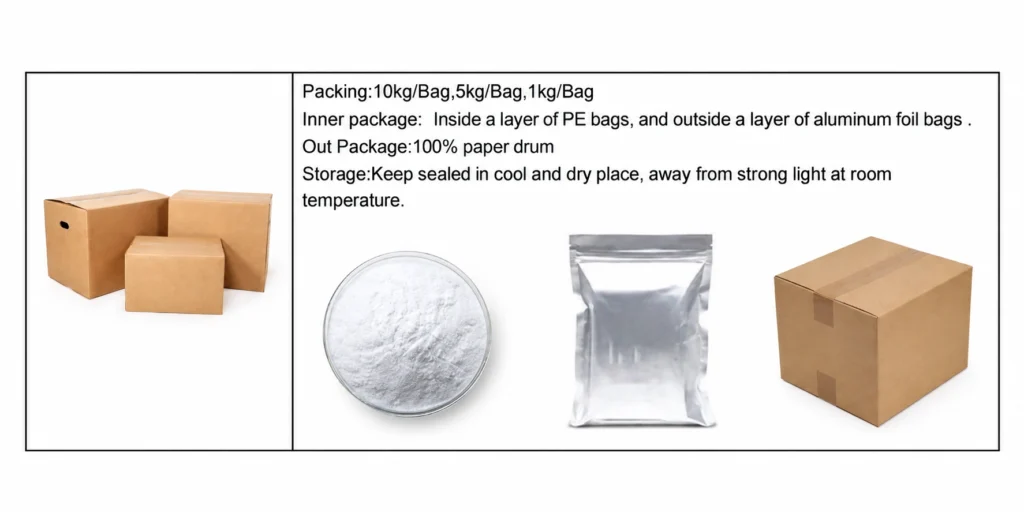
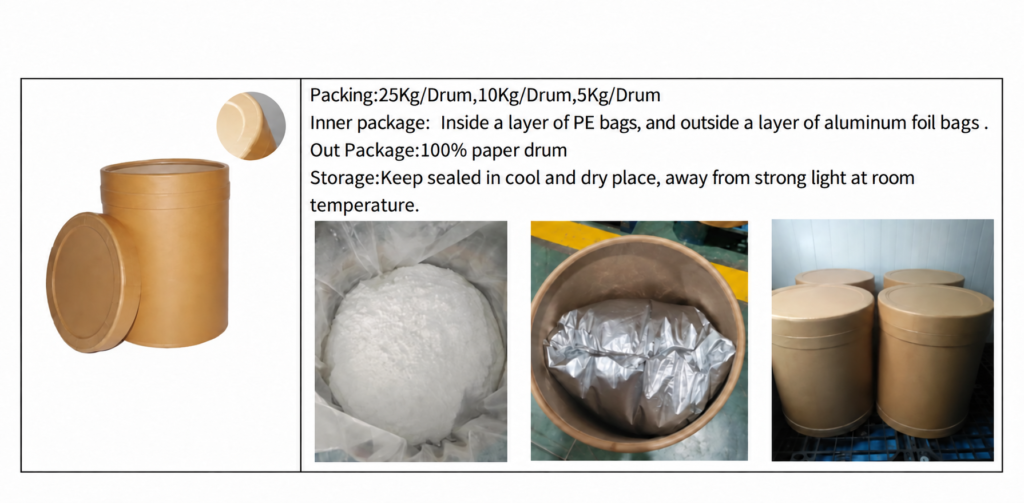
Keep sealed in a cool, dry place away from strong light at room temperature. Reseal the package promptly after opening to reduce moisture, air and light exposure.
PQQ I is a dark fine powder, PQQ II is a light coarse powder and PQQ III is a light fine powder. All three grades have an assay above 98%, but they are selected for different powder-handling and finished-product requirements.
No. Color should be evaluated separately from assay, identification, related substances and impurity testing. The correct grade depends on the finished-product appearance and processing requirements.
Particle size affects flow, dust, agglomeration, segregation and blend uniformity. Fine powder supports finer dispersion, while coarse powder may improve feeding and handling performance.
No. The two forms have different molecular weights. One gram of Pyrroloquinoline Quinone Disodium Salt corresponds to approximately 0.882 g of free-acid equivalent before assay adjustment.
It can be evaluated for acidic beverage formulations, but pH, organic acids, minerals, metal ions, heat treatment, light and storage must be assessed together. Initial dispersion does not prove long-term beverage stability.
Changes in pH, temperature, light exposure, oxygen exposure and ingredient interactions can alter the liquid system during storage. Color and sediment should be checked before processing, after processing and during storage.
Quality review should include identification, moisture, particle size, ash, residual ethanol, heavy metals, total plate count, yeast and mold, Escherichia coli and Salmonella. Beverage applications should also include color, clarity, sediment and assay-retention checks.
PQQ I and PQQ III are suitable starting grades for fine powder premixes, capsules and tablets. PQQ II and PQQ III can be evaluated for solid beverages and sachets where feeding, dust control and reconstitution are important.
INGREDIENT PARTNER
Tell us your intended application, approximate quantity and target market. Ureda Naturals will confirm the closest grade, packaging configuration and available documentation for your project.

